Q22. Are handwriting experts used in court?

Are Handwriting Experts Used in Court?

Handwriting experts are called to testify in court more often than most people realize, in everything from probate disputes to criminal forgery cases. Here’s how it works and what you need to know.

How Is an Expert Witness Different From a Lay Witness?

An expert witness is different than a lay witness, who does not have a background in law or in giving testimony. A lay witness is someone who witnessed an event purely by circumstance—a bystander who saw a car accident, for example, and can testify to what they observed.

An expert witness is supposed to be an unbiased third party, not associated with and not knowing any of the parties involved in the trial, who has expertise in a forensic field of analysis, like blood spatter, psychology, or, yes, even handwriting.

Handwriting experts (specifically forensic document examiners) are often used as expert witnesses in trials, most commonly in probate court (which handles a deceased person’s will or property) or trials involving check fraud or forgery.
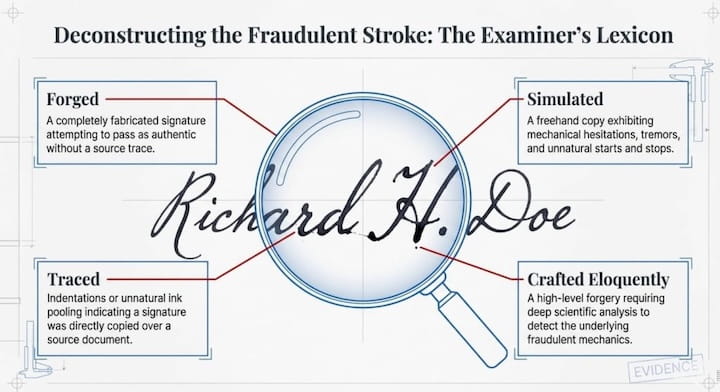
Bart Baggett forensic document examiner deconstructs fraudulent signature strokes through an examiner's lexicon diagram.
Bart Baggett, a seasoned forensic document examiner, breaks down the key types of signature fraud — forged, simulated, traced, and crafted eloquently — in this detailed examiner’s lexicon diagram. A magnifying glass over a sample signature illustrates how experts scrutinize every stroke to detect deception in court evidence. Learn more at bartbaggett.com/blog.

How Long Have Handwriting Experts Been Used in Court?

Handwriting analysis is used not only in civil cases but also in criminal cases. It’s a science that has helped solve crimes and uphold justice in courts of law for over a century.

Specifically, forensic handwriting analysis, such as forensic document examination, has been used since 1910, including by the FBI, to identify handwriting on ransom notes, check signatures made by thieves, and other crimes.
The history of forensic document examination is full of remarkable cases, some of which have even made it to Hollywood. Frank Abagnale, Jr., whose story became the basis for Catch Me If You Can, is one example I know firsthand—I met him. He forged documents and checks throughout the 1960s and 70s, was caught, and went to prison. He later worked with the FBI as a consultant. Real-world forensic document examination is rarely that dramatic, but the science behind it is just as rigorous.
Behind all of it is a rigorous science, one with its own vocabulary of terms like simulated, traced, and forged, that forensic document examiners spend years mastering.
In a criminal trial, there are two sides: a defense and a prosecution. In a civil case, you have a plaintiff and a defendant. Either side can hire expert witnesses. They can hire an attorney. They have a chance to bring the truth to the table.

How Does Expert Witness Testimony Work in Court?
In America, you can actually have two expert witnesses. You can have one, and the other side can hire their own expert in the same field who may have a different opinion.
In Europe, depending on the country and court system, both sides usually hire a single expert. They agree on the choice, they share the fee, and they follow that expert’s opinion. My concern with that approach is that not all experts are equally skilled. When both sides are bound by a single opinion, there’s no mechanism to challenge a flawed analysis.
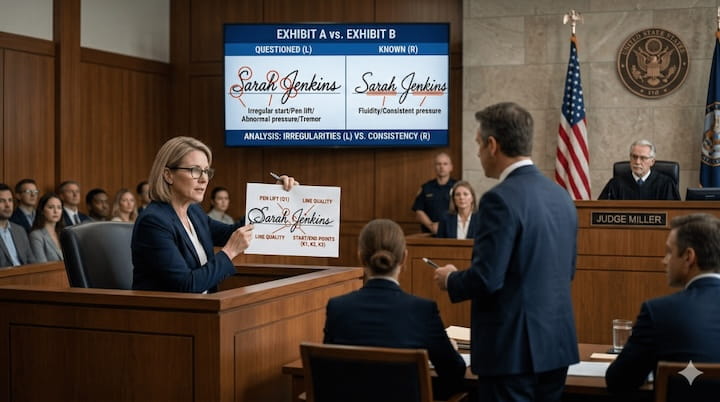
Bart Baggett, forensic document examiner, analyzes two signatures in court to identify a forgery.
Forensic document examiner Bart Baggett explains how handwriting experts present signature evidence in court, comparing a questioned document against a known authentic sample. In cases like this, an expert witness highlights key differences in pen pressure, line quality, and stroke consistency to help the judge and jury distinguish a forgery from a genuine signature. Learn more at bartbaggett.com/blog.

How Do I Choose the Right Expert Witness?

I’ve been teaching handwriting analysis and certifying people as experts for many, many years. Just because someone completed a certification program doesn’t mean they’re ready to hold up under cross-examination in a courtroom. Completing such a program is a starting point, not a finish line.
Experience on the witness stand is something you can verify. Ask how many times they’ve testified, and whether a judge has ever found them unqualified. Those two questions will tell you almost everything you need to know.

If your case is heading to court and you need a forensic document examiner who has been tested on the witness stand, reach out to us at handwritingexpertusa.com. We’ll help you find the right expert for your case, someone who is court-qualified, well-trained, and ready to testify.

Bart Baggett
The Nation’s Leading Forensic Handwriting Expert
CEO of Handwriting Experts Inc.
Forensic Document Examiner • Expert Witness • Legal Consultant
“We solve million-dollar forgery cases.”

Telephone: 1-800-980-9030

YouTube: @thehandwritingexpert
LinkedIn: bartbaggett
Facebook: bartbaggett
https://www.instagram.com/forensichandwritingexpert
https://www.tiktok.com/@handwritingexpertsinc

Frequently Asked Questions

Q1: Are handwriting experts used in court?
A1: Yes. Forensic document examiners are regularly called as expert witnesses in both civil and criminal trials, particularly in cases involving forgery, check fraud, and disputed wills.

Q2: What is the difference between an expert witness and a lay witness?
A2: A lay witness is someone who witnessed an event by circumstance, such as a bystander at an accident. An expert witness is an unbiased third party with specialized forensic expertise who provides professional analysis to the court.

Q3: What types of cases use handwriting experts?
A3: Handwriting experts are most commonly used in probate court involving wills and estates, check fraud cases, forgery investigations, and other civil or criminal matters involving questioned documents.

Q4: How long has forensic handwriting analysis been used in courts?
A4: Forensic handwriting analysis has been used in courts since 1910, including by the FBI, to examine ransom notes, forged signatures, and other questioned documents.