Many people want to know how to become a forensic document expert.
The truth is, there are very few paths into this field. When I was starting out, the standard route was a mentorship. This involved completing your studies and then finding a working forensic document examiner willing to take you on and train you in the legal side of the work. Unfortunately, those mentorships were extremely difficult to find unless you were already working inside the FBI.
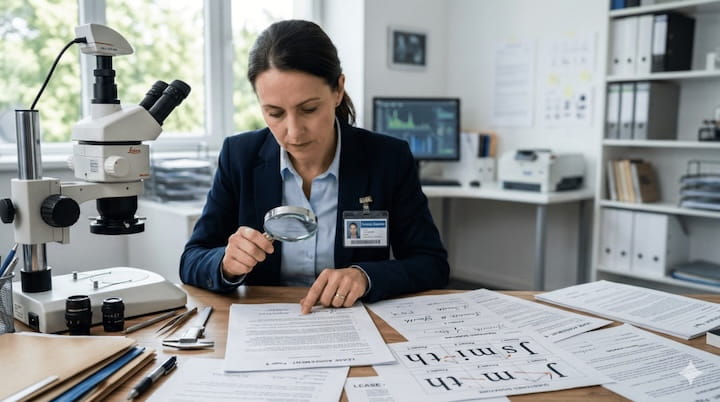
Becoming a forensic document examiner requires hands-on training with the tools and techniques used by professionals like Bart Baggett, including close examination of handwriting samples, signatures, and questioned documents. This image shows a credentialed examiner using a magnifying glass alongside a laboratory microscope to scrutinize document details that are invisible to the untrained eye. Learn more at bartbaggett.com/blog.
There is, of course, a more unconventional route—though I wouldn’t recommend it. Become a notorious international forger, get caught, then be offered a mentorship with Frank Abagnale, who catches international forgers for the FBI. The film Catch Me If You Can is based on his life. After serving time in prison, he was recruited by the FBI. If you worked with Frank for 10 years, you would obviously have the training to become an expert.
Until the mid-1990s, there was no formal education or university program in this field. I founded the International School of Forensics in 2006 because nothing else existed. Since then, we’ve trained hundreds of people around the world, some of whom went on to work for governments in Turkey and India, and most of whom work independently.
What Is the Training and Education Like for Handwriting Experts?
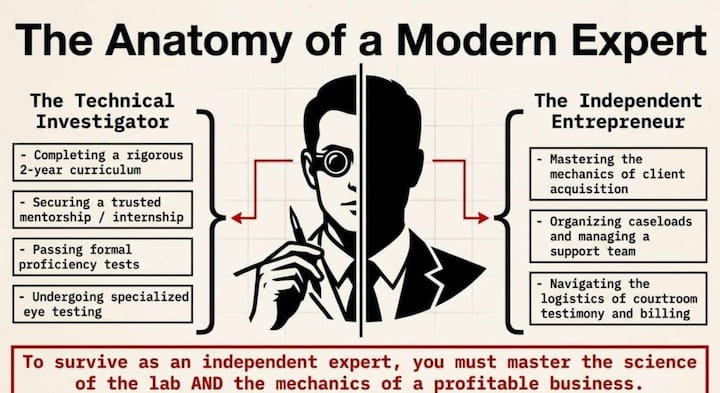
My school, the International School of Forensics, has a two-year curriculum. But on top of completing your studies and receiving your certification, I do think an internship is key.
If you look at all the documents from the forensic and handwriting analysis associations, they really recommend that you have both incredible training and that you have your eyes tested regularly to be able to qualify and renew the yearly certifications they give examiners.
To be a member of some of these associations, it is required to work side-by-side with an already recognized examiner in a government lab, which is very difficult to do if you don’t work for the government. If you don’t work for the government, you won’t be recognized by any organizations alongside other government examiners.
Forensic document examiner Bart Baggett breaks down what it truly takes to become a modern handwriting expert, balancing the rigorous technical side — curriculum, mentorship, proficiency testing, and eye training — with the business skills needed to acquire clients, manage caseloads, and navigate courtroom testimony. This infographic makes clear that surviving as an independent expert means mastering both the science of the lab and the mechanics of a profitable practice. Learn more at bartbaggett.com/blog.
In short, it’s kind of hard to get trained as a handwriting expert, particularly a legal handwriting expert. We offer classes only every couple of years because the program is expensive and time-consuming to run properly. After you complete it, you are essentially your own businessperson from day one.
How Does a Handwriting Expert Find Work After Being Certified?
Once certified, you have to learn the business of getting clients, taking cases, and testifying. You have to become an entrepreneur who can market a practice, a manager who can delegate and train staff in handling legally significant documents, and a skilled expert witness who can deliver persuasive testimony on the stand and in written reports. It is a good and profitable business, but it is also a genuinely demanding one.
How Do I Know If Becoming a Handwriting Expert Is Right for Me?
A lot of people have taken our classes and decided that they didn’t like the cross-examination. They didn’t like all the difficult attorneys. But they liked the work itself because it’s like solving a puzzle. You’re looking at evidence. You’re trying to figure out who, if anybody, is lying and whether a document is forged.
If you’re interested in that, we don’t have class all the time. We have a waiting list. You can visit our website at internationalschool.us.
If you work through all 15 videos and find them engaging, the two-year program will likely be a good fit. Much of the curriculum is delivered directly by me, along with the faculty I’ve trained over the years. If you watch all those videos and you think, “This is boring, I don’t want to answer phone calls and deal with people’s suicide notes and wills and testaments,” then it’s not for you.
At the end of the day, the path is the same regardless of how you get there: find a mentor, complete a rigorous curriculum, pass your proficiency tests, and work toward the moment when a judge looks at you and says, “I believe you are an expert. I would like to hear your opinion.”
That is how you become a handwriting expert.
If you’re interested in learning more about the path to becoming a certified forensic document examiner, visit us at internationalschool.us. And if you have a legal case that needs an expert right now, reach out at handwritingexpertusa.com.
Bart Baggett
The Nation’s Leading Forensic Handwriting Expert
CEO of Handwriting Experts Inc.
Forensic Document Examiner • Expert Witness • Legal Consultant
“We solve million-dollar forgery cases.”
Q1: How long does it take to become a certified handwriting expert?
A1: The International School of Forensic Document Examination offers a two-year curriculum leading to certification. Beyond coursework, an internship working alongside a recognized examiner is strongly recommended.
Q2: Do I need to work for the government to become a handwriting expert?
A2: Not necessarily, though some professional associations require candidates to work alongside a government-recognized examiner in a government lab, which can be difficult to arrange outside of government employment.
Q3: What kind of work does a certified handwriting expert do?
A3: Handwriting experts examine documents to identify forgeries and falsified signatures, provide written legal opinions, and deliver expert witness testimony in court proceedings.
Q4: How do handwriting experts find clients after becoming certified?
A4: Certified examiners typically work independently. They must develop skills in marketing their practice, managing client cases, working with attorneys, and delivering persuasive testimony on the witness stand.