Can Handwriting Be Used as Legal Evidence in Court?
Absolutely! In fact, the entire field of forensic document examination exists for exactly this purpose: to use handwriting and documents as legal evidence in civil and criminal courts.
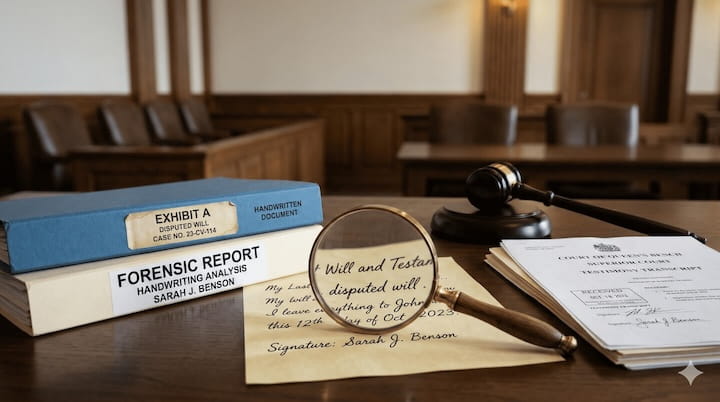
Forensic document examiner Bart Baggett specializes in analyzing disputed handwriting as legal evidence in court cases. This image illustrates the key elements of such cases: a handwritten will under scrutiny, a forensic handwriting analysis report, and the careful examination process that determines authenticity. Learn more at bartbaggett.com/blog.
When we work on a case, our goal is to answer critical questions. Was the document signed by the person it says it was? Did the person who signed intentionally go into that agreement, or was the document or signature altered?
The document and many of our cases revolved around handwriting because original wet-ink handwriting is physical evidence that a human was present when the document was created. We have to determine whether the specific human whose signature is on the document actually signed it, or whether it was signed by someone else.
Did the ex-wife sign it? Was it the maid who signed it? Did the angry caretaker sign it and cut everyone else out of the will because she doesn’t want to leave the house? (Sounds odd, but it is actually a very common story we encounter in these cases.)
This is what handwriting experts like me determine.
Can Handwriting Samples Be Used in Court?
If you have any evidence, you can use it in court. Most legal experts are hired as professional examiners and interpreters of a specific type of evidence. Blood spatter experts look at blood spatter patterns; ballistic experts analyze the trajectory and position of gunfire; and legal handwriting experts look at documents to determine who wrote them.
After they turn in their examination, if the case goes to trial, these legal experts can be called to testify and present their findings to the court. They will be called in by the attorneys of the side that hired them to break down the results of their analysis to the court. They explain what they noticed in the evidence and how that led to their expert opinion.
However, every judge and every attorney has the opportunity to try to get evidence excluded. There’s no guarantee that a piece of handwriting, a note, or a title that you found in your glove box can be admitted as evidence for the court to see and evaluate. It is the lawyer’s job to get it into evidence. If the evidence is not allowed in court, the legal expert who examined it will likely not be needed at trial.
How Long Have Legal Handwriting Experts Been Allowed to Testify in Court?
As far as the testimony of a certified court-qualified forensic examiner, it goes all the way back to the Lindbergh baby kidnapping. The interesting story about that case is that I was involved in a new investigation on the Discovery Channel of the famous kidnapping and national search for Charles Lindbergh’s son, a case that occurred in the 1930s.
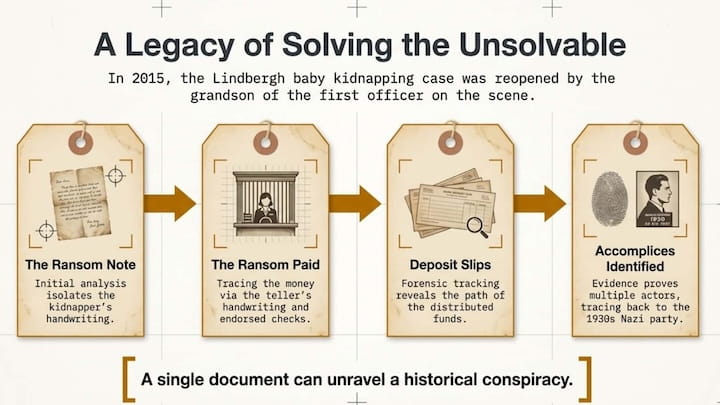
The grandson of the first cop on the scene had reopened the case, and the network had decided to film a special about the story. In the reinvestigation, I re-examined much of the handwriting used as evidence in the original case. This included analyzing the suspect’s handwriting in the kidnapping or ransom note, as well as the teller’s handwriting on the check the kidnappers made out to the bank after they received the ransom.
A significant breakthrough came when analysis of the deposit slips helped identify both the teller and the person who had endorsed the ransom check.
We were able to ascertain that the kidnapping wasn’t committed by just Richard Hauptmann, who was initially caught, tried, found guilty, and sentenced to death. Hauptmann, in fact, had several accomplices who were not prosecuted. We also discovered that the accomplices were all associated with the Nazi Party.
Fascinating story. The reason I share this case is to illustrate just how far back the use of handwriting evidence in court goes—and how much it can matter.
Forensic document examiner Bart Baggett demonstrates how a single document can unravel even a decades-old conspiracy. This infographic traces the 2015 reinvestigation of the Lindbergh baby kidnapping case across four forensic steps — from isolating the kidnapper’s handwriting on the ransom note to identifying multiple accomplices linked to the 1930s Nazi party. Learn more at bartbaggett.com/blog.
If you are in a situation where you’ve got a will and testament from a family member whose signature looks nothing like theirs, you have to spend the money to hire an examiner. You can’t hire graphologists. You can’t ask your neighbors. Often, people call and say, “Well, all my friends are positive this is a forgery.”
Unfortunately, I don’t listen to all your friends, and neither will a judge or a jury. They haven’t been to court 135 times. You have to hire a professional.
How Much Does a Handwriting Expert Cost?
It’s a couple of thousand dollars, minimum.
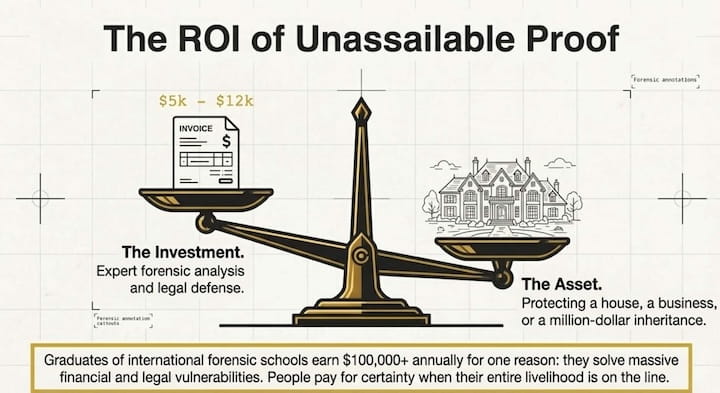
A lot of our cases end up costing $5,000 to $12,000 because we have to examine a document under a microscope and process the photos. We have to do a lot of research and then write a really long report, the summary of which is: “Here’s the narrative. Here’s how this document came to be and how certain we are about this based on the strength of the evidence provided.”
Can a Handwriting Expert Prove Something Is a Forgery?
We tend to overuse the word “forgery.” It’s actually a crime that must be designated as such by a judge.
In legal reports and in trials, handwriting experts generally say whether a signature is authentic or not. If the judge agrees the signature is not authentic, the judge would be the one to say, “I believe that’s not authentic. I think you did it, and therefore this court is charging you with the crime of forgery on your grandma’s will.”
(This actually has happened in trials here in Texas.)
Handwriting experts can’t prosecute a forgery, but they can help determine whether a signature is authentic by catching or identifying inauthentic signatures. The DAs will prosecute based on the determination or expertise of a handwriting expert.
The Bottom Line
Handwriting can be used in court, and that is why all of our graduates at the international school make $100,000 or more a year—because it’s useful. It solves a big problem, and one people are willing to pay for. Because when someone’s about to take your house or your million-dollar inheritance, you pay the money for experts and attorneys to get you out of hot water.
Forensic document examiner Bart Baggett illustrates the return on investment of securing unassailable proof in legal disputes. This graphic uses a balance scale to weigh a $5,000–$12,000 forensic analysis investment against the assets it protects — a home, a business, or a million-dollar inheritance. Learn more at bartbaggett.com/blog.
My name’s Bart Baggett. Our website is handwritingexpertusa.com. We can refer you to an expert in your area. We have a team of experts around the country that I personally trained. Whether you have a million-dollar case or you’re just fighting over a pickup truck, someone can help you out.
Bart Baggett
The Nation’s Leading Forensic Handwriting Expert
CEO of Handwriting Experts Inc.
Forensic Document Examiner • Expert Witness • Legal Consultant
“We solve million-dollar forgery cases.”
A forensic handwriting expert, also called a forensic document examiner, analyzes handwriting and signatures to determine authenticity. They are frequently called to testify in both civil and criminal court cases, helping judges and juries understand whether a document or signature is genuine.
How much does a forensic handwriting expert cost?
Retaining a forensic handwriting expert typically starts at a few thousand dollars. Many cases range from $5,000 to $12,000, depending on the complexity of the document examination, the number of specimens reviewed, and the length of the required formal written report.
Can a handwriting expert prove a signature is forged?
Handwriting experts determine whether a signature is authentic or not authentic — they do not legally declare forgery. That designation is made by a judge. The expert provides professional findings; prosecutors and attorneys then act on those findings to pursue criminal charges if warranted.
How long have handwriting experts been used in court?
Forensic handwriting experts have testified in court since at least the 1930s. One of the earliest and most prominent examples is the Lindbergh baby kidnapping case, where handwriting analysis of ransom notes and bank deposit slips played a central role in the investigation and trial.