Can a Handwriting Expert Work From a Photocopy?
I hear this question all the time in my office because, hey, we don’t always have originals. I mean, who keeps paper and pens these days?
Unless you have a lockbox containing a document from 20 years ago that your granddad wrote, it’s kind of hard to access an original document these days. My clients often find it challenging to dig through boxes in the attic for original handwriting.
However, the law in most states is the best evidence rule, which means that if we have to work from photocopies and those photocopies provide enough information to form a reliable opinion, we can do so.
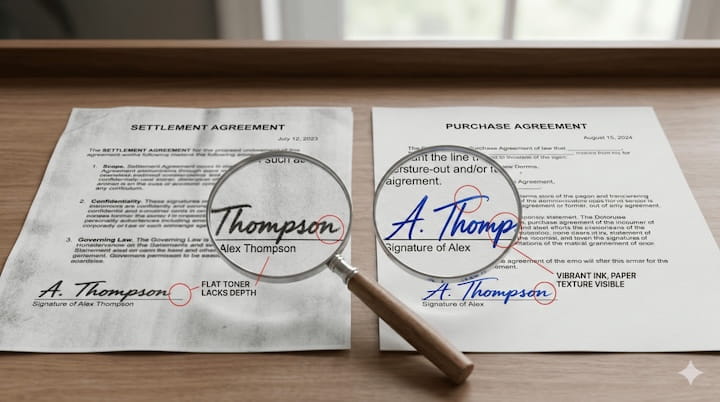
Many clients come to us and say, “Hey, all I have are photocopies. Can you still take the case?” Of course, we can take a case analyzing photocopies. However, you may not get the amazing, legally bulletproof opinion you would get with original documents.
The ideal scenario looks very different—access to all the original documents at the courthouse, ten thousand pages of original signatures at your aunt’s house, and no time pressure. Oh, and a bag of money.
(But if that is your situation, especially the bag of money part, please call us right away. We would be happy to help.)
Can an Expert Witness Testify That a Signature Is Fake Without Seeing the Original?
If you have enough time and money to get evidence of multiple original wet signatures—wet signatures meaning actual pen on paper by a human—then the report and testimony you get from an expert is going to be solid and comprehensive. They have examined heaps of evidence and will be certain of their opinion.
Anything less than that is a variation of levels of certainty, and the courts know this. Judges understand this too, which is why experts are required to disclose their level of certainty alongside their opinion, based on the quality and quantity of evidence they examined.
How Experts Express Their Level of Certainty
When experts give their opinion in court, they must also state their level of certainty based on the evidence they are working from and its strength.
Most forensic handwriting experts, and most expert witnesses in any field, have a protocol for expressing the level of certainty. In fingerprints and DNA, there’s a certain level of probability. DNA analysis, for example, experts express findings in terms of statistical probability. Forensic handwriting has its own equivalent scale, from “inconclusive” to “highly probable” to “definite,” and a qualified examiner will always tell you where their opinion falls on that scale.
Is It Even Worth Hiring a Handwriting Expert If All I Have Is a Photocopy?
The tl;dr is, of course, that we can work from a photocopy.
If you want the strongest possible testimony, dig, dig, and dig—for high-resolution scans, original wet signatures, or even a better photocopy than the one you currently have.
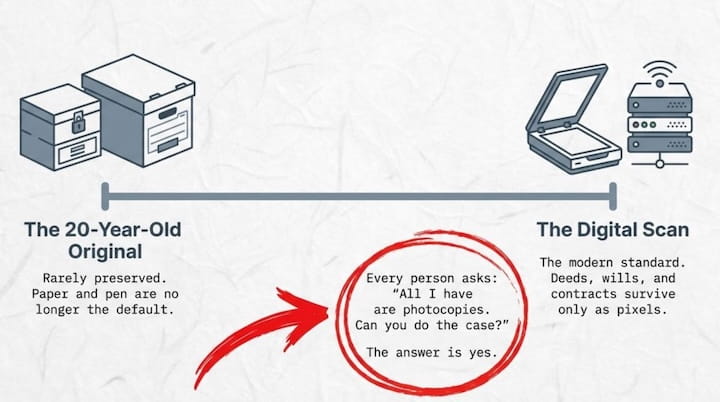
If the courthouse scan is the best evidence available and the original is inaccessible, we work with that scan. A qualified expert can still form a solid opinion from it, and that opinion will still hold up in court.
My name is Bart Baggett. Don’t let the absence of an original document stop you from pursuing your case. Call us first, tell us what you have, and we’ll give you an honest assessment of what we can do with it. Reach out at handwritingexpertusa.com. We have experts across the country ready to help.
Bart Baggett
The Nation’s Leading Forensic Handwriting Expert
CEO of Handwriting Experts Inc.
Forensic Document Examiner • Expert Witness • Legal Consultant
“We solve million-dollar forgery cases.”
Telephone: 1-800-980-9030
YouTube: @thehandwritingexpert
LinkedIn: bartbaggett
Facebook: bartbaggett
https://www.instagram.com/forensichandwritingexpert
https://www.tiktok.com/@handwritingexpertsinc
Frequently Asked Questions
Q1: Can a forensic handwriting expert work from a photocopy?
A1: Yes. Under the best evidence law, if a photocopy provides enough information to form a reliable opinion, a forensic handwriting expert can work from it and deliver a credible report.
Q2: Will a photocopy-based handwriting analysis hold up in court?
A2: Yes. A qualified forensic handwriting expert can form a valid opinion from a photocopy, and that opinion can hold up in court—though the level of certainty may be lower than when original documents are examined.
Q3: How does a handwriting expert express certainty when working from copies?
A3: Experts are required to disclose their level of certainty based on the quality and quantity of evidence available. Photocopies may reduce certainty compared to examining multiple original wet signatures.
Q4: What is a wet signature in forensic document examination?
A4: A wet signature is an actual pen-on-paper signature made by a human, as opposed to a digital or photocopied version. Wet signatures provide the strongest and most reliable evidence for forensic handwriting analysis.