Well, yes and no. That is basically what a forensic handwriting expert does: they examine a signature and determine whether it is authentic or fake. However, the question assumes you have only one comparison signature.
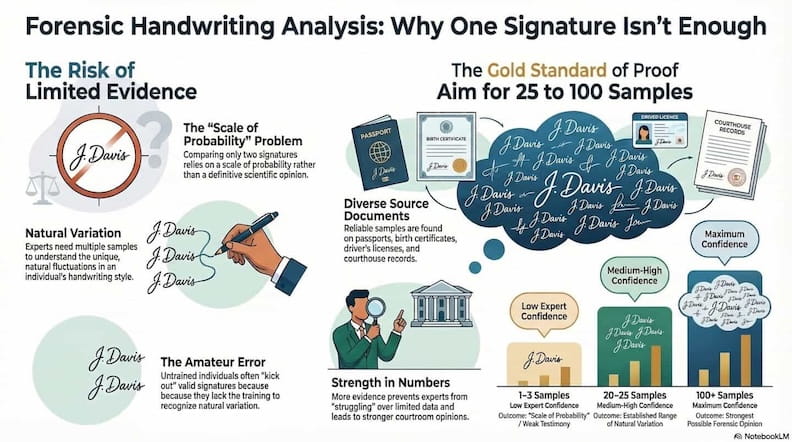
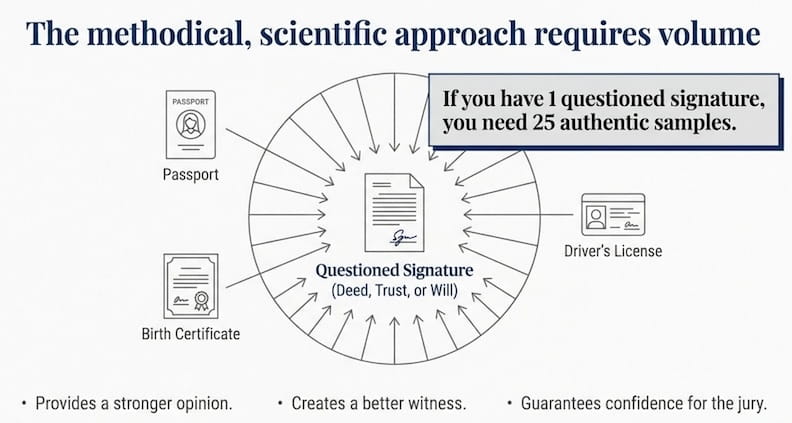
Let’s say the signature appears on a deed, a deed of trust, or a will. In most real courtroom cases, you’ll have 20 or more comparison documents, including samples taken from a person’s passport, birth certificate, or driver’s license. You have all these other comparables so that the expert can establish a range of natural variation.
Why More Samples Mean a Stronger Opinion
I’m not saying it’s impossible to compare one-to-one. There have been cases where that was enough to form an opinion. However, the better, more scientific approach would be to compare one to many, so you can establish a range of natural variation. But if you want to win your case, and if you’re going to spend $5,000 or $10,000 on an expert witness and another $30,000 on a lawyer, do it right. Find a private investigator. Go dig through trash. Go find other handwriting samples, either in the lawsuit or in the courthouse.
You don’t have to make your handwriting expert spend hours and hours struggling over three samples of handwriting when you could get 20 of them. In all cases, even though 100 samples sounds like a lot of work, if I have 100 samples, especially 100 original samples, my opinion is going to be stronger. I’m going to be a better witness, and I’m going to have more confidence that what we’re telling the jury is authentic. If we have only one or three signatures, it’s going to be a probability scale. We could end up saying, “Hey, here’s the evidence that I can see, but I don’t know what’s behind door number three for that file.” More evidence is always better.
What About Voter Fraud Cases?
Voting cases present a particular challenge because examiners often can’t access large numbers of comparison signatures. They can’t access every voter in the district because it’s not a will-and-testament case. We actually have people call up and say, “Hey, we think there’s voter fraud. There are 24,000 people,” and then, “We can’t afford you.” I would respond, “At that scale, cutting corners isn’t an option if you want reliable results.”
So, then the caller might say, “Well, here’s the voter registration card. Here’s the signature.” I mean, that is really not super scientific. I think you probably could work with just two signatures; someone like me could do a first pass. I’d be pretty accurate with that. But it really concerns me that in many places, especially in the United States, people are going untrained, and they’re kicking out votes because they think the signatures don’t match. How would they even know if the signature matches?
Without proper training, there’s no reliable way to know whether a signature genuinely doesn’t match or simply reflects natural variation in a person’s handwriting. So, luckily, I haven’t heard of too many places in America where the voting was profoundly affected. When you do see lawsuits about regions and votes, it’s not like the George Bush thing, which was a tabulation machine issue. The signatures are being thrown out by amateurs, and they really shouldn’t be given the power to do this, since they have had as little as 1 hour of training.
Even with my training, one comparison signature is enough to say yes, that’s probably the same person, or maybe not. But I would still prefer another layer of research with enough examples.
So, to answer the original question directly: can you compare one signature to another and determine if it’s fake? Well, the answer is yes, but I’d rather have a little more evidence.
My name is Bart Baggett. I’m a forensic handwriting expert. I train people to be forensic handwriting experts. If it’s a career you’re interested in, reach out to one of our companies, the International School of Forensic Document Examination. We have five offices around the country, where experts go to court, testify, and solve million-dollar forgery cases.
Bart Baggett
The Nation’s Leading Forensic Handwriting Expert
CEO of Handwriting Experts Inc.
Forensic Document Examiner • Expert Witness • Legal Consultant
“We solve million-dollar forgery cases.”
Telephone: 1-800-980-9030
YouTube: @thehandwritingexpert
LinkedIn: bartbaggett
Facebook: bartbaggett
https://www.instagram.com/forensichandwritingexpert
https://www.tiktok.com/@handwritingexpertsinc
—————————————————————-
FAQ
—————————————————————-
Q1: Can a forensic handwriting expert compare just two signatures?
A: Yes, a forensic handwriting expert can compare two signatures
and form an opinion, but it is not ideal. Comparing one signature
against many known samples establishes a range of natural
variation, resulting in a stronger and more defensible conclusion
in court.
—
Q2: How many signature samples does a handwriting expert need?
A: While one or two samples may be sufficient for a preliminary
opinion, 20 or more comparison samples are preferred. With 100
original samples, the expert’s opinion becomes significantly
stronger and more reliable for court testimony.
—
Q3: Why is voter signature comparison particularly challenging?
A: Voting cases rarely allow access to large numbers of comparison
signatures. Without sufficient samples and proper training,
examiners risk rejecting valid ballots by mistaking natural
variation in a person’s handwriting for a mismatch.
—
Q4: What is a range of natural variation in handwriting analysis?
A: A range of natural variation refers to the normal differences
that occur in a person’s own signature over time. Establishing
this range requires multiple samples and is essential to
distinguishing a genuine signature from a forgery.