Is It Too Late to Bring a Handwriting Expert Into an Active Legal Case?
It is never too late to bring in an expert witness in a case as a rebuttal witness.
If someone says, “Hey, we found this document, and it proves that my client is telling the truth, and this document was found in the glove box yesterday,” well, that’s new evidence. And so, the judge can decide whether to allow new evidence into the case.
The Legal Protocol for Bringing In an Expert
However, if you’ve had that evidence for years, then you should have disclosed that. And there’s a whole protocol for getting an expert witness disclosed, and it gives the prosecution and the other side time to depose that person if they want. Deposition rights vary by state, so it’s important to know the rules in your jurisdiction.
If you just spring an expert witness on a judge or a jury and the other side didn’t have time to look at the expert witness’s credentials, look at the evidence, or read the report, they’re going to object to that. In an active legal case, absolutely any new evidence, including a human being, can be objected to. It depends on your attorney. And in your case, your safest bet is to bring in that expert witness as a rebuttal to some evidence that was not previously disclosed.
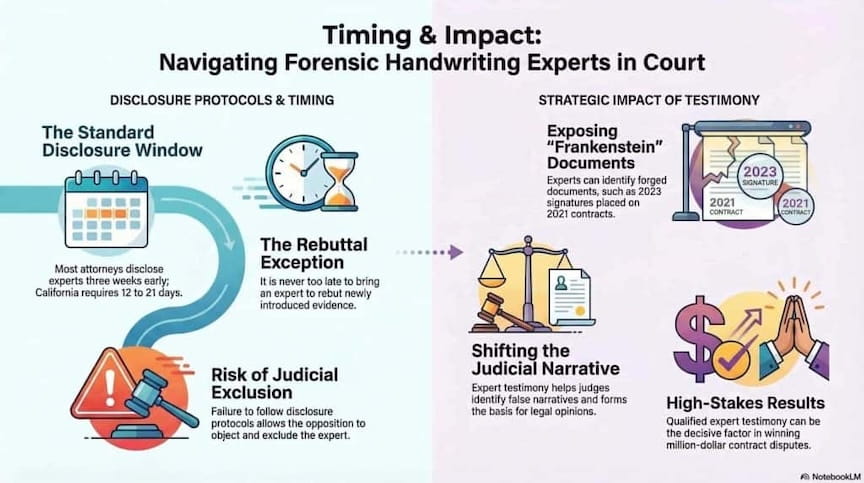
Most attorneys I work with prefer to disclose expert witnesses well in advance, typically three weeks or more. In California specifically, the window is 12 to 21 days.
If you don’t disclose your expert witness, you can’t bring them. So even if you hired me a year ago and I wrote a report a year ago, if you never disclosed me and gave them the right to depose me in California, you’re probably not going to get me on the witness stand. Even then, they have a right to oppose and object to that. All that is legal paperwork, and it’s completely normal. And they’re going to object to every witness who’s going to help you.
I just had a case in Chatsworth, California, and there were a bunch of legal motions back and forth to get me excluded because they knew that my testimony was going to be the dagger in the heart of their case. Their client had submitted fake documents, like taking checks from 2023 and putting them on documents from 2021, implying there was a business arrangement and that this guy owed him a million dollars. It was entirely fabricated. The other side knew that if I could get on the witness stand and the judge could hear me, that would be the nail in their coffin.
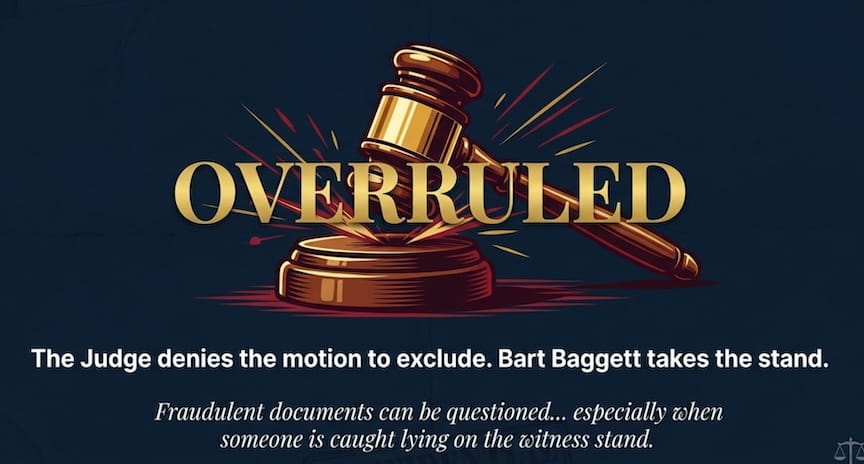
And guess what? The judge said, “No, I decline your motion to exclude. This is somebody I want to hear from.”
Then they went on and said, “There was no reason for him to testify. We’ve already agreed that that document is not true.” So, they got caught. They got caught after two years. They all agreed that this was a fake document. We don’t need to hear the expert. The judge said, “I want to hear the expert.” And then that judge listened to me. And the other attorney, of course, was not happy, because discrediting the expert witness is standard courtroom strategy.
In the end, I just got a call yesterday. My client won that trial. My testimony was exactly what the other side feared it would be. The judge said, “I really liked Mr. Baggett’s testimony. He made a difference, and that helped me form the opinion that this narrative is false.”
My client won a million dollars’ worth of what that contract was worth. The other guy… since it’s a civil case, he probably won’t go to jail for lying under oath or for submitting fake evidence to the court. I hope they put him away because the guy’s done it before. In fact, he’d already been convicted for forgery in another case, but the judge wasn’t allowed to know that because that would have been prejudicial. If the judge knows that this guy’s already been convicted for faking evidence at previous trials in previous business relationships, the judge might have had some bias against him.
I’ll leave it at that. If you’re entering a business arrangement with someone and something feels off, trust your intuition.
All that being said, you absolutely can bring an expert witness into an active trial, but there’s a lot of legal protocol that you have to go through.
Talk to your lawyer. Call your forensic handwriting expert. Make sure they’re court-qualified. And if you need help with any complicated legal case, give us a call. We have offices all over the country. My name is Bart Baggett. The company is called Handwriting Experts Incorporated. Go to handwritingexperts.com, and you will be in good hands.
Bart Baggett
The Nation’s Leading Forensic Handwriting Expert
CEO of Handwriting Experts Inc.
Forensic Document Examiner • Expert Witness • Legal Consultant
“We solve million-dollar forgery cases.”
Telephone: 1-800-980-9030
YouTube: @thehandwritingexpert
LinkedIn: bartbaggett
Facebook: bartbaggett
https://www.instagram.com/forensichandwritingexpert
https://www.tiktok.com/@handwritingexpertsinc
—————————————————————-
FAQ
—————————————————————-
Q1: Can you bring a handwriting expert into an active legal case?
A1: Yes. A forensic document examiner can be brought into an active case as a rebuttal witness at any stage, provided the required legal disclosure protocols are followed in your jurisdiction.
Q2: How far in advance must an expert witness be disclosed?
A2: Disclosure timelines vary by state. In California, the window is typically 12 to 21 days. Most attorneys prefer to disclose expert witnesses at least three weeks in advance so the opposing side has time to review credentials and the expert’s report.
Q3: What happens if an expert witness is not properly disclosed?
A3: If an expert witness is not disclosed within the required timeframe, opposing counsel can object to their testimony and the judge may exclude them from the witness stand entirely — even if a report was prepared well in advance.
Q4: Can opposing counsel try to have a forensic document examiner excluded from testifying?
A4: Yes. Filing motions to exclude expert witnesses is standard courtroom strategy, particularly when their testimony is expected to significantly impact the case outcome. Judges, however, retain full discretion to allow the expert to testify.