Is the Handwriting Expert the Same as a Document Examiner?
It’s a question that comes up often, and the distinction matters if you’re trying to hire the right person for your case. The two are actually interrelated, but one is a subset of the other. And so, if you hire a forensic document examiner, that person has been trained in paper, ink, various ESDA machines, and related technical aspects for analyzing documents, even historical ones.
New Youtube video here
https://www.youtube.com/watch?v=YV74LITN2_w
I cannot tell you how many times people call me and say, “I’ve got an original Abraham Lincoln. It’s worth a million dollars. Would you do it for free?” Well, that’s not something I can take on pro bono, but, more importantly, let me tell you why those “originals” are almost never what people think they are. There are hundreds of photocopies from the 1900s of Abraham Lincoln’s 1863 Gettysburg Address. So, people think they have an original, but they do not. That is a forensic document problem: analyzing the paper, the ink, and the artifact’s age.
Where Handwriting Analysis Fits In
Most forensic document examiners also do handwriting analysis. Unless you work for the British or American passport authority, you will deal with documents, ink, passports, and currency, for example. Those are all document examiners. They may not ever be trained in handwriting. But for most private examiners, roughly 90% of cases come down to one question: who signed this document? That’s handwriting analysis—specifically, forensic identity determination.
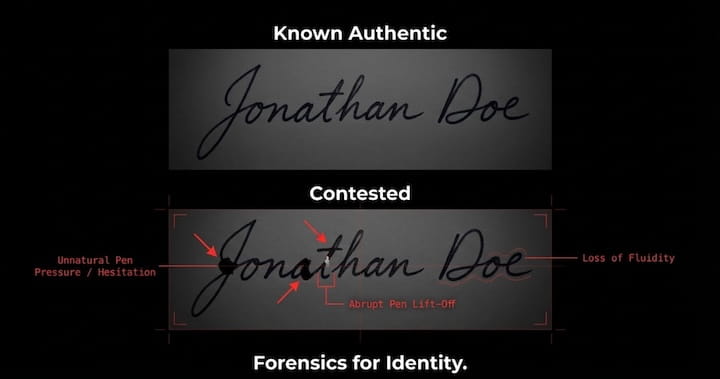
The other term that often gets confused with forensic document examination is graphology, or the psychology of understanding people from handwriting. It is also very useful, but there just aren’t many good trainers. Most of my books on the subject have been copied and distributed online without authorization. So if you do read one, at least know it will be accurate, even if I never see a penny from it. My Grapho-deck cards are also out there and worth using.
Even though graphology can be highly accurate in skilled hands, it is not something a beginner can pick up quickly and apply reliably. Understanding whether one trait outweighs another—whether the T-bar matters more than the Y formation in a given context—takes years of study and practice. I would not recommend presenting yourself as a graphology expert until you have that depth of experience.
My name is Bart Baggett. If you’re not sure whether you need a forensic document examiner, a handwriting analyst, or both, give us a call. We’ll help you figure out exactly what your case requires. Find us at handwritingexpertusa.com.
Bart Baggett
The Nation’s Leading Forensic Handwriting Expert
CEO of Handwriting Experts Inc.
Forensic Document Examiner • Expert Witness • Legal Consultant
“We solve million-dollar forgery cases.”
Telephone: 1-800-980-9030
YouTube: @thehandwritingexpert
LinkedIn: bartbaggett
Facebook: bartbaggett
https://www.instagram.com/forensichandwritingexpert
https://www.tiktok.com/@handwritingexpertsinc
Frequently Asked Questions
Q1: What is the difference between a handwriting expert and a forensic document examiner?
A1: A forensic document examiner is trained in analyzing paper, ink, and document artifacts, while a handwriting expert focuses on identifying who wrote or signed a document. Handwriting analysis is a subset of forensic document examination.
Q2: Does a forensic document examiner also perform handwriting analysis?
A2: Most private forensic document examiners also perform handwriting analysis. In fact, approximately 90% of their cases involve one central question: who signed a particular document?
Q3: What is graphology and how is it different from forensic handwriting analysis?
A3: Graphology is the study of personality and psychology through handwriting, whereas forensic handwriting analysis focuses on identity determination—specifically, verifying the authorship of a document. Both are distinct disciplines that require years of dedicated study and practice.
Q4: How do I know whether I need a forensic document examiner or a handwriting analyst?
A4: If your case involves questions about document authenticity, ink, paper, or the age of an artifact, you likely need a forensic document examiner. If the primary question is who signed or wrote a document, you need a forensic handwriting analyst. Many cases require both.