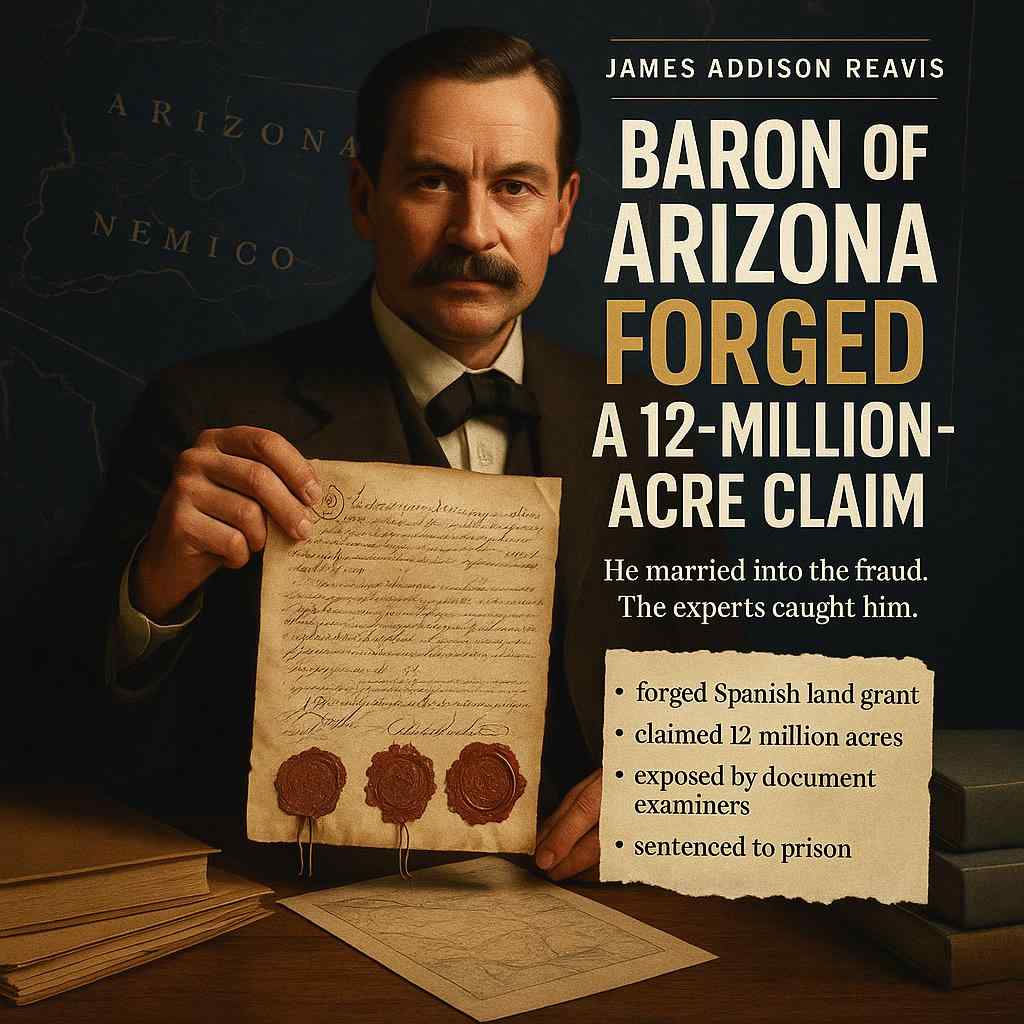
In the late 1800s, a man named James Addison Reavis set out to become the richest landowner in the American West. He nearly pulled it off. Reavis claimed a Spanish land grant gave him ownership of more than 12 million acres—stretching across what is now Arizona and New Mexico. His documents looked authentic, his story was convincing, and for a while, even powerful railroads and mining companies paid him millions to keep their land.
James Reavis forged a Spanish land grant and claimed 12 million acres across Arizona and New Mexico. Forensic document examiners uncovered his fraud, leading to his conviction and prison sentence.
The Man Who Would Be Baron
Reavis’s scheme began with a simple but audacious idea: if he could prove a vast tract of land was granted by Spanish royalty to the Peralta family in 1748, and that he had inherited the rights, he could claim ownership of a territory larger than some states. He didn’t stop at paperwork. To bolster his story, Reavis married a woman he claimed was the last surviving Peralta heir, weaving her into the legend and giving his claim a human face.
Settlers, mining companies, and railroads faced with the threat of eviction or endless legal battles paid Reavis for quitclaims and leases. The money added up. By the time his fraud unraveled, Reavis had collected an estimated $5.3 million in cash and promissory notes. His operation was so elaborate, it later inspired a Hollywood film, “The Baron of Arizona.”
How the Forgery Worked
Reavis’s forged documents were not simple fakes. He created a web of supporting paperwork: legal papers, family trees, royal decrees, and archival records. He even traveled to Spain and Mexico, planting some of his forgeries in official archives to make them seem authentic. The central piece was a supposed 1748 Spanish land grant to the Peralta family, complete with ornate seals and period handwriting.
But the devil, as always, was in the details. Reavis used steel-nib pens, which weren’t available in the 18th century. Some documents showed modern typefaces. The seals were glued onto the papers, not pressed as was the custom in the era he was trying to mimic. These inconsistencies were subtle, but they would become his undoing.
How Document Examiners Unraveled the Scheme
Forensic document examiners were called in to scrutinize Reavis’s mountain of paperwork. They looked for clues in the materials and methods. The pen strokes from steel-nib pens, for example, left distinct lines that didn’t match the quill pens of the 1700s. Modern typography stood out to a trained eye. Seals that should have been embossed were simply glued on. Even the handwriting itself—its style, its flow—didn’t always fit the period or the supposed authors.
Handwriting analysis played a key role. By comparing the writing on the forged documents to authentic samples from the era, experts could spot unnatural similarities and differences. Natural variation is a hallmark of genuine writing; forgers often struggle to mimic it convincingly. In Reavis’s case, the handwriting analysis, combined with material evidence, exposed the fraud.
The Verdict and Its Impact
The courts were not fooled. In 1895, the Court of Private Land Claims rejected Reavis’s claim. By 1896, he was convicted of fraud and sentenced to two years in prison, along with a $5,000 fine. His wife, the supposed Peralta heiress, was left with nothing. The case became a cautionary tale for anyone dealing with high-stakes documents.
What stands out is not just the scale of Reavis’s ambition, but how close study of handwriting and materials unraveled a fraud that fooled so many for so long. It’s a reminder: even the most convincing documents can be questioned—and sometimes, should be.
How Would a Document Examiner Approach a Case Like This?
In a case involving an old land grant or will, a forensic document examiner starts with the basics: the paper, the ink, the seals, and the handwriting. Are the materials consistent with the claimed date? Does the handwriting match known samples from the person or period? Are there signs of tracing, copying, or unnatural uniformity?
Examiners look for natural variation in handwriting, check the method of seal application, and analyze ink or paper under magnification. Originals are always better than copies, and small details—like the type of pen used—can reveal a document’s true age.
What This Means for You
If your family faces a disputed will, deed, or signature, don’t take the document at face value. Preserve the original, avoid adding notes or staples, and consult a forensic document examiner early. The details matter—and sometimes, they’re all that stands between truth and a costly mistake.
Frequently Asked Questions
What happened in the James Addison Reavis ‘Baron of Arizona’ case?
James Addison Reavis forged a Spanish land grant and supporting documents to claim ownership of more than 12 million acres in Arizona and New Mexico. He collected millions from settlers and companies before forensic document examiners exposed the fraud.
When did the Baron of Arizona land fraud happen?
The fraud took place during the 1880s and 1890s, with Reavis’s claim rejected in 1895 and his conviction for fraud in 1896.
What was the outcome of the James Reavis land grant case?
The courts rejected Reavis’s claim in 1895. In 1896, he was convicted of fraud, sentenced to two years in prison, and fined $5,000.
Was the handwriting or document ever questioned, and what role did document examination play in the Baron of Arizona case?
Yes, forensic document examiners identified inconsistencies in handwriting, materials, and seals that exposed the forgeries and led to Reavis’s conviction.
How do forensic document examiners detect forged historical documents like the Reavis land grant?
They examine materials, ink, handwriting style, and seals for inconsistencies with the claimed era. Even small details, like pen type or seal application, can reveal a forgery.
What should someone do if they suspect a will or land deed is forged?
Preserve the original document, avoid writing or stapling on it, and consult a forensic document examiner as soon as possible.
If you’re dealing with a questioned will, signature, or document, Handwriting Experts Inc. can help. Visit HandwritingExpertUSA.com or call 1-800-980-9030.