Can a Handwriting Expert Tell if a Document Was Signed Under Duress?
This is a question that comes up more than you might expect, and the answer is more nuanced than a simple yes or no.
There I was, sitting in a police station, when this detective told me she believed a letter had been written by someone tied to a chair, the pen put in his hands. That was her theory, the detective theory about this under-duress writing, which is really interesting because most of our cases are about whether an individual wrote a letter, not whether an individual wrote a letter under duress.
What Duress Actually Looks Like in Handwriting
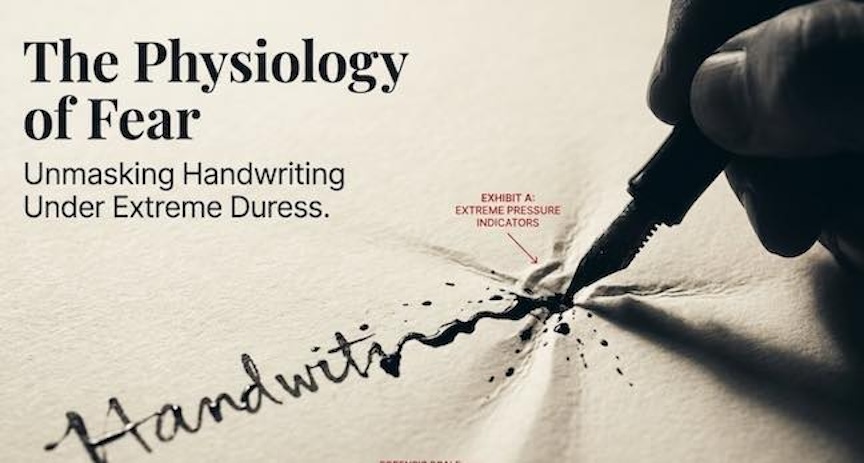
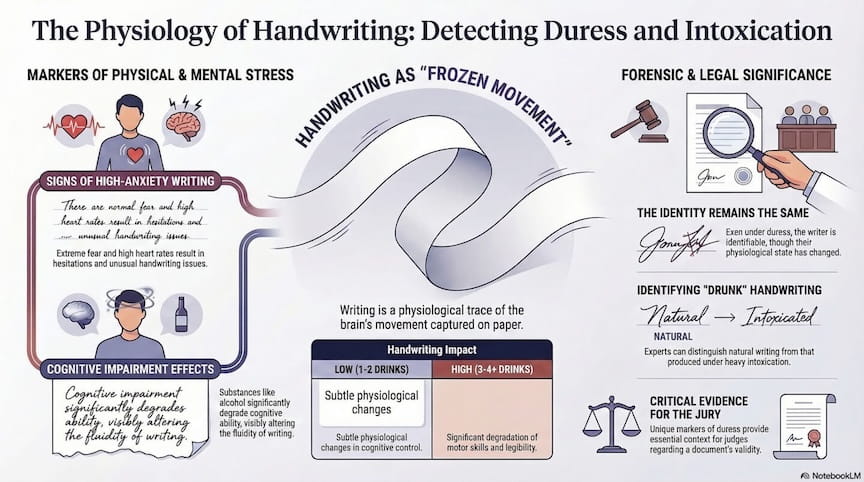
And so that is a tricky situation. There are clues, and there are books and research studies on what anxiety or stress looks like, but essentially, it’s going to be a high heart rate and a lot of fear, and there are going to be hesitations and unusual handwriting issues that wouldn’t be there naturally. Now, I will say that handwriting under duress is still the same person’s handwriting. So, you are identifying the writer, but you’re saying there’s something so unique about this that it needs to be considered by the judge or the jury.
How Intoxication Affects Handwriting
I would say the same thing about intoxication. I did a will once, and it was genuinely disappointing because it actually was the dude’s handwriting. But it had been written on a bar napkin, and the man was, to put it plainly, drunk as a skunk. You could tell from the handwriting.
There’s a well-known Seagram’s ad from 1971 that illustrates this beautifully, showing how handwriting degrades after one, two, three, and four drinks. Based on the ad and my own experience examining the handwriting of people under the influence of various substances, the effect on cognitive function and, therefore, handwriting ability is clear and measurable. Whether or not the ad is scientifically rigorous, it lines up with what I have observed over decades.
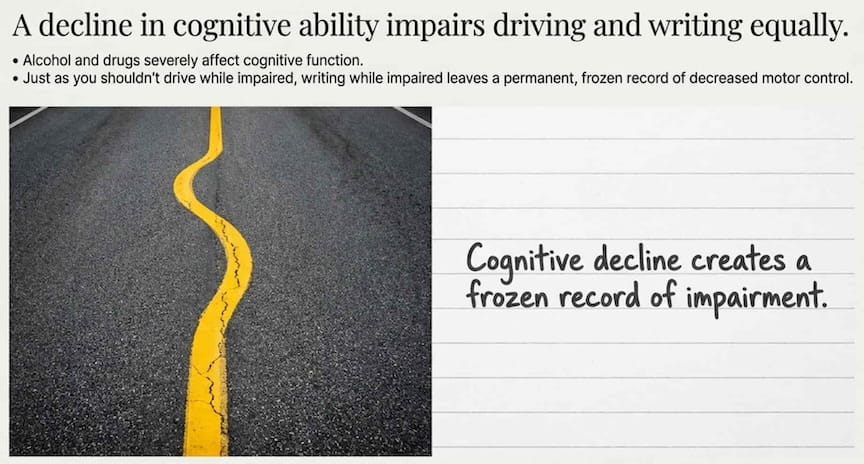
Drinking affects driving ability and, of course, handwriting. I mean, essentially, handwriting is just a frozen movement of your physiology as you’re moving your fingers.
The best way I can explain what handwriting actually captures is this: if you think about a person ice skating, there’s this beautiful art going on, but there are traces of where that person was on the ice. That’s kind of the edges, right? That’s what handwriting is. It’s tracing the physiology of your brain.
And because it’s so unique, it has been used in court for hundreds of years to identify individuals.
My name is Bart Baggett. If you have a case involving a document you believe was signed under duress, under the influence, or under any other compromised circumstances, that’s exactly the kind of nuanced analysis we specialize in. Reach out to us at handwritingexpertusa.com. We have offices across the US and are happy to help you determine whether you have a case worth pursuing.
Bart Baggett
The Nation’s Leading Forensic Handwriting Expert
CEO of Handwriting Experts Inc.
Forensic Document Examiner • Expert Witness • Legal Consultant
“We solve million-dollar forgery cases.”
Telephone: 1-800-980-9030
YouTube: @thehandwritingexpert
LinkedIn: bartbaggett
Facebook: bartbaggett
https://www.instagram.com/forensichandwritingexpert
https://www.tiktok.com/@handwritingexpertsinc
https://handwritingexpertdallas.com/
https://handwritingexpertusa.com/
https://californiahandwritingexperts.com/
https://sanfranciscohandwritingexpert.com/
https://handwritingexpertstlouis.com/
https://floridahandwritingexperts.com/
https://www.instagram.com/forensichandwritingexpert
https://www.tiktok.com/@handwritingexpertsinc
—————————————————————-
FAQ
—————————————————————-
Q1: Can a handwriting expert tell if someone signed a document under duress?
A: Yes, though the analysis is nuanced. Duress can produce hesitations and unusual handwriting irregularities caused by elevated heart rate and fear. The writing still belongs to the same person, but these anomalies can be flagged for a judge or jury to consider.
Q2: What does handwriting under duress look like?
A: Research and forensic practice indicate that stress and anxiety can cause hesitations and other irregularities not typically present in a person’s natural handwriting. These unusual features can signal to an examiner that something was wrong at the time of writing.
Q3: Can a forensic document examiner detect intoxication in handwriting?
A: Yes. Intoxication impairs cognitive function and motor control, both of which directly influence handwriting. Just as alcohol affects driving ability, it affects the brain’s capacity to produce consistent, controlled pen movement — changes a trained examiner can identify.
Q4: Why has handwriting been used as evidence in courts for hundreds of years?
A: Handwriting is a record of the brain’s physiological activity as it controls fine motor movement. Because each person’s handwriting is uniquely their own, forensic document examiners have used it to identify writers in legal proceedings for centuries.