Question:
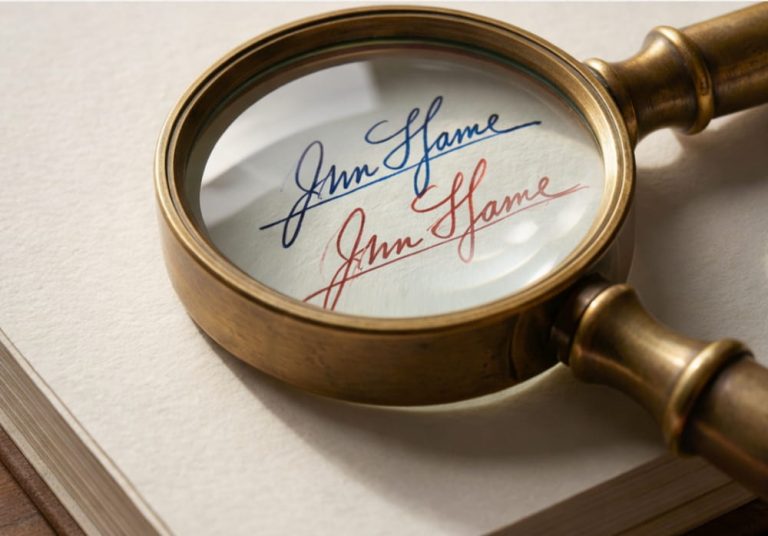
Can a Forensic Expert Still Identify a Forgery If a Signature Changes Over Time?
Yes. Signature changes over time are not only expected—they are part of every professional forensic handwriting analysis.
This is one of the most common questions I hear in legal cases:
“What if my signature has changed over the years?”
“What if someone else’s handwriting looks different now than it did decades ago?”
The short answer is simple: that’s exactly what forensic document examiners are trained to evaluate.
Do Signatures and Handwriting Naturally Change Over Time?
Yes, handwriting and signatures can evolve gradually throughout a person’s life. Common reasons include:
- Age and physical development
- Name changes due to marriage or divorce
- Career or writing habit changes
- Major life events or trauma
- Health or neurological factors
For example, handwriting from ages 12 to 20 often changes significantly as motor control matures. Later in life, changes tend to be more subtle.
However, these changes occur within a predictable range of natural variation.
How Forensic Handwriting Experts Account for Signature Changes
Professional forensic document examiners do not rely on a single signature or a single moment in time.
Instead, we establish a range of natural variation by examining:
- Known genuine signatures spanning years—or decades
- Writing samples before and after major life events
- Multiple documents created under normal conditions
In many cases, examiners analyze writing samples covering 20 to 30 years of a person’s life.
What Does NOT Change in Authentic Handwriting
While surface appearance may evolve, certain identifying characteristics remain remarkably consistent:
- Neuromuscular movement patterns
- Stroke order and rhythm
- Pen lifts and hesitations
- Line quality and pressure habits
- Microscopic ink deposits and striations
These features are driven by physiology and neurochemistry—not conscious choice.
You cannot fake another person’s neuromuscular handwriting system.
Why Originals Matter in Signature Analysis
The most reliable forensic conclusions come from examining original documents.
Using magnification and microscopy, experts can identify:
- Pen speed variations
- Ink flow disruptions
- Natural tremor vs. simulated tremor
- Microscopic pauses invisible in copies
Low-resolution scans, photocopies, or faxed documents eliminate much of this critical evidence.
Can Experts Still Identify a Forgery Despite Signature Changes?
Absolutely.
When enough genuine writing samples are available, forensic document examiners can:
- Differentiate natural variation from simulation
- Identify disguised or slowly drawn signatures
- Detect tracing, patching, and hesitation patterns
- Provide a defensible professional opinion
If the findings support your legal position, that opinion can be presented through a written forensic report, sworn declaration, or live court testimony.
Why Courts Trust Forensic Handwriting Experts
Judges value independent experts who rely on science—not speculation.
A qualified forensic handwriting examiner provides:
- Objective analysis
- Court-admissible methodology
- Clear explanations for judges and juries
That credibility often makes the difference between winning and losing a case.
Final Takeaway
Signatures may change over time—but the underlying handwriting system does not.
That’s why professional forensic document examiners can account for natural variation and still determine whether a signature is authentic or forged.
If you’re facing a dispute involving a questioned signature, don’t guess. Get a professional analysis.
— Bart Baggett
The Nation’s Leading Forensic Handwriting Expert
CEO of Handwriting Experts Inc.
Forensic Document Examiner • Expert Witness • Legal Consultant
“We solve million dollar forgery cases.”
http://handwritingexpertusa.com
Telephone: 1-800-980-9030