Do You Need an Original? Can You Work From a Photocopy?
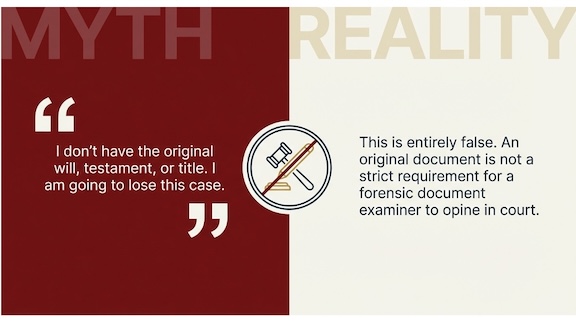
Attorneys often need to hire a forensic document examiner as an expert witness to opine in court that something is or is not a forgery. Common types of evidence can include a will, a codicil, a title, or any document that helps the court determine the truth of the agreements. It happens all the time and has been happening for centuries. Many clients think, “I don’t have an original. I’m going to lose this case.” That is not true. Even in cases involving a Last Will and Testament, where state laws typically require a wet signature and two witnesses, a copy is sometimes accepted by the court as valid evidence.
How Evidence Has Changed Over the Decades
Since I’ve been in this business for about 30 years, I have seen a shift in the types of documents that come before a judge. When the first textbooks on forensic document examination were written, originals were the only form of evidence available. In the 1980s, faxes were often used as evidence. Photocopies have been used as evidence since the invention of the copy machine.
Read More
Fax machines have largely disappeared, and with them, fax copies as evidence have been replaced by PDF files, email attachments, and scans of varying quality. There are high-resolution scanners and low-resolution scanners. What many clients don’t realize is that deeds and titles recorded at the courthouse are often scanned at very low resolution, and in some cases, that low-resolution scan is the only copy that exists.
The Best Evidence Rule
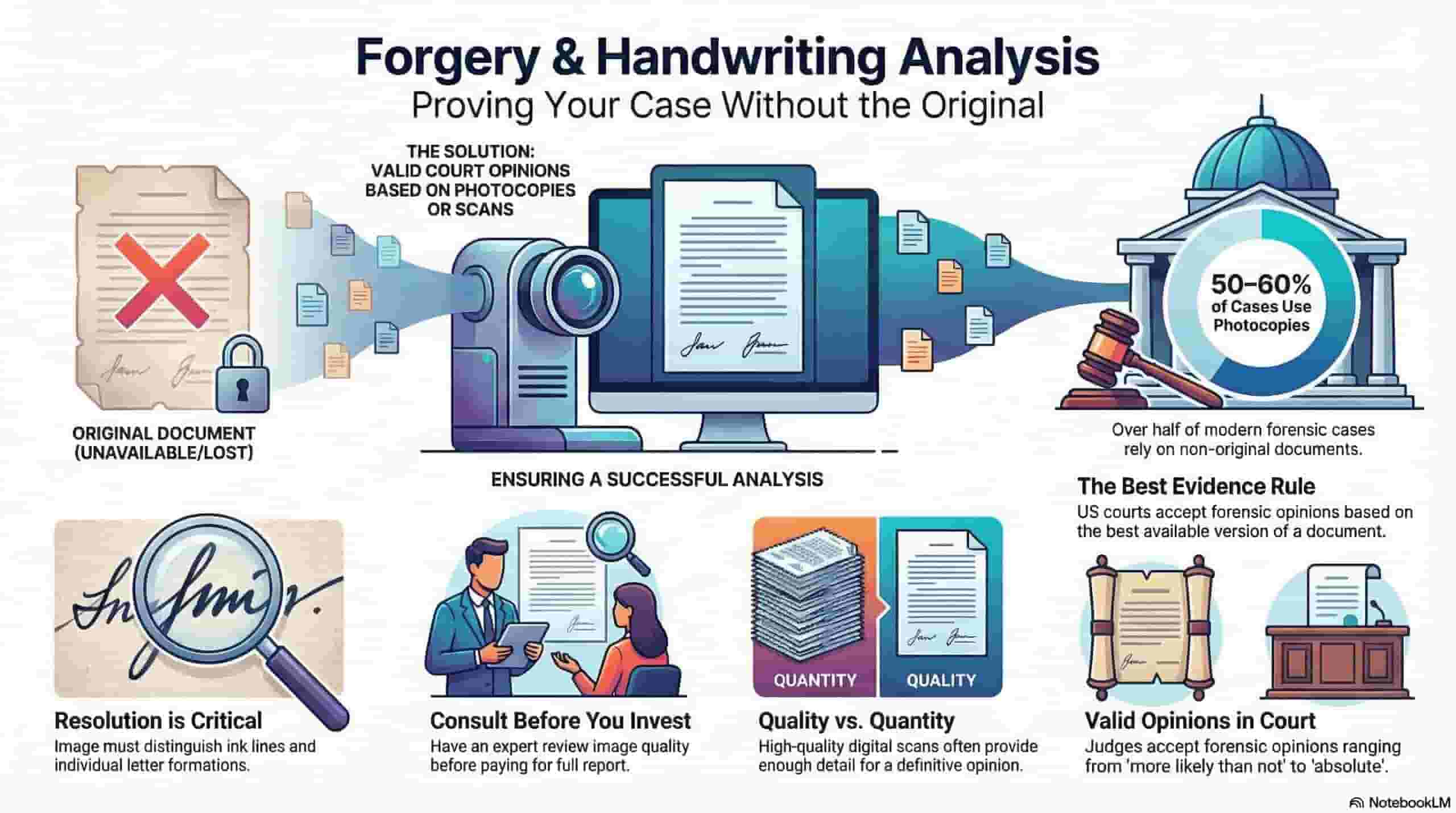
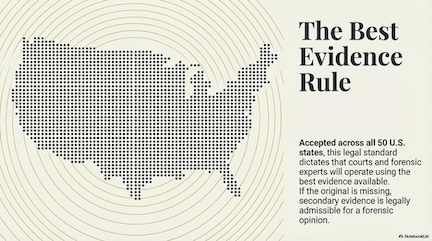
The general rule, at least in the United States, across all 50 states, is the Best Evidence Rule. It holds that the court will accept the highest-quality evidence available, meaning that even a photocopy can be admitted if it is the best version of the document that exists. A forensic document examiner’s opinion based on that evidence can still carry significant weight.
Will a forensic opinion based on a photocopy be accepted by the court? Yes. An inconclusive opinion is still a valid opinion. A finding of “more likely than not authentic” carries weight in court. And in some cases, an examiner can reach an absolute conclusion even without an original, though originals are always preferred. If you have originals, whether the known signatures or the questioned signature, we want to see them. Obviously, we want the best evidence.
I would say 50% to 60% of our cases end up creating a letter, maybe going to court, maybe not, based on some form of a photocopy because the document itself is lost. I had a copy of a marriage certificate from Mexico, signed in 1956. Well, the original just didn’t exist. That’s a 70-year-old document. We had to make the best decision possible given the document’s quality.
What to Do Before You Hire an Expert
When you call your local office, tell your examiner what you have. Sometimes we’ll look at a case, and the resolution is so bad that the photocopy is almost indiscernible. So if you can’t identify the ink, you can’t see the letters, everything’s faded, you probably can’t even move forward with the case. And that would be one of those conversations you want to have before you invest the $5,000 to hire and retain and get a letter from a forensic document examiner.
So the answer is yes, you can bring a photocopy. Yes, the judge will allow it. You can win a case if you don’t have an original. But it’s always better to have higher-quality evidence, and more of it.
My name is Bart Baggett. If you need my help or would like to speak with one of our handwriting experts, visit handwritingexperts.com. Whether you’re dealing with a million-dollar forgery case or a disputed title on a pickup truck, we’ve handled it all. Reach out to us at handwritingexpertusa.com, and we’ll connect you with the right expert.
Bart Baggett
The Nation’s Leading Forensic Handwriting Expert Firm
CEO of Handwriting Experts Inc.
Forensic Document Examiner • Expert Witness • Legal Consultant
“We solve million-dollar forgery cases.”
https://handwritingexpertdallas.com/
https://handwritingexpertusa.com/
https://californiahandwritingexperts.com/
https://sanfranciscohandwritingexpert.com/
https://handwritingexpertstlouis.com/
https://floridahandwritingexperts.com/
Telephone: 1-800-980-9030
YouTube: @thehandwritingexpertLinkedIn: bartbaggettFacebook: bartbaggetthttps://www.instagram.com/forensichandwritingexperthttps://www.tiktok.com/@handwritingexpertsinc
—————————————————————-
FAQ
—————————————————————-
Q1: Can a forensic document examiner work from a photocopy?
A1: Yes. Under the Best Evidence Rule applied in all 50 U.S. states, a forensic document examiner can render opinions from photocopies, PDFs, and scanned documents when no original is available.
Q2: Will a court accept a forensic opinion based on a copy rather than an original?
A2: Yes. Courts can accept forensic opinions based on copies. Even an inconclusive opinion is valid, and a “more likely than not” opinion is still admissible and meaningful in litigation.
Q3: What types of copied documents can a forensic document examiner analyze?
A3: Forensic document examiners can work with photocopies, faxes, PDFs, email attachments, and low-resolution scans such as those produced when deeds and titles are scanned at the courthouse.
Q4: Is there ever a situation where a photocopy is too poor quality to examine?
A4: Yes. If resolution is so degraded that ink strokes and letterforms are indiscernible, the examiner may be unable to render any opinion. It is advisable to discuss document quality with the examiner before investing in a full forensic report.
Is it possible to trace someone’s signature and make an expert think it’s real?