Help, I Didn’t Sign That Lease! I’m Getting Evicted
If your landlord is trying to evict you or raise your rent based on a lease you never signed, you have the law on your side—but you’ll need to prove that you didn’t sign that lease. Furthermore, you will need to know where the documents are.
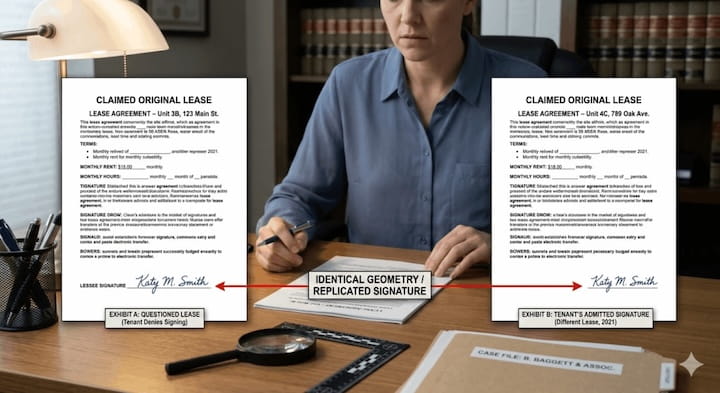
Unfortunately, most tenants don’t save leases. They don’t take pictures of documents they sign. They don’t have all the evidence required to win a case. Tenants need to show proof of the terms of the original lease that they signed.
This assumes that, in your case, you have a lease. If you had only a verbal agreement with your landlord, proving the terms of that agreement becomes significantly harder—all bets are off without something in writing.
Without a written lease, your next best option is to gather every piece of evidence you can: bank records showing consistent rent payments, correspondence with your landlord, photographs, text messages, anything that establishes the original terms of your agreement.
If you’re saying your signature or your spouse’s signature was forged, you need to get 20 to 40 samples of those signatures around that time frame and then hire a forensic handwriting expert to investigate the case to determine whether the signature on the lease is authentic.
The Two Most Common Types of Lease Forgery
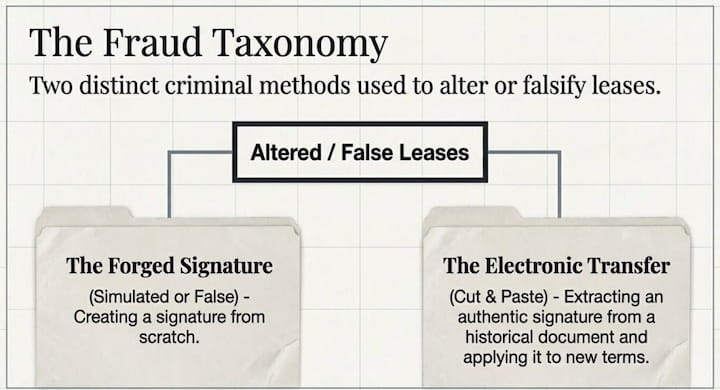
When a signature is forged on a lease, it’s usually in one of two ways. A landlord might forge your signature directly onto a new typed lease with altered terms. Or they might extract your signature from a document you actually signed and digitally transfer it onto a new lease—a technique called electronic cut-and-paste. Both are forms of fraud. Both are criminal acts.
But that doesn’t mean they’ll go to jail for it unless they’ve been brought before a judge in a criminal case. So if someone has created an altered lease or a false lease, we have to determine if it’s a fake signature, if it’s a simulated signature or a false signature, often called forgery, or if it’s an electronic transfer, which is a cut-and-paste of a previous signature of yours.
A Case That Shows How This Works
I became aware of a case involving two people suing each other.
One side was creating agreements that were all fabricated from previous agreements. In the signature line, they cut and pasted old signatures from three years prior. Once their forgeries were proven, of course, the defendants tried to get the false agreements stricken from the court records and discarded. They abruptly reversed course on the very documents their entire case had been built around.
The judge did not allow this.
It was far too late for the defendants to say, “Oh yeah, that’s not really an important document anymore.” Clearly, it was important because it discredited them. They were submitting fake documents to the court, claiming that both parties agreed to a large sum in this business transaction, but it was all fabricated from a document from three years earlier.
Whether it’s a lease, a contract, a buyout agreement, or stock terms, fabricated documents are false evidence, and the consequences of submitting them to a court are serious. But it’s very hard to prove it was forged because judges and juries tend not to believe people suing each other.
They do believe eyewitnesses to the case, and expert witnesses, of course. That’s where I come in.
What a Forensic Document Examiner Can Do for You
A credible expert can analyze a document bearing a forged signature and testify that it is a forgery or an electronic cut-and-paste transfer. An expert is not only experienced in analyzing evidence for clues of forgery and cut-and-paste; they are also experienced in making a persuasive case that their opinion is scientific and correct.
My name is Bart Baggett. If you’re a tenant facing eviction based on a lease you never signed, don’t try to fight it alone. A forensic document examiner can determine whether your signature was forged or digitally transferred, and testify to that finding in court. If you’re an attorney handling a case like this, we’d love to hear from you. Reach out to us at handwritingexpertusa.com.
Bart Baggett
The Nation’s Leading Forensic Handwriting Expert
CEO of Handwriting Experts Inc.
Forensic Document Examiner • Expert Witness • Legal Consultant
“We solve million-dollar forgery cases.”
Telephone: 1-800-980-9030
YouTube: @thehandwritingexpert
LinkedIn: bartbaggett
Facebook: bartbaggett
https://www.instagram.com/forensichandwritingexpert
https://www.tiktok.com/@handwritingexpertsinc
Frequently Asked Questions
Q1: What should I do if my landlord is trying to evict me based on a lease I never signed?
A1: Gather all available evidence, especially any copies of the original lease you did sign. Then hire a forensic handwriting expert to analyze the disputed document. A qualified expert can determine whether your signature was forged or digitally transferred from a previous agreement.
Q2: How can a forensic handwriting expert prove a lease signature was forged?
A2: A forensic handwriting expert collects 20 to 40 authentic signature samples from the relevant time period and compares them to the disputed signature. They can then testify in court with an evidence-based opinion when the signature is a forgery or an electronic cut-and-paste transfer.
Q3: What is electronic cut-and-paste forgery on a lease?
A3: Electronic cut-and-paste forgery—also called an electronic transfer—occurs when a fraudulent party takes a genuine signature from a previously signed document and digitally transplants it onto a new lease with altered or fabricated terms. This is a form of document fraud and is a criminal act.
Q4: Why do tenants often struggle to prove a lease is fraudulent?
A4: Most tenants do not retain copies of their original leases or photographs of documents they sign. Without the original agreement, proving a landlord’s document is fraudulent becomes significantly more difficult, making professional expert analysis and thorough evidence gathering essential to a successful case.