How Long Does a Full Handwriting Examination Take?
I get this question constantly, from clients who just got sued, from families dealing with a contested will, and from attorneys who need an expert “like, yesterday.”
The answer is: It takes as long as it takes to get the evidence and to form the opinion.
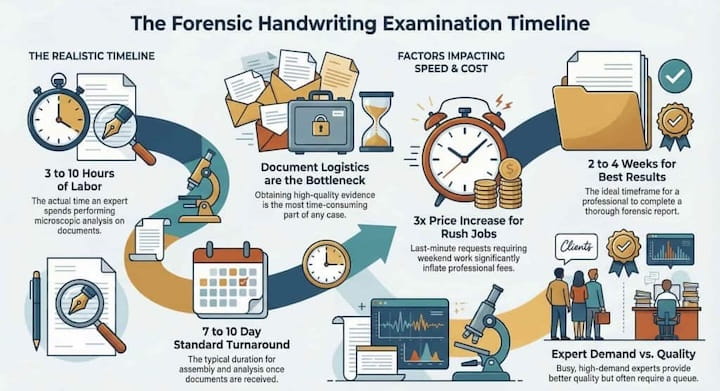
The actual analytical work—examining the writing, studying the documents, and running the comparison—can take anywhere from three to ten hours under the microscope. But that’s only one piece of the total timeline.
We have to obtain the documents from the client, verify their significance and quality, scan, assemble, and label them, and create magnified, side-by-side exhibits that I can study and show as exemplars of my analysis.
How Long Will My Full Handwriting Report Take?
Start to finish, most of our cases take about seven to ten days from the moment we receive the documents. It takes a lot of time to assemble them into the format that we need for me to spend my hours of analysis. For most clients, a two- to three-week turnaround works well; it gives us time to do the job properly without unnecessary delays.
What Is the Part of a Handwriting Report That Generally Takes the Longest?
We’ve had cases that have been on the books for three or four months because the documents aren’t available. We have to stay in contact to receive updates on the client’s progress, track down handwriting samples, or follow the client’s legal efforts to subpoena documents. Sometimes we have to go out of town or to a courthouse to look at the document under a microscope. Getting the documents is the most time-consuming part.
What If I Need a Full Handwriting Report Done in Less Than a Week?
When you call one of our experts on our website, you will ask, “Hey, what’s your caseload? Can you get to me in the next four weeks?” Because if you can give them four or six weeks, you may get a price break. But if you call our office and say, “Hey, Bart, you need to drop everything, work on the weekend, and get me a report on Monday,” we can do it, but that’s going to cost three times the usual price.
What Affects the Timeline Most?
The answer depends on three things: how urgent your need is, how quickly you can get us the documents, and how busy the examiner you hire happens to be.
If the expert you want is busy, that’s actually a good sign. It means they’re in demand and doing quality work. You may have to wait in the queue, and you may pay a premium, but in a high-stakes legal case, that tradeoff is almost always worth it.
If you need any more advice, visit handwritingexpertusa.com or our social media. The bottom line: give us as much time as you can, get us the best evidence you can, and we’ll deliver the strongest possible opinion. If your timeline is tight, call us anyway. We’ll tell you honestly what’s possible. Reach out at handwritingexpertusa.com.
Bart Baggett
The Nation’s Leading Forensic Handwriting Expert
CEO of Handwriting Experts Inc.
Forensic Document Examiner • Expert Witness • Legal Consultant
“We solve million-dollar forgery cases.”
Telephone: 1-800-980-9030
YouTube: @thehandwritingexpert
LinkedIn: bartbaggett
Facebook: bartbaggett
https://www.instagram.com/forensichandwritingexpert
https://www.tiktok.com/@handwritingexpertsinc
Frequently Asked Questions
Q1: How long does a full handwriting examination typically take?
A: Most cases take seven to ten days once documents are received, with a total turnaround of two to four weeks for a complete forensic handwriting analysis.
Q2: What is the most time-consuming part of a handwriting examination?
A: Obtaining the documents is the most time-consuming step. Cases can remain open for three to four months while waiting for handwriting samples or subpoenaed records to become available.
Q3: Can I get a forensic handwriting report completed in less than a week?
A: Yes, rush reports are possible, but they typically cost three times the standard rate due to the expedited turnaround required.
Q4: Does hiring a busy forensic handwriting expert mean a longer wait?
A: Yes, a highly in-demand expert may require you to wait in a queue, but high demand generally reflects greater professional experience and higher quality work.