How Many Known Signatures Do You Actually Need to Compare?
It’s one of the most common questions we get, and the answer matters a great deal if you want your case to hold up in court.
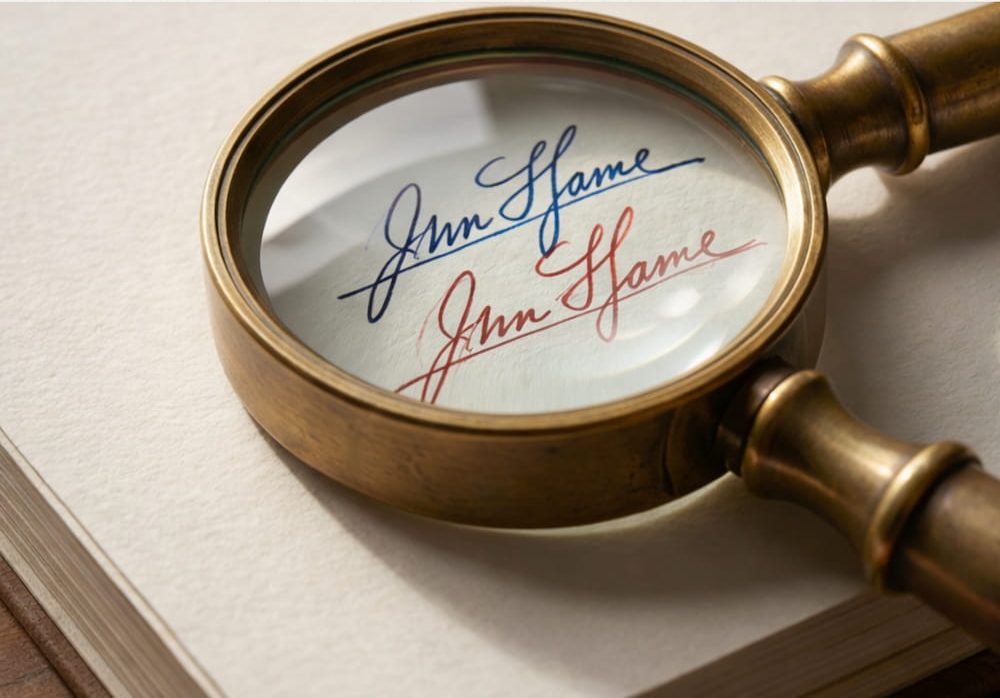
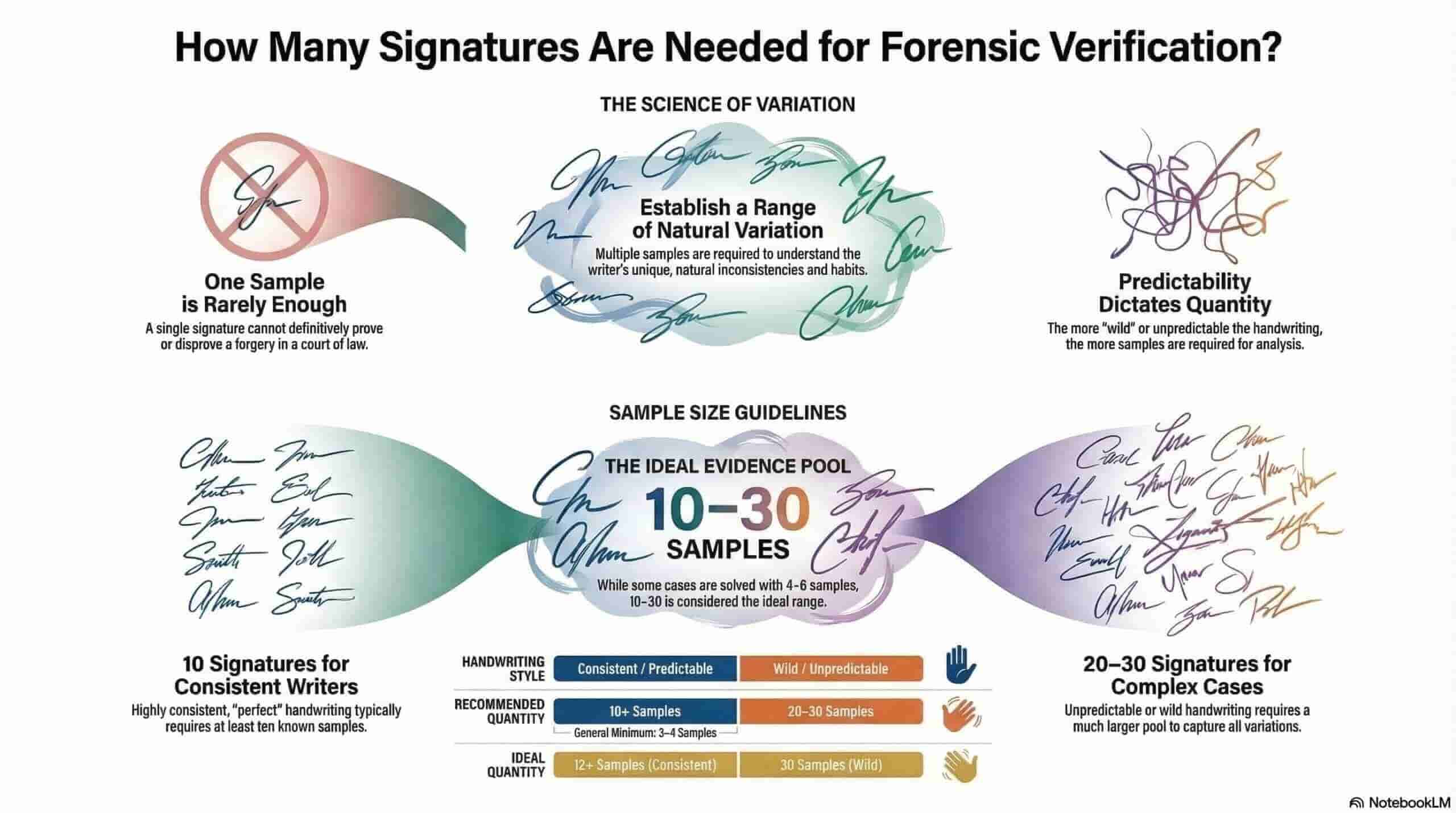
People call me, or one of my associates, and say, “Hey, I’ve got this document, and I’ve got one signature from my dad. Can you tell me if it’s a forgery and prove it in court?” Maybe. But one signature is not really enough to prove a forgery or prove authenticity. There are some exceptions, but generally, here is the guiding rule: You need enough to get what we call a “range of natural variation.”
Why One Signature Is Rarely Enough
Some clients come to us asking, “Isn’t it obvious? The G looks different, the Y looks different. Can’t you just say it’s a forgery?” With only one comparison sample, the honest answer is: not definitively.
If someone writes like a Catholic school teacher and they write really perfectly, 10 signatures is probably fine. But if a person’s handwriting is a little wild and unpredictable, and they use different signature styles in different circumstances, you need 10, 20, or 30. I’ve had cases with 400 samples. That’s more than necessary, but when you walk into court with thorough, well-organized exhibits, the judge has no doubt that the analysis was rigorous.
Think of it like points on a graph. It takes at least two points to establish a distance. In handwriting terms, that distance is the range of natural variation. Two signatures give you a starting point, but 10, 20, or 30 give you a map. For most cases, somewhere between 10 and 30 is ideal, though some cases can be resolved with as few as three or four.
Gather As Many Samples As Possible
One thing worth knowing before you call a forensic document examiner: gathering the samples is up to you. A forensic document examiner is not going to go dig through files for you. They’re not going to go rifle through boxes in your attic. They’re not going to go into the courthouse and look for transactions and records. You have to do that.
It’s worth the investment of your time, though, because the more signatures you have, the better.
If you’re gathering evidence for a potential forgery case, start collecting handwriting samples now—from documents, records, courthouse filings, wherever you can find them. The more you bring us, the stronger our opinion will be. Reach out to us at handwritingexpertusa.com, and we’ll help you figure out whether you have enough to build a case.
Bart Baggett
The Nation’s Leading Forensic Handwriting Expert
CEO of Handwriting Experts Inc.
Forensic Document Examiner • Expert Witness • Legal Consultant
“We solve million-dollar forgery cases.”
Telephone: 1-800-980-9030
YouTube: @thehandwritingexpert
LinkedIn: bartbaggett
Facebook: bartbaggett
https://www.instagram.com/forensichandwritingexpert
https://www.tiktok.com/@handwritingexpertsinc
—————————————————————-
FAQ
—————————————————————-
Q1: How many signature samples are needed for a forgery case?
A1: For most cases, between 10 and 30 known signatures is ideal. Some cases can be resolved with as few as three or four, while others may require more depending on how consistent or variable the person’s handwriting naturally was.
Q2: Why isn’t one signature enough to prove forgery?
A2: A single signature cannot establish a range of natural variation — the spectrum of how a person naturally writes. Without multiple known samples, a forensic document examiner cannot definitively conclude whether a questioned signature is genuine or forged.
Q3: What is the range of natural variation in handwriting analysis?
A3: The range of natural variation refers to the natural differences that occur in a person’s signature from one signing to the next. Establishing this range requires multiple known samples, much like needing at least two points to define a distance on a graph.
Q4: Who is responsible for gathering signature samples before contacting a forensic document examiner?
A4: That responsibility falls on the client. A forensic document examiner will not search files, storage boxes, or courthouse records on your behalf. You must collect as many known samples as possible from documents, records, and public filings before reaching out.