What Does a Handwriting Expert Actually Do?
Bart Baggett illustrates the two distinct disciplines within handwriting analysis: on the left, a mind map showing how personality traits and thoughts are revealed through writing, and on the right, a forensic close-up of script under a magnifying glass with technical annotations marking ink pressure, fiber interaction, micro-fissures, and stroke directionality. As a forensic document examiner, Bart bridges both worlds — the psychological and the scientific — to deliver expert testimony and authentication analysis.
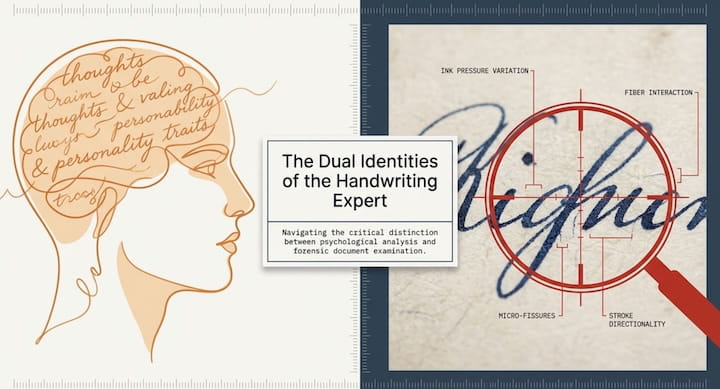
The term “handwriting expert” actually means two very different things—and knowing which one you need could save you a great deal of time and money. On the forensic side, a handwriting expert is someone trained to detect forgeries, analyze questioned documents, and testify in court. The correct professional term is “forensic document examiner,” because the work covers far more than just handwriting.
And then the other side of a handwriting expert is someone who can understand handwriting for psychological, human resources, or maybe therapy purposes, or even personal development. There are a lot of great books and very interesting methodologies on how handwriting, physiology, and even Parkinson’s and other diseases relate to it. That is also loosely known as a handwriting expert.
So you need to decide, are you looking for personality or marriage compatibility? That would probably be more of a graphologist, graphotherapist, or graph analyst. And the technical term for a handwriting expert in forgery is “document examiner” or “forensic document examiner.”
What a Forensic Document Examiner Actually Does
Most of our business comes from attorneys who are trying to solve million-dollar problems. They need a forensic expert witness, a forensic handwriting expert, or a forensic document examiner to review the documents and determine the truth. Did the deceased really leave everything to someone the family barely knows? Or was that will manufactured after the fact? Those are the questions a forensic document examiner is called in to answer.
Think of a forensic document examiner as a detective whose evidence happens to be paper and ink. We’re looking for the truth, the source, the one who made it, why they made it, how they made it, whose handwriting is on it, when it was made, and what paper it was on. All that stuff can help the narrative because the judge in the case is trying to make a decision. Who do I believe?
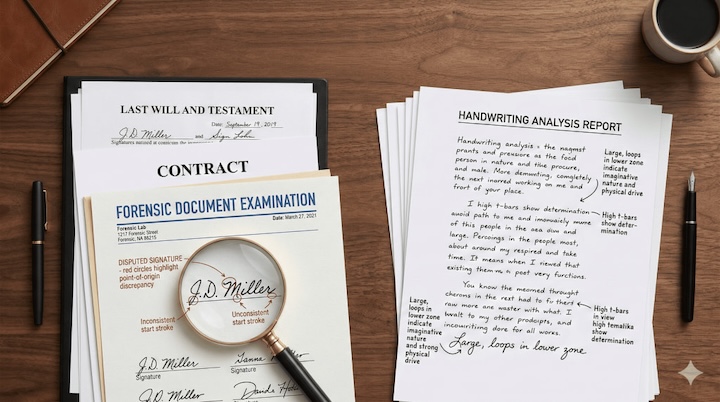
Let’s say this is a brother or sister fighting over a million-dollar estate. The brother says, “Hey, I haven’t seen our dad in 20 years, but I know he wouldn’t give everything to my sister.” “Look,” she says, “I took care of him for the last 20 years, and he left everything to me. I just found the will. It was in the back of my car all along.” Did that exist, or did he die intestate? “Intestate” means without a written will. Determining whether that will is real, altered, or manufactured from scratch, that’s exactly what a forensic document examiner is called in to decide.
Knowing Which Type of Expert You Need
To summarize: a forensic document examiner handles legal cases involving questioned documents, while a handwriting analyst focuses on psychological assessment and personal development—two separate fields, each with its own training and purpose.
My name is Bart Baggett. If you’re not sure which type of expert you need—forensic or psychological—give us a call and we’ll help you figure it out. And if you do need a forensic document examiner, we have qualified experts across the US ready to help. Reach out at handwritingexpertusa.com.
Bart Baggett
The Nation’s Leading Forensic Handwriting Expert
CEO of Handwriting Experts Inc.
Forensic Document Examiner • Expert Witness • Legal Consultant
“We solve million-dollar forgery cases.”
Telephone: 1-800-980-9030
YouTube: @thehandwritingexpert
LinkedIn: bartbaggett
Facebook: bartbaggett
https://www.instagram.com/forensichandwritingexpert
https://www.tiktok.com/@handwritingexpertsinc
Frequently Asked Questions
Q1: What is the difference between a forensic document examiner and a graphologist?
A1: A forensic document examiner analyzes handwriting and documents to detect forgeries and serves as an expert witness in legal cases. A graphologist uses handwriting analysis for psychological assessment, HR screening, or personal development purposes.
Q2: What types of cases does a forensic handwriting expert typically work on?
A2: Forensic handwriting experts most commonly work with attorneys on high-value cases involving disputed wills, forged signatures, and other document fraud matters where a judge must determine the authenticity of written evidence.
Q3: What does a forensic document examiner investigate when reviewing a document?
A3: They investigate who created the document, when it was made, what paper was used, the source of the handwriting, and whether the document is authentic—providing the court with the evidence needed to resolve disputes.
Q4: Is a forensic handwriting expert the same as a forensic document examiner?
A4: Yes. The terms are interchangeable. Both refer to a professional who examines documents and handwriting as evidence in legal proceedings to help determine truth and authenticity.