When a signature is faked, there are two main methods a forger uses, and understanding the difference between them matters both in how the fraud is committed and how it gets caught. If you’re researching forgery, signatures, and document examination, you’ll see the words traced and simulated.
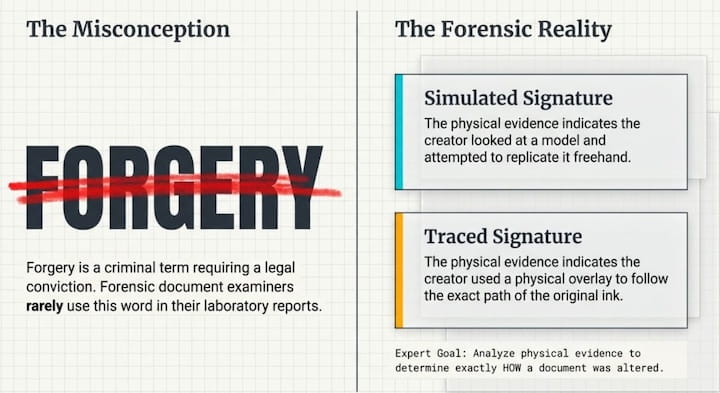
First, let’s look at a fake signature that is simulated, which means someone is looking at a model and tracing it. Imagine a con artist sneaking into the Louvre at night to look at the Mona Lisa very closely and to sketch and paint his own forgery. He is simulating the Mona Lisa: freehand drawing a copy by studying the different lines and brushstrokes, and trying to make the picture look as much like the original as possible. A simulated signature is created the same way; a forger looks at a signature and tries to emulate it as closely as possible.
Faking a signature by tracing would be like a con artist stealing the Mona Lisa, sticking a piece of paper over it, and then tracing it. With traced signatures, forgers take a signature, place a sheet of paper over it, and often use a backlight on the sheet with the original signature to see the outline clearly. Then they slowly trace the signature on the top paper.
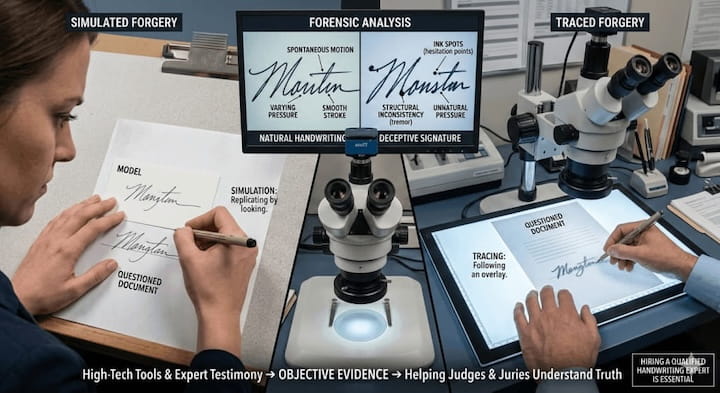
Luckily, forensic document examiners are smart enough that they can distinguish between traced, simulated, and natural fluid handwriting, especially if they have access to a microscope and the original signature. That’s why you pay $600 an hour for a forensic document examiner—so they can conduct the investigation and tell you definitively whether a signature is traced, simulated, or naturally written.
These two methods—simulation and tracing—account for the vast majority of forged signatures we encounter in casework.
What Will Experts Write in Reports to Prove a Signature is Fake?
One thing clients often ask is: what will the expert actually say in their report? Here’s how forensic document examiners typically frame their findings. An expert report might read something like: “It is my professional opinion that this signature was not written by the named individual. The evidence indicates it was simulated by a third party.”
They don’t usually use the word “forgery” because that’s a criminal term; when someone is convicted of forgery, that is a crime.
They’ll use the word “simulated” and write something like, “I believe this signature was simulated by a third person and not written by the actual person.” Or, “I believe it was traced, and here is the evidence of tracing.”
What Experts Look for in Their Analysis
I’ll be honest, I’m not going to walk you through every indicator to look for, because trying to be your own handwriting expert is like going to WebMD instead of seeing a doctor.
But it’s very hard to trace a signature without leaving evidence, without hesitating and stopping and leaving ink spots. And it’s very hard to simulate a signature without making errors in the letter forms, the structure, and the speed.
So, that’s why you hire a forensic document examiner. A handwriting expert can determine that.
Their job, if the case goes to court, is to present their findings to the judge and jury—using side-by-side photographs and microscopic images—and to clearly explain what a simulated, traced, and natural signature looks like.
They are experienced and practiced at making the judge and the jury feel confident that an independent expert reached the opinion, and at making their work and opinion clear so everyone knows who is lying.
Now that you understand the difference between these two types of forgery, you’ll know exactly what to tell a forensic document examiner when you call, and what to expect from their analysis.
My name is Bart Baggett. If you have a signature you believe was simulated or traced, that’s exactly the kind of case we handle. Reach out to us at handwritingexpertusa.com, we have experts across the country ready to analyze your document and tell you the truth about what the evidence shows.
Bart Baggett
The Nation’s Leading Forensic Handwriting Expert
CEO of Handwriting Experts Inc.
Forensic Document Examiner • Expert Witness • Legal Consultant
“We solve million-dollar forgery cases.”
Telephone: 1-800-980-9030
YouTube: @thehandwritingexpert
LinkedIn: bartbaggett
Facebook: bartbaggett
https://www.instagram.com/forensichandwritingexpert
https://www.tiktok.com/@handwritingexpertsinc
Frequently Asked Questions
Q1: What is the difference between a simulated and a traced signature?
A1: A simulated signature is created freehand. The forger studies a genuine signature and attempts to replicate it by hand. A traced signature is produced by placing paper over the original and physically tracing its outline, often using a backlight to reveal the lines more clearly.
Q2: What evidence do forensic document examiners look for to detect forged signatures?
A2: Traced signatures often leave evidence such as hesitation marks and ink spots caused by stopping and starting. Simulated signatures typically exhibit errors in letterforms, structure, and writing speed. Examiners use microscopes and compare the questioned document against known originals to identify these indicators.
Q3: Do forensic experts use the word “forgery” in their official reports?
A3: No. Forensic document examiners avoid the word “forgery” in reports because it is a criminal and legal term reserved for court convictions. Instead, they use professional terminology such as “simulated” or “traced” to describe how a false signature was created.
Q4: How much does a forensic document examiner charge to analyze a signature?
A4: Forensic document examiners typically charge around $600 per hour to investigate and analyze signatures—determining whether a signature is natural and fluid, simulated by a third party, or traced from the original.