Can a Forensic Handwriting Expert Testify in a Criminal Trial?
Yes. A qualified forensic handwriting expert can testify in criminal court as an expert witness, offering an opinion on whether a document or signature is authentic.
Absolutely. In fact, I have done that. There was a double murder homicide in Los Angeles, and the DA called me and said, “Listen, we’ve got a trial coming up, and our handwriting expert has passed away. So, you’re up, sir.”
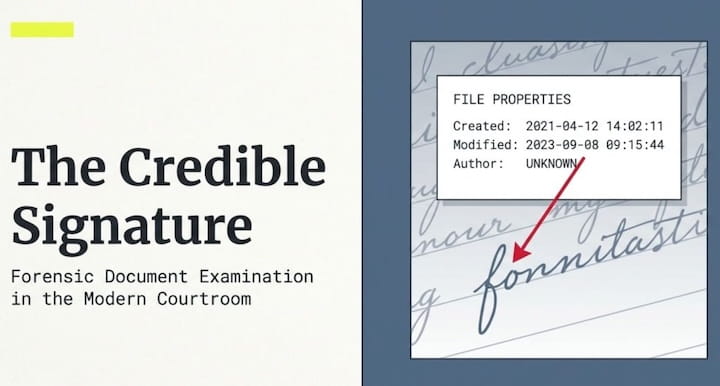
This graphic introduces The Credible Signature, a resource on forensic document examination in the modern courtroom, as explored by forensic document examiner Bart Baggett. The image highlights how digital file properties — such as creation date, modification history, and unknown authorship — can raise red flags when authenticating a signature in a criminal trial. Learn more at bartbaggett.com/blog.
A Criminal Case That Stands Out
I actually went down to the jailhouse, took exemplars from it, and I consider him a cordial young fellow with tattoos. He was clearly in a gang, and he had the most beautiful penmanship because, apparently, gang writing is very unique. It’s almost an art form. And so, his handwriting was not only found in some notes—what they call a “CITE”—in a cell back and forth, which implicated him, but the task was fascinating because someone had tagged or written on a tarp over the two dead bodies. And it was kind of an analysis of, like, can you see who painted the tarp?
This may have been 20 years ago in Los Angeles, and it was a fascinating case. And I ended up testifying about the letters from prison, which was actually pretty easy because he had such unique handwriting, and that helped the DA end up tying him to the murder scene for a number of reasons that didn’t testify to the tarp. But I think, I think there was evidence to tie him to the tarp.
But of course, spray painting and handwriting are very difficult things to do. So, of course, you can testify in a criminal trial. In fact, you guys have all seen it. When you got the OJ Simpson trial, you saw all kinds of expert witnesses, including blood expert witnesses or the guy who put on the glove, I think that was Johnny Cochran, but all those expert witnesses have expertise in blood spatter and crime scene analysis, handwriting, and forensics, which is one of those forensic sciences.
What It Takes to Testify in a Criminal Trial
So, absolutely, you could testify in a criminal trial. Now, obviously, any expert will do their best to get you excluded. That’s why you have to hire an expert with 50, 60, or 100 cases under their belt; there is going to be a lot of precedent that other judges in the same court system have found you credible.
And that’s the key. If other judges found you credible, the judge you’re sitting in front of is probably not going to buck the system unless you’ve got some felonies or you’re caught lying on the oath or hiding evidence or something really nefarious, of course, which I’ve never done. So, I’m about 100 percent when I get on the stand to take a testimony.
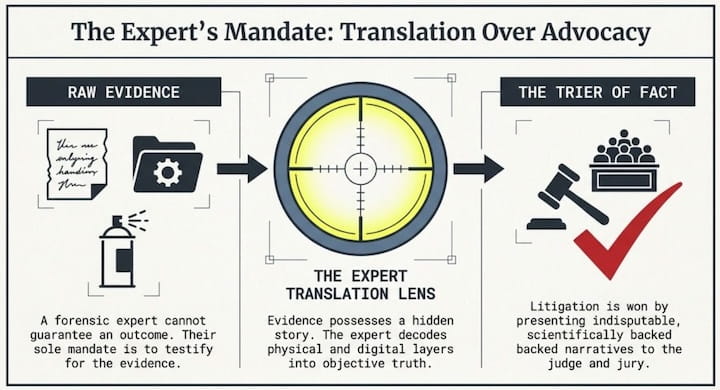
This diagram illustrates forensic document examiner Bart Baggett’s principle that an expert’s sole mandate is to translate evidence — not advocate for an outcome. Moving from raw evidence through an expert translation lens, the process delivers scientifically backed, objective findings to the judge and jury as the trier of fact. Learn more at bartbaggett.com/blog.
The judge has always found me credible. And that’s really good. Most experts can’t say that. And I think the reason people hire people that I work with at Handwriting Experts Incorporated is that we have a great track record of not only testifying but also winning, as we want to help people win their case.
We can never guarantee an outcome. And it’s great when they win. The best I can do is testify to the evidence in a way that lets the judge and the jury know it tells this story. And that story hopefully is the truth.
And that story will help the juror or the trier of fact, which is the judge, actually come to a valid conclusion on which to base the truth and a criminal trial. Generally, did somebody commit a crime? And is that the evidence that meets the bar of putting that person in prison or, God forbid, the death penalty, right?
So they’re trying to find out what really happened. And so, even though most of my cases are criminal trials, it is definitely important to know that the same criteria and due diligence apply to an investigation. And if the evidence doesn’t support the narrative, then I don’t report.
When the Evidence Tells a Different Story
I would say in about half of our cases, we call the line and say, “This evidence that you presented is telling a different story.” So, I’m probably not going to be a great witness for you, because I think this other person wrote it, not the person you want to have write it.
And attorneys are great.
It’s the individual clients who are difficult because they’ve got a story. You know, they’re the ones going to jail. They’re the ones losing their pickup truck at their house. They’ve got this big narrative about their sister. However, the attorneys are more level-headed; they just want the truth, then they can fight, and they can find other ways because, you know, one document is not always the pivotal evidence in a case. Now, in a last will, a testament, it is usually a key piece of evidence. I was in a trial in Chatsworth last week where the key pieces of evidence were contracts stating that one person owed another a million dollars.
Well, those contracts were 100 percent fabricated.
I mean, cut and pasted. They had emails and text messages, like the guy telling another guy, “Change this in the contract.” You know, he pasted the date from 2021, but all the emails and the text messages even had a text message at the dude’s foot writing on it. And that text message was shown in court.
I read all that stuff for the judge. And it was just obvious that the guy in 2023 manufactured these agreements, put them in the court file, and then had the nerve to get on the stand and lie about it, as well as have one, two, or three of his relatives get on the stand and make up other lies about it. I saw him sign it. I witnessed it.
Oh, yeah. That contract. Yeah, yeah. And we planted the evidence, and it was like, “Are you insane?”
So luckily, in that case, the judge was a great judge of character. He actually said at his ruling that only did the client that I was working with, the attorney named Mitch, only did his side win the case, which means that he’ll end up winning the damages and the legal fees and stuff. But he said, “You know, I found Mr. Baggett’s testimony very compelling, like it was good. And it wasn’t his testimony.”
The other examiner, the other attorney, was very, very talented and condescending and did everything in his bag of tricks to make me look like I didn’t know what I was talking about.
But, man, I’ve been using Microsoft Word and Photoshop for 25 years. And we were able to view the document’s properties. We were to see when it was published, when it was created, and who created it. Like, all of that stuff goes into establishing a document.
And it’s not just handwriting. In fact, the handwriting was a piece of it because it was manufactured, though there would never be a wet signature. That was a fun case. So yes, you can testify in criminal trials.
Yes, you can testify in civil trials, but you still have to get past voir dire. So, if you are looking for a forensic expert, make sure they’ve been to court and court-qualified. That is the key factor there. If you need help with anything, give our office a call at handwritingexperts.com. One of our experts can definitely help you, and we’d be glad to help see if we can help win your case. They can’t win your case when you just tell the truth.
Bart Baggett
The Nation’s Leading Forensic Handwriting Expert
CEO of Handwriting Experts Inc.
Forensic Document Examiner • Expert Witness • Legal Consultant
“We solve million dollar forgery cases.”
Q1: Can a forensic handwriting expert testify in a criminal trial?
A1: Yes. Forensic handwriting experts are regularly called as expert witnesses in criminal trials to analyze handwritten evidence — such as notes, letters, and documents — that may connect a suspect to a crime scene. Court-qualified examiners like Bart Baggett have testified in both criminal and civil proceedings across the United States.
—
Q2: What qualifications does a handwriting expert witness need to testify in court?
A2: A handwriting expert must be court-qualified, meaning a judge has found them credible. Experts with 50 or more cases on record have established precedent within the court system, which makes it significantly easier for a new judge to accept their qualifications without challenge.
—
Q3: What happens if the handwriting evidence does not support the client’s version of events?
A3: An ethical forensic document examiner reports the evidence honestly, regardless of which side retained them. In roughly half of cases, the evidence tells a different story than what the client expects. In those situations, the examiner will advise accordingly rather than serve as a favorable witness.
—
Q4: Can a handwriting expert testify in civil trials as well as criminal trials?
A4: Yes. Forensic handwriting experts can testify in both criminal and civil trials. In either setting, the expert must pass voir dire — the court’s process for qualifying expert witnesses — before being permitted to offer testimony.