Is Handwriting Analysis a Real Science or Just an Opinion?
Handwriting analysis—and forensic document examination more broadly—is often dismissed as subjective guesswork. But is that fair? The answer lies in understanding what expert opinion actually means in a court of law, and how rigorous methodology separates science from mere speculation.
An opinion from an expert witness is very valuable in a court of law. So, every expert witness, whether a psychologist, a psychiatrist, a shoe-boot expert, or a fingerprint expert, is giving their expert opinion on the evidence. Expert witnesses convey to the jury an opinion that is based on a forensic test.
For example, I performed a forensic test on a photograph. I said, “Hey, this photograph has been doctored.” That was my professional opinion. The science behind it is the methodology I used to determine whether that photograph had been altered. Forensic document examination is itself a subset of forensic science.
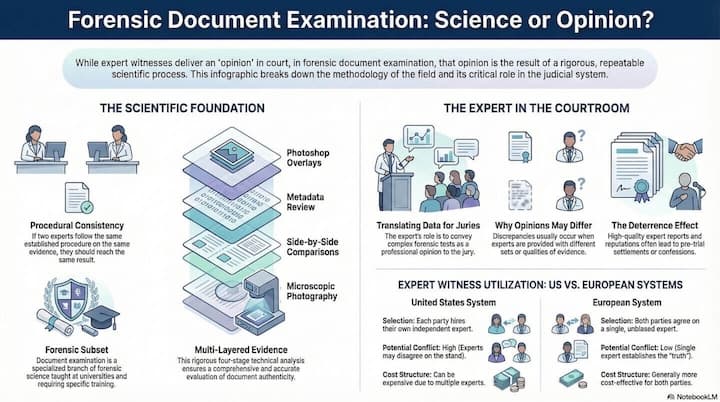
Forensic document examiner Bart Baggett breaks down the scientific foundation behind forensic document examination and its role in the courtroom. This infographic covers the four-stage multi-layered analysis process — from microscopic photography to metadata review — and compares how expert witnesses are utilized across the US and European legal systems. Learn more at bartbaggett.com/blog.
Expert Opinion Is Grounded in Science
Every expert witness, whether a psychologist, a fingerprint specialist, or a forensic document examiner, is offering an opinion, but it’s an opinion grounded in a forensic process. For example, when I examine a photograph and conclude it has been doctored, that conclusion isn’t a guess. It’s the result of a specific methodology: side-by-side comparisons, metadata analysis, and tools like Photoshop forensics. The opinion is the conclusion; the science is everything that led to it.
Forensic document examination is taught at universities as a forensic science course, and practitioners must be specially trained and qualified before they can testify as expert witnesses. It’s a field with real standards, real procedures, and reproducible results, which is the hallmark of any legitimate science.
I’ve had attorneys try to reduce hours of detailed testimony to “you just looked at it and gave your opinion.” With respect, that misses the point. Yes, it is my opinion, but it’s an opinion backed by 30 years of experience and a mountain of supporting evidence: text messages, PDF metadata, and clear signs of cut-and-paste alteration. The opinion is the tip of the iceberg. The science is everything beneath the surface.
One of my first mentors was Dan Poynter, who wrote a book on expert witnesses based on his experience parachuting. There’s no school to be a parachute expert, but he had 500 jumps. Now, was his opinion always right? He was a pretty bright guy. But in the court of law, the judge had to say, “Hey, here’s this guy with this many jumps and this much experience. Do we trust that his opinion about whether this parachute was packed improperly really matters?” Man, I miss him. Good guy. Dan Poynter was an interesting expert witness on parachuting because that was his skill set.
Why Experts Sometimes Disagree
If forensic document examination is a science, why do experts sometimes reach different conclusions? The answer is usually one of two things: either someone didn’t follow the proper procedure, or both experts weren’t working from the same evidence. If two investigators only get to examine different parts of a crime scene, it shouldn’t be surprising if they come to different conclusions.
This raises an interesting structural difference between how American and European courts handle expert testimony. In America, because of the way the courts are structured, each side can have its own independent expert: independent blood expert, shoe expert, fingerprint expert, and handwriting expert. In Europe, they tend to basically agree on an expert that’s established, and then both parties just say, “Hey, let’s send it to the forensic handwriting expert, whatever he says, that’s what we’re going to go with.”
Let’s hope that if you are in Europe, you get someone who’s really good at their job, because both parties are relying on that single, unbiased expert to come back with the truth. I’ve seen cases where a single flawed opinion would have been a serious miscarriage of justice, and having an opposing expert in the room was the only thing that caught it.
What Happens When Experts Go Head to Head
There was a case in Florida. I really respect the guy, but he made an error. He wasn’t 100% sure; he said, “Hey, based on the evidence, it’s probably not the same writer.”
But when I had my report, I had color photographs, looked at the original, and put in all my arrows. I stated, “Here’s all this evidence of this woman’s handwriting; she signed this.” He ultimately withdrew his opinion, meaning the other side decided not to pursue that line of argument. Now, he never wrote a letter and said, “Hey, I’m wrong. Bart’s right.” No one would do that because there’s a lot of ego in this business. But he basically said, “Hey, I don’t think we can win this.”
And so really, most experts, if they’re ethical, will agree if they have all the same evidence. If they have it, which is why most of our cases don’t end up at trial, because they see my opinion, they see my letter, and they look at my reputation and are like, “Oh man. That guy does not make too many mistakes. I don’t want to go against him. Plus, he’s good with the jury because he’s on CNN, and people think he’s a celebrity. We don’t want that guy in court.”
I once showed up to court in Los Angeles, dressed sharp and ready to testify. The lawyer for the opposing side looked out in the hall, looked at me, went back in, came out, and said, “We don’t need you.” “What do you mean you don’t need me?” I asked. He said, “Yeah, they just admitted that it was a forgery because they didn’t want you on the stand. You can go now.” By the way, I keep the money because you get it whether you testify or not.
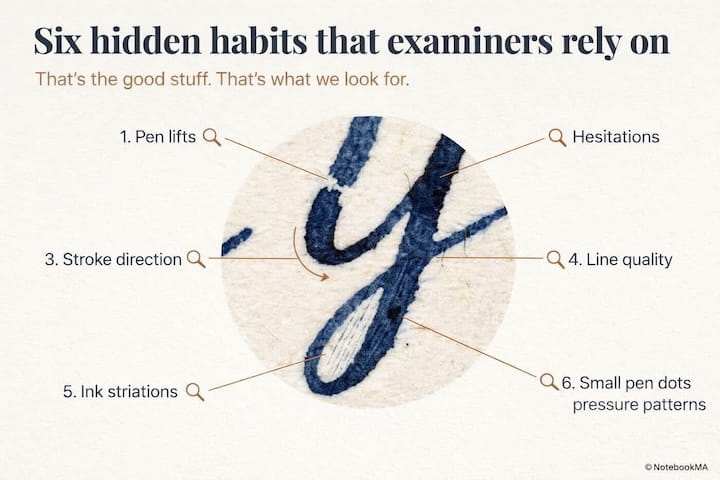
Forensic document examiner Bart Baggett reveals the six hidden handwriting habits that trained examiners look for when analyzing a document’s authenticity. This close-up diagram of a single letter points out subtle forensic markers — including pen lifts, hesitations, stroke direction, line quality, ink striations, and pressure patterns — that the untrained eye would never notice. Learn more at bartbaggett.com/blog.
That is the scoop on whether you get to testify. I do believe that it’s an interesting career. And yes, if you are a handwriting expert and you have an opinion, you can express that opinion in a court of law, and the judge understands that you’re a human being, that you have biases, and that you have skill sets.
My name is Bart Baggett. If you need any help in the handwriting field, visit handwritingexperts.com. We’ll refer you to someone in your area and within your budget. You don’t always need the big guns. You don’t need them unless you’ve got a $2 million case and you need the world’s best expert. And may find another expert in your budget. We have experts at all levels, from those who are newer to the field to seasoned professionals with 30 or more years of experience.
Bart Baggett
The Nation’s Leading Forensic Handwriting Expert
CEO of Handwriting Experts Inc.
Forensic Document Examiner • Expert Witness • Legal Consultant
“We solve million-dollar forgery cases.”
Q1: Is forensic handwriting analysis considered a real science?
A1: Yes. Forensic document examination is taught at universities as a forensic science course, and practitioners must be specially trained and qualified before they can testify as expert witnesses. The field operates on real standards, established procedures, and reproducible results — the hallmarks of legitimate science.
Q2: Why do handwriting experts sometimes reach different conclusions?
A2: Disagreements typically occur for one of two reasons: either an expert did not follow proper procedure, or both experts were not working from the same evidence. If two investigators examine different portions of the same evidence, differing conclusions are not surprising.
Q3: How does handwriting expert testimony differ between the United States and Europe?
A3: In the United States, each side in a legal dispute may retain its own independent forensic expert. In Europe, both parties generally agree on a single court-appointed expert, and both sides accept that expert’s findings as the definitive conclusion.
Q4: What is the difference between a forensic expert’s opinion and the underlying science?
A4: The opinion is the conclusion — the expert’s final determination. The science is the methodology that produced it, including side-by-side comparisons, metadata analysis, and forensic tools. The opinion is the tip of the iceberg; the science is everything beneath the surface.