What Are the Biggest Red Flags That a Signature Is Not Genuine?
What Are the Biggest Red Flags That a Signature Is Not Genuine?
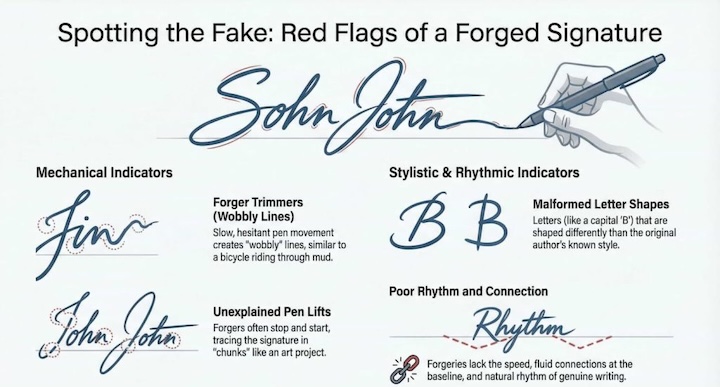
Handwriting experts are like detectives. They are trained to spot the subtle clues that distinguish a genuine signature from a forgery. Here are the five biggest red flags that tell us something may not be authentic.
The First Forgery Red Flag: “Forger Tremors”
A forger tremor is the mark of hesitancy; it’s the wobbly line that happens when the pen moves too slowly. Think of “tremors” as the handwriting version of tracks. In this case, think of the tire marks or indentations that a bike leaves on the ground when you ride it.
Imagine you are riding a bike quickly and confidently on a dirt road, leaving a smooth single track behind you. That’s what it’s like when you sign your signature. It’s smooth, it’s easy, it’s fast, it’s muscle memory. You’ve done it a million times and can do it without thinking.

Now imagine you’re on the bike and the dirt road ends. Suddenly, you hit mud. You have to slowly ride through it. The track goes from straight and consistent, then becomes a little wobbly, a little unsure, a little curvy and uneven as you trudge and push your bike through the mud’s resistance.
In forgery, the “mud,” the “resistance” is the uncertainty of having to carefully fake a signature that goes against your own signature, your own muscle memory.
And the wobbly line left in the signature’s “tracks” is called a tremor.
The Second Forgery Red Flag: Unexplained Pen Lifts
A handwriting expert can easily spot when a pen has lifted from the paper. You can see in the handwriting exactly where the pen lifts, where it stops, and where it starts again.
When you’re signing your own name, you can generally do it easily in one or two fluid motions. But if someone’s tracing a signature, they’ll do it one chunk at a time, like an art project. Or think of the bike tracks again, maybe when you hit the mud, you pick up your bike and reposition it to make your way through. You could see that stop and start in your tracks, right? So can handwriting experts.
The Third Forgery Red Flag: Malformed Letters
Malformed letters occur when elements of the letter forms don’t match. That would be something like a B in my name, Bart Baggett. A forger might shape the letter “B” differently than the way I do, changing the flourishes, size, or angles.
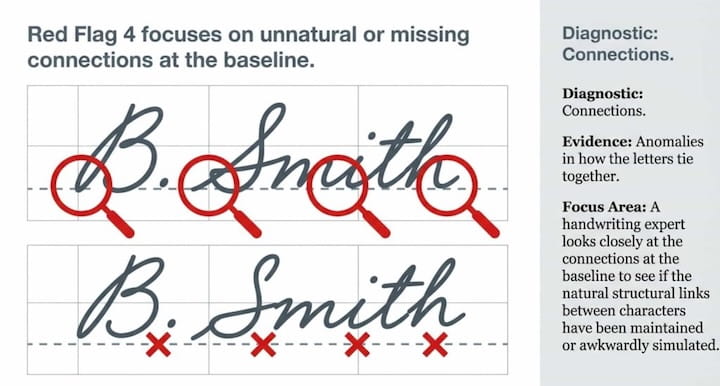
The Fourth Forgery Red Flag: Connection
Connections mark where the letters meet. It’s not something any of us really think about on a day-to-day basis while writing or signing, or have even paid attention to in our own penmanship.
Each person develops a unique way of connecting letters and positioning the pen. This is the product of years of muscle memory that is almost impossible for a forger to replicate, even if they manage to copy the signature’s visual appearance.
Even if a signature is perfectly copied, emulating the placement and movement that a person uses when connecting a pen to paper or a letter to a letter is almost impossible.
The Fifth Forgery Red Flag: Rhythm
Rhythm relates to speed and fluidity. Most signatures appear speedy, quick, and natural rather than looking like a painstaking recreation.
Think of the bike in the mud again, the way you can see the deep track, the heavy indentation—it looks difficult. It has none of the carefree “rhythm” of riding quickly, freely down the dirt road in a single track. It looks difficult.A forged signature has none of the carefree rhythm of a signature written from muscle memory. It looks labored, deliberate, and slow.
These red flags may be hard to spot as a novice…
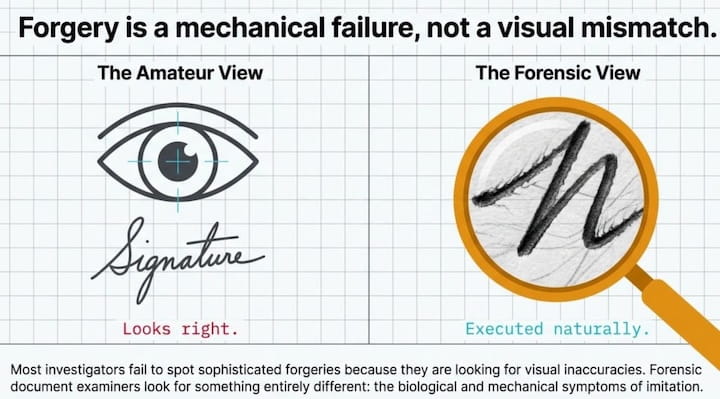
But any handwriting expert is quite familiar with how to detect these (sometimes microscopic) telltale signs of a forger.
None of these red flags requires a leap of faith. They are physical, measurable, and consistent. Just as you can read the story of a bike ride by looking at the tracks it leaves behind, a forensic document examiner reads the story of a signature in the marks the pen leaves on the page. If you have a signature you believe may be forged, reach out to us at handwritingexpertusa.com. We know exactly what to look for.
Bart Baggett
The Nation’s Leading Forensic Handwriting Expert
CEO of Handwriting Experts Inc.
Forensic Document Examiner • Expert Witness • Legal Consultant
“We solve million-dollar forgery cases.”
Telephone: 1-800-980-9030
YouTube: @thehandwritingexpert
LinkedIn: bartbaggett
Facebook: bartbaggett
https://www.instagram.com/forensichandwritingexpert
https://www.tiktok.com/@handwritingexpertsinc
Frequently Asked Questions
Q1: What is a “forger tremor” in forensic handwriting analysis?
A1: A forger tremor is a wobbly, uneven line that appears in a signature when
the pen moves too slowly. It is caused by the hesitancy and uncertainty of
copying someone else’s signature, rather than signing naturally from muscle
memory.
Q2: How do handwriting experts detect pen lifts in a forged signature?
A2: Experts can identify exactly where a pen stopped and restarted on the page.
A genuine signature is typically completed in one or two fluid motions, while a
forger tends to work in sections—creating visible stops and starts within
the pen strokes.
Q3: What role does rhythm play in identifying a forged signature?
A3: Rhythm refers to the speed and fluidity of a signature. Authentic signatures
appear fast and natural, while forged signatures tend to look labored and
uneven, comparable to riding a bike freely on a smooth road versus slowly
pushing through mud.
Q4: Why is it nearly impossible to perfectly copy someone’s signature?
A4: Every person develops a unique way of connecting letters and positioning the pen
to the paper through years of muscle memory. Even if a forger replicates the visual
appearance of a signature, duplicating the precise spacing, connections, and
natural movement is nearly impossible.