Can a Forensic Witness Be Wrong?
Any witness can be wrong, and expert witnesses are no exception. If an expert is working with incomplete or misleading evidence, even the most qualified professional can reach the wrong conclusion.
What sets a good forensic expert apart is integrity. Expert witnesses understand the boundaries of their role, both in their investigation and on the witness stand, and are trained to testify only to what the evidence supports. I can say with confidence that I have never intentionally misled a court, and any expert worth hiring will be able to say the same.
The Role of an Expert Witness
Expert witnesses generally take evidence and information, and then they testify about the tests they run in forensics.
If you hire a forensic handwriting expert or forensic handwriting expert witness, you’re hiring someone to do an investigation on a case: an investigation into the handwriting itself, the paper stock, staple holes, page consistency, and the estimated age of the document. When facts come to light indicating whether this entire document is fraudulent or completely legitimate, that expert testifies to that.
Yes, they can be wrong, but normally they’re wrong not because they’re bad people or have poor ethics. They’re wrong because they’re only seeing part of the evidence.
Think about a detective on one of the crime procedurals you’ve seen. We’ve all seen the episode where the hero cop becomes obsessed with their case against a suspect. They know in their heart they got the bad guy, and he needs to go to jail. And then years later, DNA evidence exonerates the suspect, and everything unravels. DNA evidence says that wasn’t the guy. That doesn’t make the cop a bad person or a corrupt officer. It makes him human.
If you get into a case, and an attorney, a lawyer, or even an expert witness thinks you forged a signature when you did not, it just means they have evidence they’re not seeing or choosing not to see. That’s why the American court system is the way it is. If an opposing expert has reached a conclusion that you believe is wrong, the American court system gives you the right to hire your own expert to examine the same evidence.
If the opposition is ethical and recognizes the part of the evidence they had missed, they will change their opinion to align with the defense.
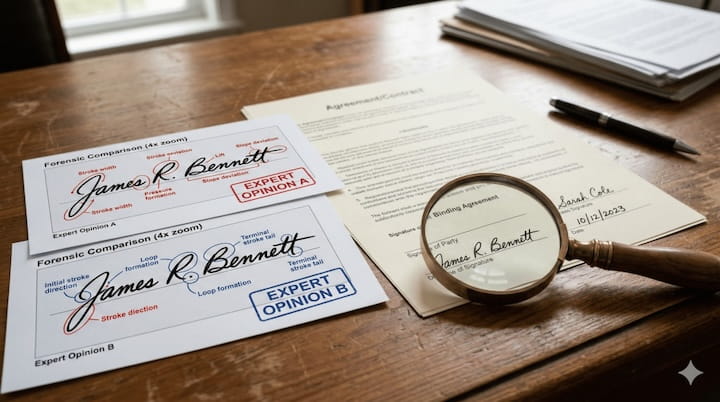
Why Opposing Experts Sometimes Disagree
If you’re in a legal case where there’s another opposing forensic document examiner who has a different opinion from the truth that you believe, you must hire an equivalent-level expert to read that report and find flaws in the report. They may come back and tell you the opposing report is sound. If that’s the case, it’s important to hear that, even if it’s not what you were hoping for.
Usually, clients are biased towards the narrative they want to believe. But experts have no dog in the fight. They are independent contractors who will do their best to reach as accurate a conclusion as possible. After all, they are staking their reputation every time they take on a case. Lying on purpose would destroy their livelihood. Being wrong or missing evidence, while human, is also detrimental to their reputation.
The Bottom Line
So if an expert is wrong, it’s probably an unintentional mistake, because we try really, really hard to always get it right.
Can a handwriting expert be wrong or an expert witness be wrong? Of course, because we’re only human. We’re subject to bias. Sometimes we are looking at false evidence. We’re subject to people lying to us. If you have a good forensic expert, they won’t be wrong because they’ll get the facts, and they’ll testify on the facts. My name is Bart Baggett. I can help you if you have any legal case troubles involving handwriting and/or documents. Reach out to one of our team members at handwritingexperts.com.
We have offices across the United States and handle cases worldwide to help solve forensic document examination problems.
Bart Baggett
The Nation’s Leading Forensic Handwriting Expert
CEO of Handwriting Experts Inc.
Forensic Document Examiner • Expert Witness • Legal Consultant
“We solve million-dollar forgery cases.”
Telephone: 1-800-980-9030
YouTube: @thehandwritingexpert
LinkedIn: bartbaggett
Facebook: bartbaggett
https://www.instagram.com/forensichandwritingexpert
https://www.tiktok.com/@handwritingexpertsinc
—————————————————————-
FAQ SECTION
—————————————————————-
Q1: Can a forensic expert witness be wrong?
A1: Yes. Expert witnesses are human and can make errors — typically because they are working with limited or incomplete evidence, not because of dishonesty or poor ethics.
Q2: Why might a forensic handwriting expert reach an incorrect conclusion?
A2: A forensic handwriting expert may reach an incorrect conclusion because they are only seeing a portion of the available evidence, or because evidence was misrepresented to them — not due to intentional deception.
Q3: What should I do if an opposing forensic document examiner disagrees with my position?
A3: You should hire an equivalent-level expert to review the opposing report, identify any flaws, and provide an independent opinion based on the full body of evidence available.
Q4: Do forensic expert witnesses have a personal stake in case outcomes?
A4: No. Expert witnesses are independent contractors with no personal interest in a case’s outcome. Their professional reputation depends on accuracy, which motivates them to reach the most truthful conclusion possible.