This is a great question. First, let’s consider that handwriting analysis is allowed in court, and a judge will allow a trained expert to testify based on expert witness analysis. Clearly, there must be a scientific basis for it if it’s allowed in court as a viable forensic testing methodology. You could just as easily ask, “How accurate are thumbprints?” or “How accurate is DNA testing?” These are as accurate as the human being performing the test and the equipment used in the analysis. The same goes for handwriting analysis: the standard of accuracy depends on the quality of the analysis and the jurisdiction you’re in.
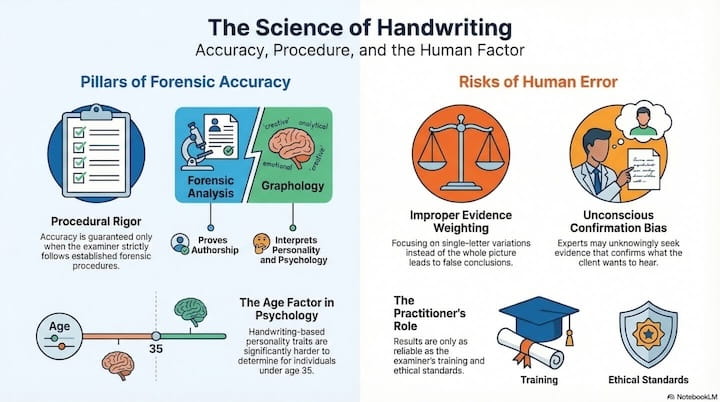
The interesting aspect of this question is that when some people refer to handwriting analysis, they may be talking about the psychology of understanding people through their handwriting, which can be very useful for human resources and therapists.
I happen to be skilled at both, so I know the limitations of the personality field, which really have to do with the practitioner’s skill level. I’m probably one of the most humble ones, saying, “Hey, this is what you can tell. This is what you can’t tell.”
For example, I wouldn’t know whether someone’s cheating on you or is an evil person. I’m just not going to make those broad generalizations. But some character traits can be determined, especially for people who learned to write in cursive and have done so all their lives. Not so much for people under 35.
The Science Behind Analysis
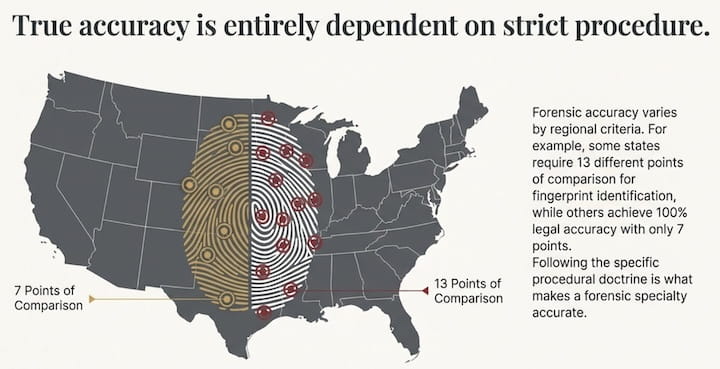
In fingerprint analysis, there are 13 points of comparison, and in some states only 7 are allowed in court. So, depending on the state, you may get 100% accuracy with only seven points of comparison, as opposed to 13 or more in other states. Different states have different criteria for what constitutes a forensic specialty.
However, the science of it is definitely accurate because it’s all about procedure. There are dozens of procedures in forensic document, handwriting, fingerprinting, and shoe prints, and all of those matter, because one has to follow the procedure.
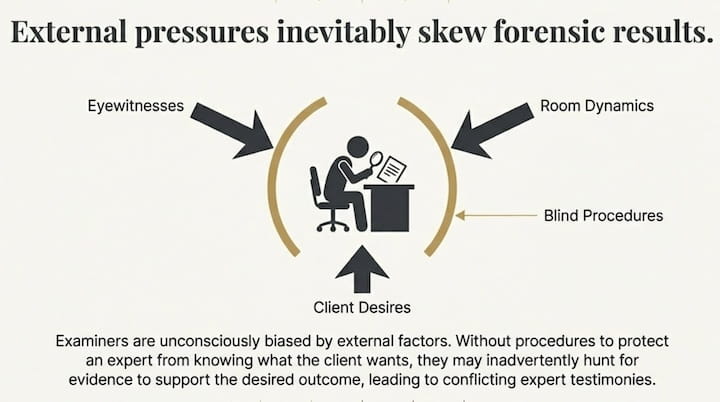
As far as the science of handwriting analysis goes, if you get a court-qualified forensic examiner and they’re making an opinion based on the science, whether or not a human being wrote a note, such as a full handwritten note, you’re going to get an accurate opinion as long as that person follows the procedures and has been properly trained so they can minimize their bias. People are unconsciously biased by whatever is going on around them, including witnesses and eyewitnesses in a courtroom. Without proper procedural safeguards, an examiner may unconsciously seek out evidence that confirms what the client wants to hear. That’s how bias creeps in.
Weighing the Evidence Correctly
Let me give you an analogy to explain what I mean. For example, in my truck, there is a steering wheel, a bottle of kombucha, and a phone. There are four wheels, and it’s a truck. However, if you weigh one thing really heavily, like, “Oh, there’s a steering wheel, it’s definitely a car,” you will be wrong, because you focused on only one thing. The same applies to handwriting: you have to take in the whole picture.
If a handwriting expert sees a little difference in a G or a Y and they say, “Oh, there’s a difference there. That means it’s a forgery,” they’re weighing the evidence improperly. And that’s where I think human error can come into play: if the evidence is weighed incorrectly.
Normally, most of my peers share my opinion if we look at the same evidence, the same quantities, and the same quality. Now, that doesn’t mean that all of my peers are ethical. If you’re hiring a handwriting expert for a legal matter, ask about their training, their methodology, and whether they follow established procedures to minimize bias. That will tell you a lot about whether you can trust their opinion.
So yes, forensic handwriting analysis is highly accurate when performed correctly. The key words there are “when performed correctly.” If you need a forensic document examiner, look for someone who is court-qualified, follows established procedures, and is transparent about the limitations of the analysis. That’s how you get an opinion you can actually rely on.
My name is Bart Baggett. If you need any help or a handwriting case, please give our office a call. We have offices in many cities around the country, and we’ll be glad to help you solve that case.
Bart Baggett
The Nation’s Leading Forensic Handwriting Expert
CEO of Handwriting Experts Inc.
Forensic Document Examiner • Expert Witness • Legal Consultant
“We solve million-dollar forgery cases.”
15233 Ventura Blvd. Floor 5
Sherman Oaks, CA 91403
323-544-9277
Telephone: 1-800-980-9030
YouTube: @thehandwritingexpert
LinkedIn: bartbaggett
Facebook: bartbaggett
https://www.instagram.com/forensichandwritingexpert
https://www.tiktok.com/@handwritingexpertsinc
——————————————————————————–
FAQ
——————————————————————————–
Q1: Is forensic handwriting analysis admissible in court?
A1: Yes. Judges permit trained forensic document examiners to testify as expert witnesses, provided they are properly qualified and follow established procedures.
Q2: How does examiner bias affect the accuracy of handwriting analysis?
A2: Without procedural safeguards, an examiner may unconsciously seek evidence that confirms a client’s preferred outcome. Proper training and established procedures help minimize this risk.
Q3: What is the difference between forensic handwriting analysis and graphology?
A3: Forensic handwriting analysis determines whether a specific individual wrote a document, while graphology interprets personality traits. They serve distinct purposes and require different skill sets.
Q4: What should I look for when hiring a forensic document examiner?
A4: Ask about their court qualifications, training, methodology, and commitment to established procedures that minimize bias. Transparency about the limitations of the analysis is a key indicator of reliability.