Can a Forgery Expert Determine Who Signed Someone Else’s Name?
I get this question often. A client might say, “I understand a forensic document examiner can determine whether a signature was forged. Can you tell us who did the forging?”
And that’s a great question, because I have found it is more difficult to identify who committed the forgery than to exclude the person who didn’t.
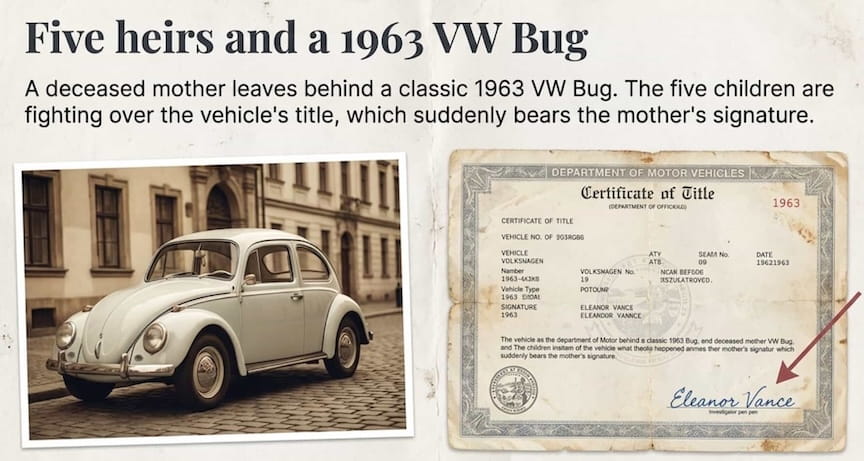
So, let’s say there’s a VW Bug, someone has passed away, and her kids are fighting over the title. In my office, we might say, “Hey, we’ve concluded that the decedent, the lady who died, did not sign the title.” When I absolutely know that, I’m comfortable saying it. But the problem is that there are five kids. One of them is probably the suspect. And we can look at all their handwriting and determine which one is most likely to have signed it.
Why Identifying the Forger Is Harder Than It Sounds
That works well when the forger has written naturally. But not all forgers do. If you think about a forgery by art thieves, like if they’re actually craftily mirroring or simulating that signature, they’re not going to leave a lot of evidence of their natural writing ability. The result looks more like an art imitation than a natural writing sample, which makes identifying the forger’s own handwriting characteristics nearly impossible.
We can’t tell from the handwriting alone who committed the forgery, but circumstances generally reveal the culprit and help the court or the police identify them.
A Case Where We Could Identify the Forger
There was a case in Tyler, Texas, where an entire three-page will was allegedly written in the grandma’s handwriting, but it clearly was not. I prepared a forensic report concluding not only that the will was not in the grandmother’s handwriting, but also that it was, in fact, written by the niece, and here’s how I knew. She didn’t do a very good job of copying her grandmother’s handwriting, and it looked an awful lot like her own natural handwriting. She simply had no idea that handwriting experts even existed.
She also had no idea that the police were going to come knock on her door and say, “You are not receiving the inheritance you were attempting to claim, and we’re placing you under arrest for forgery and attempted theft of an estate.” And so, that was a civil case. The report was so persuasive that the police called me to verify it was real, then arrested her and charged her with forgery and attempted theft of an estate.
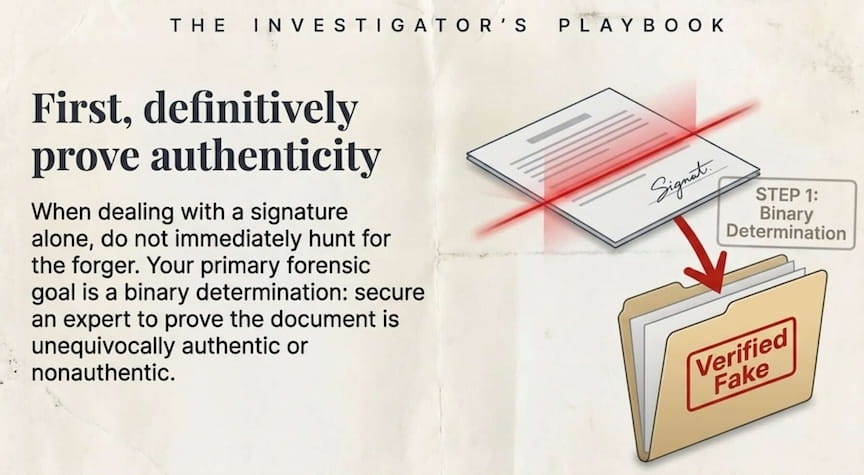
Handwriting can be used to criminally prosecute. In that case, I was able to identify the forger because it was an entire page of handwriting, and the forger’s natural tendencies showed up. From a signature alone, I would say your best bet is to verify its authenticity, and then whoever benefited from it probably had a hand in creating the document.
When to Let the Investigators Take Over
My job is to tell the truth about what the ink on the page reveals. Everything beyond that—the full investigation, the prosecution, the final judgment—belongs to the detectives, the district attorney, and the court. In most cases, the handwriting is just one piece of a larger evidentiary puzzle.
If you suspect a document in your case has been forged, that’s exactly the kind of analysis we specialize in. Reach out to us at handwritingexpertusa.com, and we’ll help you determine what the evidence actually shows.
Bart Baggett
The Nation’s Leading Forensic Handwriting Expert
CEO of Handwriting Experts Inc.
Forensic Document Examiner • Expert Witness • Legal Consultant
“We solve million-dollar forgery cases.”
Telephone: 1-800-980-9030
YouTube: @thehandwritingexpert
LinkedIn: bartbaggett
Facebook: bartbaggett
https://www.instagram.com/forensichandwritingexpert
https://www.tiktok.com/@handwritingexpertsinc
—————————————————————-
FAQ
—————————————————————-
Q1: Can a forensic document examiner determine who committed a forgery?
A1: Sometimes. It is generally easier to exclude someone who did not sign a document than to positively identify the forger. When a forger writes naturally, their own handwriting characteristics may appear in the document, making identification possible.
Q2: Why is identifying a forger harder than proving a forgery occurred?
A2: Skilled forgers attempt to simulate or mirror another person’s handwriting, which suppresses their own natural writing traits. This makes it difficult to match the forgery back to the forger’s known handwriting samples.
Q3: What role does handwriting evidence play in a criminal prosecution?
A3: A forensic document examiner’s report is one piece of a larger evidentiary puzzle. It can be persuasive enough to support a criminal arrest, but the full investigation and prosecution belong to detectives, the district attorney, and the court.
Q4: Can a forged will or title document lead to criminal charges?
A4: Yes. In one case, a forensic document examiner identified a niece as the author of a forged three-page will. The report was sufficiently compelling that police arrested her and charged her with forgery and attempted theft of an estate.