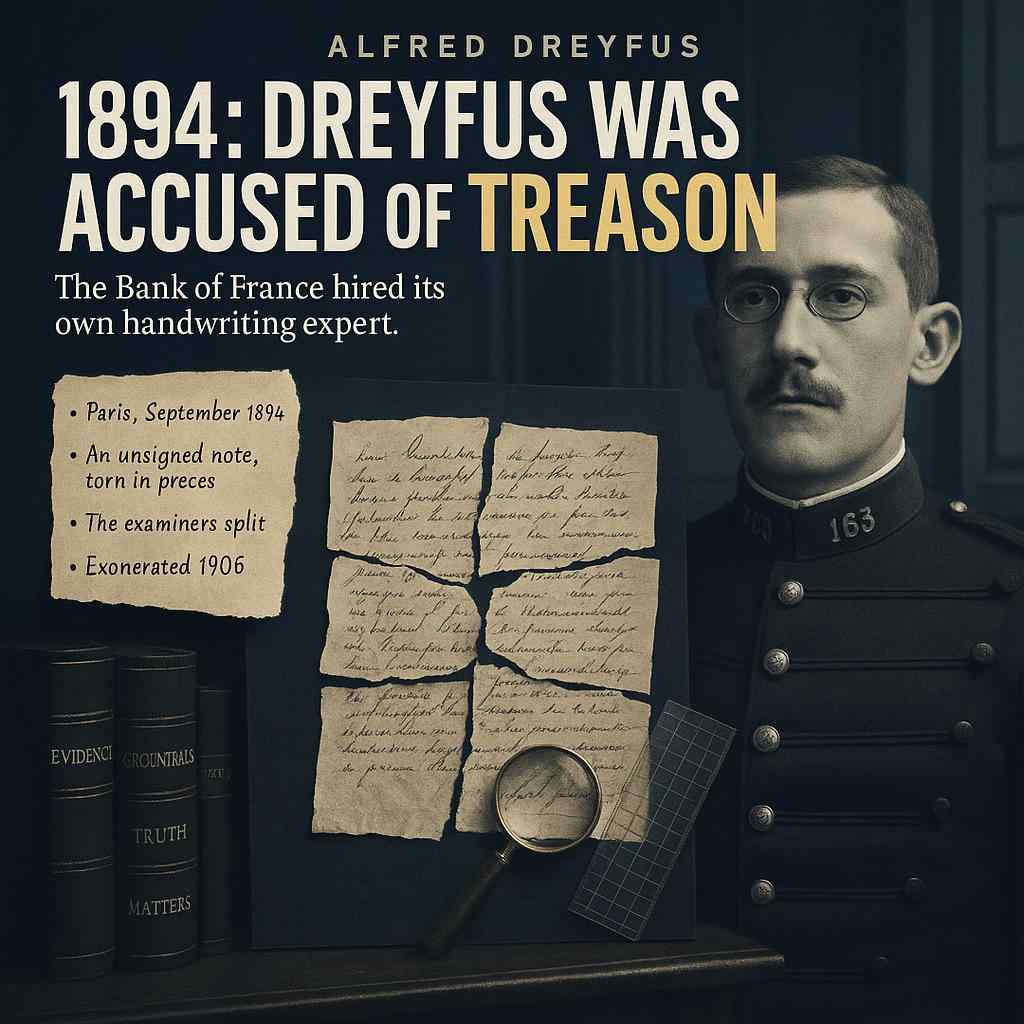
In September 1894, French intelligence recovered a torn, unsigned note from the German embassy in Paris. The note, later called the bordereau, offered French military secrets to a foreign power. Within weeks, Captain Alfred Dreyfus, an Alsatian Jewish artillery officer on the General Staff, was arrested for treason. The case would become one of the most infamous miscarriages of justice in European history—and a cautionary tale about the importance of real expertise in forensic document examination.
The Dreyfus case turned on a torn, unsigned note and divided opinions among handwriting experts. Some experts found the writing did not match Dreyfus, while others, less qualified in handwriting, insisted it did. Ultimately, Dreyfus was exonerated when the real author was identified years later.
What Was the Bordereau?
The bordereau was a single sheet, torn into pieces, and found in the wastebasket of the German embassy in Paris. It was unsigned and undated, but its contents made clear it was intended for the German military attaché. The French government saw it as proof of a spy in their midst. Suspicion quickly fell on Captain Dreyfus, one of the few Jewish officers on the General Staff, and he was arrested on October 15, 1894.
How Did the Handwriting Experts Disagree?
With no signature on the bordereau, the prosecution turned to handwriting analysis. But the examiners did not agree. Alfred Gobert, the handwriting expert for the Bank of France, found “numerous and important dissimilarities” between Dreyfus’s writing and the bordereau. He concluded the note was not written by Dreyfus. Another expert, Pelletier, also excluded Dreyfus.
On the other side, Alphonse Bertillon, head of police identification at the Paris Prefecture, argued that Dreyfus had written the note in a disguised hand. Bertillon was not a handwriting expert by training; his background was in anthropometry and police identification. He theorized that Dreyfus had deliberately mixed elements of his own handwriting with those of his wife and brother, supposedly to create an alibi in the future. Two other experts, Charavay and Teyssonnières, agreed with Bertillon, but the expert community was deeply divided.
What Went Wrong with the Analysis?
Bertillon’s theory of “autoforgery”—that Dreyfus had disguised his writing using family members’ characteristics—was unorthodox and, as later shown, methodologically unsound. In 1904, mathematicians Henri Poincaré, Paul Appell, and Gaston Darboux examined Bertillon’s approach and found its reasoning circular. They pointed out that Bertillon’s use of probability theory was not legitimate: he would always find what he was looking for, regardless of the evidence. Their report was a turning point, undermining the credibility of the prosecution’s handwriting evidence.
Dreyfus was convicted in December 1894, and despite public outcry—including Émile Zola’s famous “J’Accuse”—he was re-convicted in 1899 before finally being pardoned. It was not until 1906, after the real author, Major Ferdinand Walsin Esterhazy, was identified, that Dreyfus was fully exonerated and the case against him quashed without remand.
What Would a Document Examiner Look For?
In any questioned document case, a qualified examiner compares known writing samples with the document in question. They look for both similarities and differences in features such as letter forms, slant, spacing, pressure, and rhythm. Natural variation is expected in genuine writing, but certain characteristics remain consistent for each writer. An examiner also considers whether a signature or text appears to be disguised, traced, or written under unusual conditions.
In the Dreyfus case, the core issue was not just the technical analysis, but the qualifications of those performing it. Expertise in one forensic discipline does not make someone an expert in another. Attorneys and courts must always ask what the examiner is truly qualified to examine, and whether their methods are accepted in the field.
What Does This Mean for You?
If you are facing a questioned will, signature, or document, the first step is to keep the original safe and undisturbed. Do not write on, staple, or attempt to “fix” the document. Seek a qualified forensic document examiner early in the process—someone with real credentials and experience in handwriting and document examination, not just general forensic science.
If you’re dealing with a questioned will, signature, or document, Handwriting Experts Inc. can help. Visit HandwritingExpertUSA.com or call 1-800-980-9030.