In the early 1980s, a young rare-document dealer in Salt Lake City named Mark Hofmann seemed to have a knack for unearthing pieces of history that no one else could find. Letters from the founding days of the Mormon church. A so-called “salamander letter” that threatened to rewrite LDS history. Even what he claimed was the only surviving copy of the first document ever printed in British America. The buyers lined up. So did the church. And, reportedly, even federal investigators examined his finds and saw no reason to doubt them.
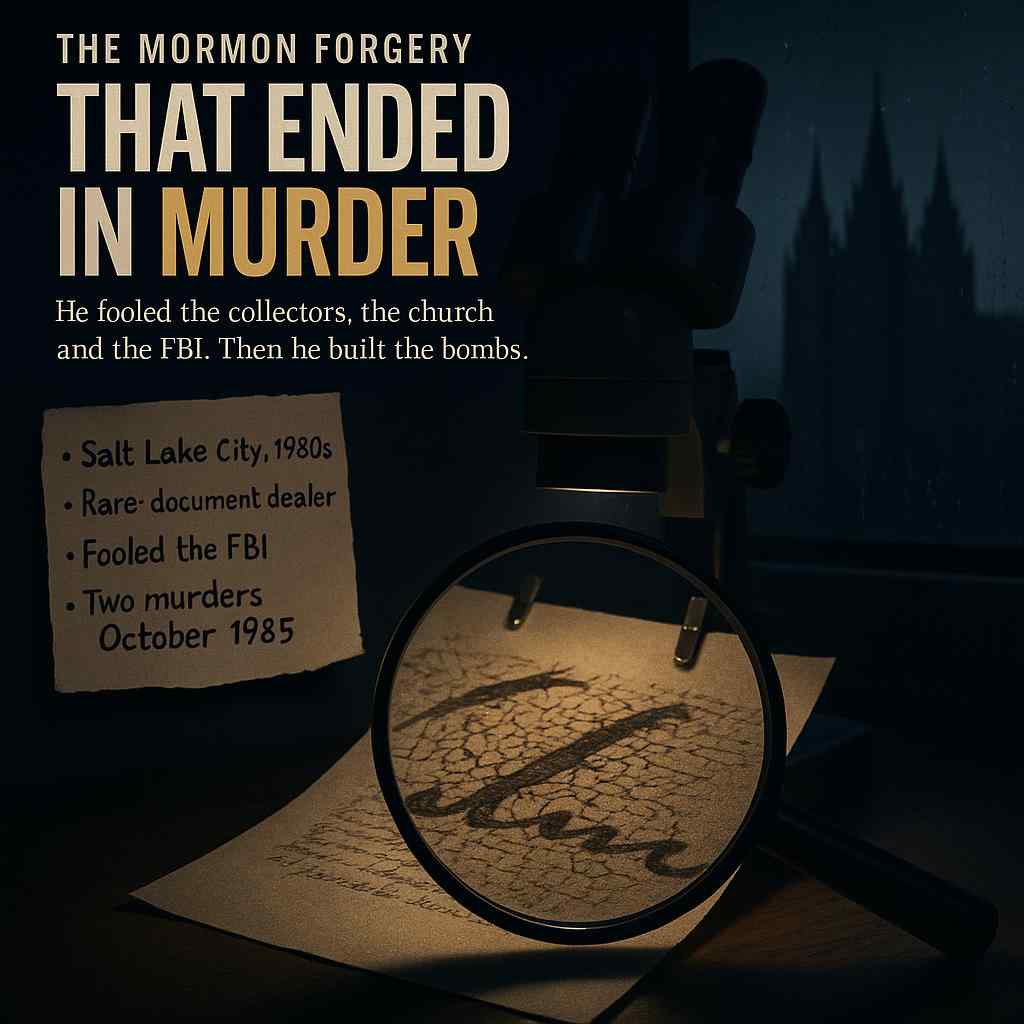
Mark Hofmann forged historical Mormon documents that fooled collectors, church officials, and experts. When his fraud began to unravel, he turned to murder before document examiners exposed the truth behind his forgeries.
How Did Mark Hofmann Fool So Many?
Hofmann’s documents weren’t just good—they were convincing enough to pass through the hands of collectors, archivists, and, according to some reports, even the FBI. His most infamous creation, the “salamander letter,” appeared to cast the origins of the Mormon faith in a new and controversial light. The letter, attributed to Martin Harris, described Joseph Smith’s discovery of the golden plates in terms that contradicted official church history. The impact was immediate and far-reaching.
Hofmann didn’t stop there. He produced document after document, each more sensational than the last. At one point, he was preparing to sell the so-called “Oath of a Freeman”—a document valued at over a million dollars. For collectors and institutions eager for a piece of history, Hofmann’s finds were irresistible.
When the Scheme Turned Deadly
But in October 1985, the story took a dark turn. On the morning of October 15, a package bomb killed Steven Christensen, a document collector, in his Salt Lake City office. Later that day, a second bomb killed Kathleen Sheets at her home. The next day, a third explosion severely injured Hofmann himself. The truth soon emerged: Hofmann had built the bombs. As his document fraud began to unravel, he had resorted to murder to cover his tracks.
The violence shocked the community and the nation. Suddenly, the question of whether a document was genuine or forged was no longer just about history or money—it was a matter of life and death.
How Document Examiners Exposed the Forgeries
This is where the story intersects with my profession. After the bombings, document examiners George Throckmorton and William Flynn began a systematic comparison of Hofmann’s documents with genuine historical material. They didn’t just look at the signatures or the handwriting style. They went deeper—literally—using microscopes to inspect the very surface of the ink.
What they found changed the case. Under magnification, the ink on Hofmann’s documents showed a distinctive cracked pattern, like alligator skin. This “alligator cracking” wasn’t present in authentic documents from the same era. It turned out to be a byproduct of the chemical oxidants Hofmann used to artificially age his ink. The examiners also noted other recurring anomalies: the ink had run in one direction, suggesting the papers had been hung to dry, and there were clothespin clip marks at the edges. In a control group of over 400 genuine documents, none showed these features.
These findings didn’t just reveal a forgery—they showed the method behind it. The work of Throckmorton and Flynn demonstrated how a careful, methodical examination can succeed where a quick look cannot.
What Do Document Examiners Actually Look For?
In a case like this, a forensic document examiner examines much more than handwriting. We compare the questioned document with known authentic samples, looking at ink composition, paper type, and even microscopic features. Natural variation—the small, unconscious differences in a person’s writing over time—is a key part of handwriting analysis. But when it comes to forgeries, especially those involving historical documents, we also look for signs of artificial aging, chemical treatments, and physical alterations.
Microscopic analysis can reveal ink cracking, layering, or unusual surface features. Examiners may also use chemical tests to identify modern materials in documents that are supposed to be old. The goal is to find patterns or anomalies that can’t be explained by natural variation or age alone.
If You’re Facing a Questioned Document
The Mark Hofmann case is a sobering reminder that even experts can be fooled—at first. But a thorough, scientific examination can uncover the truth. If you ever find yourself dealing with a questionable will, contract, or historical document, there are a few things you should do right away: preserve the original document, avoid writing on or altering it, and consult a qualified document examiner as soon as possible. Early, careful handling can make all the difference.
Frequently Asked Questions
What happened in the Mark Hofmann and Salamander Letter case?
Mark Hofmann, a rare-document dealer in Salt Lake City, forged historical Mormon documents—including the “salamander letter”—and sold them to collectors and the church. When his scheme began to unravel, he built and detonated bombs, resulting in two deaths.
When did the Mark Hofmann forgeries and murders take place?
Hofmann’s forgeries emerged in the early 1980s. The murders occurred on October 15, 1985, and Hofmann was injured by a third bomb the next day.
What was the outcome of the Mark Hofmann case?
Mark Hofmann pleaded guilty in 1987 and was sentenced to prison.
Was the handwriting or document ever questioned, and what role did document examination play?
Yes, document examiners George Throckmorton and William Flynn found distinctive ink cracking and other anomalies in Hofmann’s documents, revealing his methods of forgery.
How did Mark Hofmann’s forged documents fool experts and collectors?
Hofmann’s documents were initially convincing enough to pass through collectors, church officials, and reportedly some federal investigators before detailed forensic examination uncovered the forgeries.
What do forensic document examiners look for in a suspected forgery?
They compare the document to authentic samples, analyze ink and paper, and use microscopes to detect artificial aging, chemical treatments, and other anomalies.
What should someone do if they suspect a document is forged?
Preserve the original document, avoid altering it, and consult a qualified forensic document examiner as soon as possible.
If you’re dealing with a questioned will, signature, or document, Handwriting Experts Inc. can help. Visit HandwritingExpertUSA.com or call 1-800-980-9030.