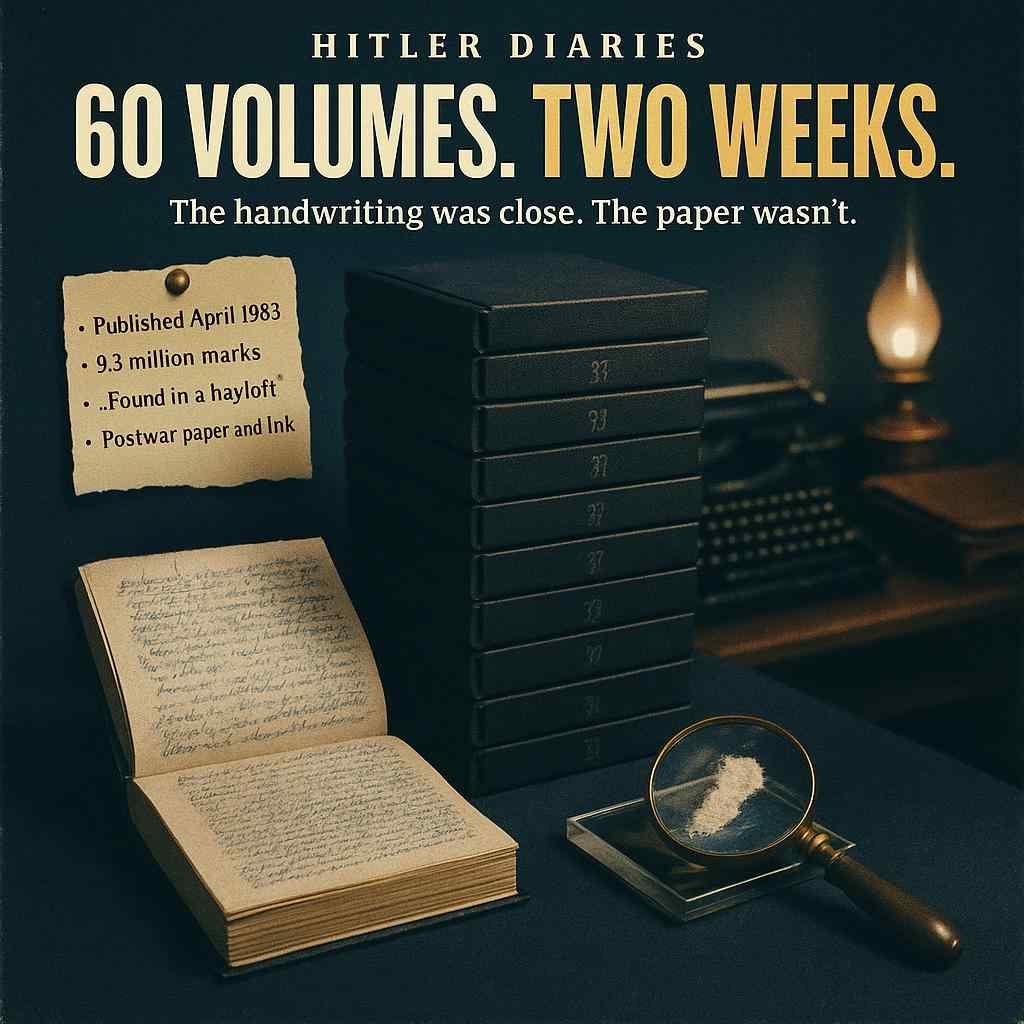
In April 1983, the German magazine Stern made a stunning announcement: they had acquired Adolf Hitler’s personal diaries. Sixty volumes, each one thick with cramped script, supposedly written by Hitler himself during the war years. The story behind them was as dramatic as the find. These diaries, it was said, had survived a plane crash in the last days of World War II, hidden for decades in a hayloft in East Germany before finally being smuggled to the West.
The Hitler Diaries were a massive forgery. While the handwriting looked convincing, forensic tests on the paper and ink proved the diaries were created decades after Hitler’s death. This case shows why examining the physical evidence is just as important as studying handwriting.
The Story Behind the “Discovery”
Stern paid 9.3 million Deutschmarks for the diaries—a sum that reflected both the supposed historical value and the confidence of the experts involved. A well-known British historian vouched for their authenticity. The Sunday Times bought the rights to publish them. Newsweek even ran a cover story. The world was ready to rewrite history based on these newly unearthed documents.
The source of the diaries was a Stuttgart antiques dealer who called himself Konrad Fischer. In reality, his name was Konrad Kujau, and he was a skilled forger. Between 1981 and 1983, Kujau painstakingly wrote out every page himself, imitating Hitler’s handwriting with impressive accuracy.
Why Did People Believe the Diaries?
The handwriting was close enough to Hitler’s known writing to fool many at first glance. The backstory—a dramatic plane crash, decades in hiding—added to the credibility. When a respected historian vouched for the find, skepticism faded. Publishers and media outlets rushed to secure rights, eager to be part of a major historical revelation.
But almost immediately, historians began to notice problems. The content of the diaries contained errors and inconsistencies. Still, it was the physical evidence that delivered the final verdict.
How Forensic Testing Revealed the Truth
The German federal archive, the Bundesarchiv, was brought in to examine the diaries. They didn’t just look at the handwriting. They tested the paper, the ink, the glue, and the bindings. Within about two weeks, the Bundesarchiv announced their findings: the materials were all postwar. The paper hadn’t existed during Hitler’s lifetime. The ink was of a modern type. Even the bindings and adhesives were made from materials that weren’t available in the 1940s.
In other words, no matter how convincing the handwriting appeared, the diaries could not have been written by Hitler. The physical evidence was irrefutable.
What Would a Document Examiner Look For?
In a case like this, a forensic document examiner looks at much more than just the handwriting style. Here are some of the key elements:
- Paper analysis: Is the paper consistent with the claimed era? Modern paper often contains chemicals and fibers that didn’t exist decades ago.
- Ink composition: Was the ink available at the time the document was supposedly written? Chemical tests can reveal when and where ink was manufactured.
- Bindings and adhesives: Are the materials used in binding the document consistent with the period?
- Handwriting comparison: Does the handwriting match known authentic samples? Is there evidence of tracing, hesitation, or unnatural variation?
- Line sequence and indentations: Which lines were put down first? Are there impressions from other pages that suggest a different writing sequence?
When the original document is available, these physical clues often carry as much weight as the handwriting itself—sometimes more.
The Aftermath: Consequences for the Forger and the Press
Once the forgery was exposed, the fallout was swift. Konrad Kujau, the forger, went to prison. So did the Stern reporter who had brokered the deal. In a final twist, when Kujau confessed, he wrote out his confession in a handwriting style nearly identical to Hitler’s—demonstrating just how skillful he was at mimicry, but also how little that mattered in the face of hard scientific evidence.
What This Means for You
The Hitler Diaries case is a powerful lesson for anyone dealing with questioned documents. A practiced forger can get close to the real thing when it comes to handwriting. But it’s nearly impossible to fake the age, chemistry, and construction of a document without leaving evidence behind.
If you’re facing a questionable will, signature, or document, keep the original safe and untouched. Don’t staple, write on, or otherwise alter it. Get a forensic examination early—sometimes the strongest evidence is in the paper, the ink, or the indentations, not just the handwriting.
Frequently Asked Questions
What happened in the Hitler Diaries case?
In 1983, the German magazine Stern announced it had acquired sixty volumes of Hitler’s diaries. The diaries were actually forgeries created by Konrad Kujau, who imitated Hitler’s handwriting.
When did the Hitler Diaries events take place?
The diaries were published in April 1983. They were created by Kujau between 1981 and 1983.
What was the outcome of the Hitler Diaries case?
Forensic testing revealed the diaries were modern forgeries. Konrad Kujau and the Stern reporter involved both went to prison.
Was the handwriting or document ever questioned, and what role did document examination play in the Hitler Diaries case?
The handwriting was convincing, but forensic document examination of the paper, ink, and bindings proved the diaries were postwar forgeries.
How did forensic document examiners expose the Hitler Diaries forgeries?
They tested the paper, ink, glue, and bindings, finding all materials were made after Hitler’s death, which proved the diaries could not be authentic.
What should someone do if they suspect a document is forged?
Keep the original safe and unaltered, and seek a forensic document examination as soon as possible to analyze both handwriting and physical evidence.
If you’re dealing with a questioned will, signature, or document, Handwriting Experts Inc. can help. Visit HandwritingExpertUSA.com or call 1-800-980-9030.