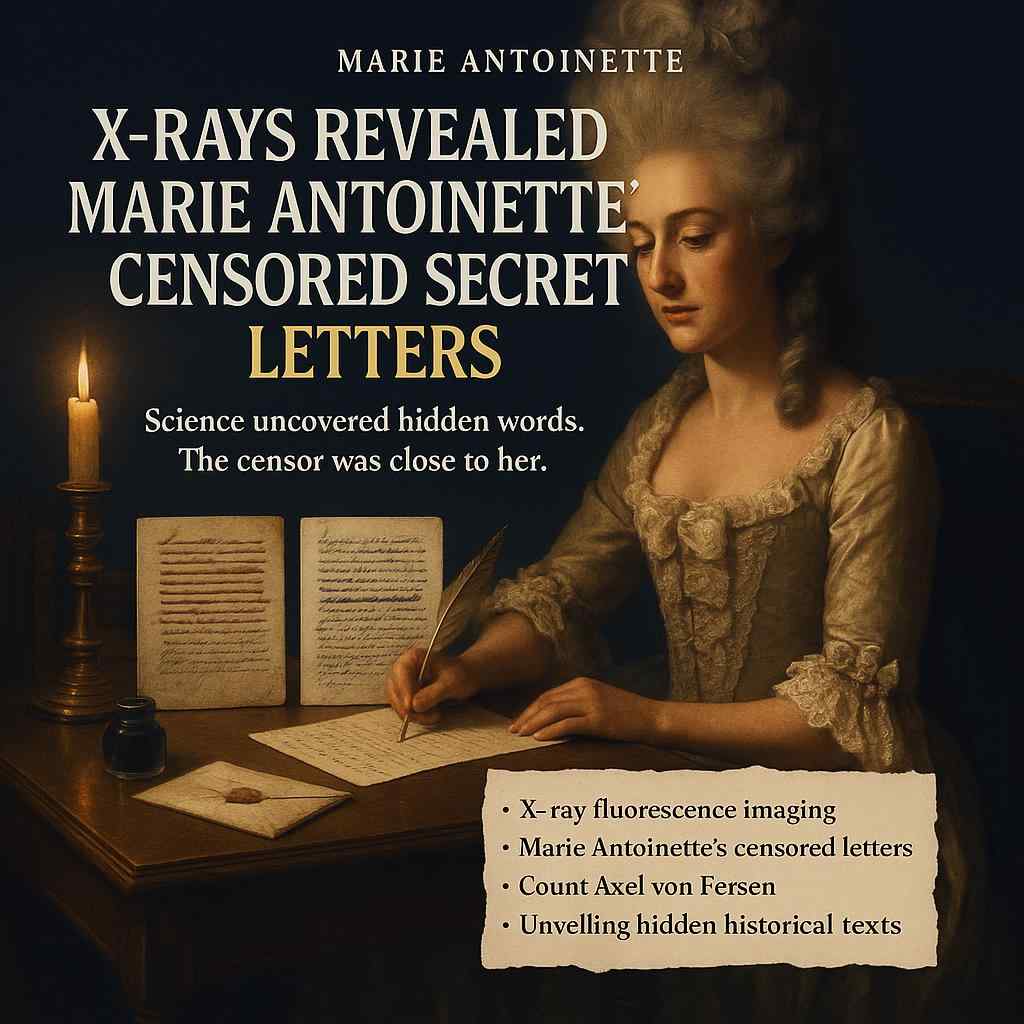
In the swirling chaos of revolutionary France, Queen Marie Antoinette reached for pen and paper. Her letters to Count Axel von Fersen, a Swedish nobleman and close confidant, were charged with secrecy and emotion. But for more than two centuries, the most intimate passages in this royal correspondence were hidden—blacked out by thick, deliberate redactions. Who censored these words, and what truths did they conceal?
Using X-ray fluorescence imaging, researchers uncovered the censored words in Marie Antoinette’s letters to Count Fersen, revealing personal expressions like “beloved” and “adore.” Evidence suggests Fersen himself may have redacted the letters to protect the queen’s reputation.
The Mystery of the Redacted Letters
The letters at the heart of this story were written between 1791 and 1792, as France teetered on the edge of revolution. Marie Antoinette, isolated and under threat, confided in Count Axel von Fersen. Their correspondence was more than political—it was personal, sometimes intimate, and always shrouded in the risk of exposure. At some point, someone took pains to censor the letters, obscuring entire lines with dark ink. For generations, historians wondered what secrets lay beneath those blacked-out passages—and who wielded the censor’s pen.
How Science Saw Through the Censor’s Ink
Centuries after the letters were written, a team of researchers brought new technology to an old puzzle. They used X-ray fluorescence (XRF) imaging, a technique that analyzes the elemental makeup of inks without damaging the fragile paper. By comparing the chemical signatures of the original writing and the redactions, the researchers could digitally separate the layers. This allowed them to read the hidden words for the first time in over 200 years.
The results were striking. Words like “beloved” and “adore” emerged from beneath the censor’s ink, offering a rare glimpse into the emotional bond between Marie Antoinette and Fersen. The language was unmistakably personal—far more revealing than the public faces either could show in the political storm of the French Revolution.
Who Was the Censor?
The biggest surprise came when researchers studied the composition of the redacting ink. Their analysis suggested that Count Fersen himself may have been the one who censored the letters. If true, this act was likely meant to protect Marie Antoinette’s reputation, shielding her most private words from prying eyes. It’s a reminder that sometimes, the person with the most to lose is the one who takes steps to hide the truth—even from history.
What Would a Document Examiner Look For?
Cases like this highlight the power of combining traditional document examination with scientific analysis. A forensic document examiner would start by looking at handwriting features—slant, pressure, letter forms, spacing, and rhythm—to confirm authorship or detect alterations. But when ink or paper is altered, or when words are redacted, examiners often turn to non-destructive scientific tools. Techniques like X-ray fluorescence or infrared imaging can reveal what the naked eye cannot, separating layers of ink or uncovering erased or covered writing. The goal is always to answer key questions: Who wrote this? What was changed? And why?
What This Means for You
Whether you’re dealing with a centuries-old letter or a modern legal document, the lessons remain the same. If you suspect a document has been altered, keep the original safe and avoid adding marks, staples, or tape. Seek a qualified examiner early—sometimes, the right scientific method can reveal the truth that handwriting alone cannot. And remember: the story a document tells is rarely just what’s on the surface.
Frequently Asked Questions
What happened in the Marie Antoinette redacted letters case?
Marie Antoinette wrote secret letters to Count Axel von Fersen during the French Revolution. Some passages were censored, hiding intimate words, which were later revealed by scientific analysis.
When did Marie Antoinette write the censored letters to Count Fersen?
Marie Antoinette wrote the censored letters to Count Fersen between 1791 and 1792, during the turmoil of the French Revolution.
What was the outcome of uncovering Marie Antoinette’s redacted letters?
Researchers successfully revealed the hidden words and phrases in the letters, shedding light on the personal relationship between Marie Antoinette and Count Fersen.
Was the handwriting or document ever questioned, and what role did document examination play in Marie Antoinette’s letters?
The letters themselves were not questioned for authenticity, but scientific methods like X-ray fluorescence imaging were used to uncover the redacted content.
How did researchers reveal the censored words in Marie Antoinette’s letters?
Researchers used X-ray fluorescence imaging to distinguish between the original ink and the redactions, allowing them to read the hidden text.
Who is believed to have censored the letters, and why?
Evidence suggests Count Axel von Fersen himself may have censored the letters, likely to protect Marie Antoinette’s reputation.
What should someone do if they suspect a document has been altered or redacted today?
Keep the original document safe, avoid adding marks, and consult a qualified document examiner as soon as possible for a professional analysis.
If you’re dealing with a questioned will, signature, or document, Handwriting Experts Inc. can help. Visit HandwritingExpertUSA.com or call 1-800-980-9030.