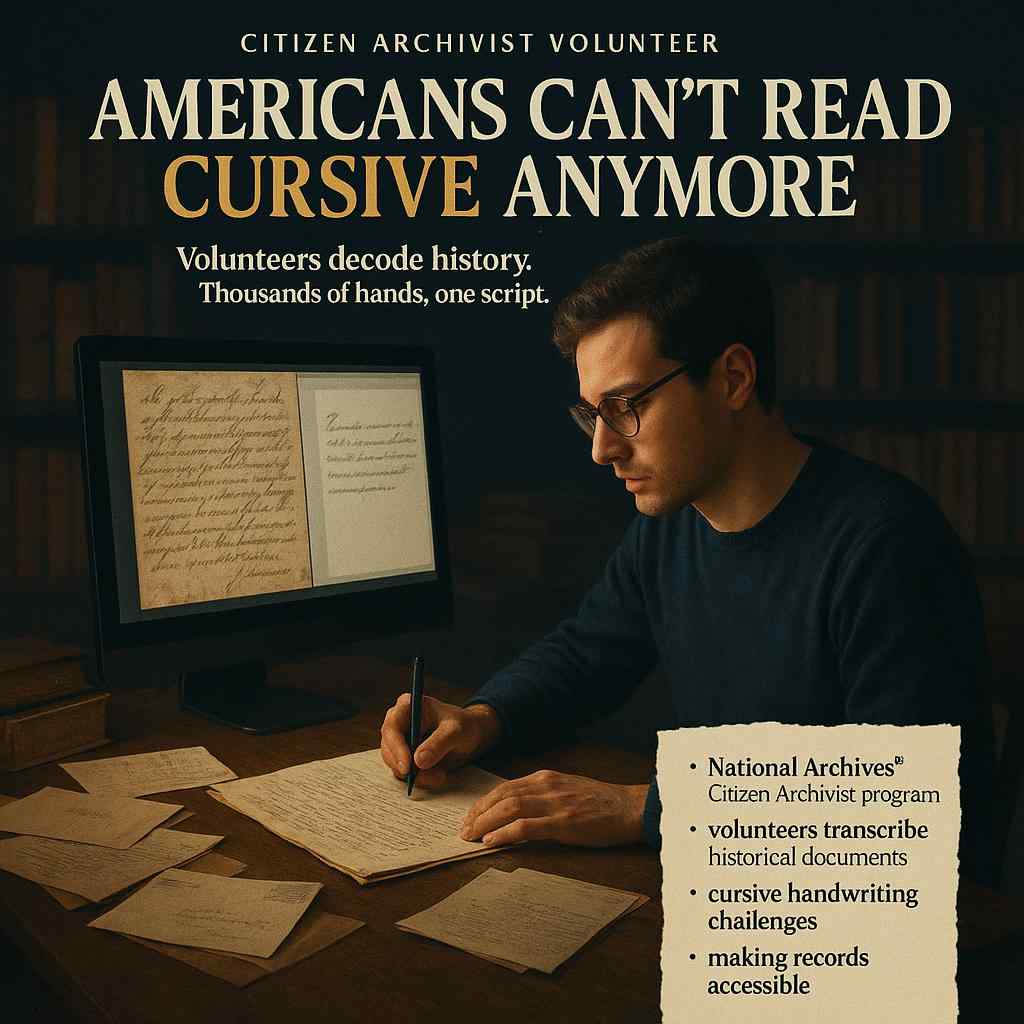
Walk into any courtroom, library, or family archive, and you’ll likely find a handwritten document that most Americans today can’t easily read. Cursive handwriting—once a core skill—has quietly faded from daily life. But a surprising group is stepping up to decode the past: volunteers working with the National Archives’ Citizen Archivist Program.
The National Archives’ Citizen Archivist Program enlists thousands of volunteers to transcribe historical handwritten documents, making them searchable and accessible to everyone. These efforts help bridge the growing gap as fewer Americans can read cursive handwriting.
Why Cursive Matters More Than Ever
For centuries, Americans recorded everything from military service to family milestones in flowing, sometimes elaborate, cursive script. Today, those records are still vital—whether you’re tracing your ancestry, settling a legal matter, or researching history. But there’s a problem: most people under 40 never learned to read or write cursive fluently.
That means a pension file from the Revolutionary War or a Civil War-era letter might as well be written in code. The words are there, but the meaning is locked behind unfamiliar loops and strokes. If no one can read the original, the story—and sometimes the truth—remains hidden.
The Citizen Archivist Program: A Volunteer Army
Since 2010, the National Archives has invited everyday people to help solve this problem. Their Citizen Archivist Program is open to anyone with internet access. Volunteers log in, choose a document—maybe a soldier’s letter home or a faded legal contract—and start transcribing the cursive script into plain, searchable text.
Over 5,000 volunteers have joined the effort. Together, they’ve tackled everything from 18th-century pension files to 19th-century correspondence. The work isn’t easy: ink bleeds through old paper, handwriting styles change over time, and fading can turn a word into a mystery. But every transcription makes a piece of history accessible to researchers, attorneys, and families across the country.
Why Decoding Cursive Is So Challenging
Cursive handwriting isn’t just about fancy loops. Each era—and often each writer—had a unique style. Some letters are joined in ways that look unfamiliar to modern eyes. Old ink can fade or smudge, and paper may deteriorate. Even for experts, reading a 200-year-old document can feel like detective work.
Technology helps, but it’s not a complete solution. Optical character recognition (OCR) struggles with handwritten script, especially when the writing is ornate or the paper is damaged. That’s why human eyes and hands are still the most reliable tools for unlocking these records.
What a Document Examiner Looks For
As a forensic document examiner, I see these challenges every day. When a case involves a handwritten will, contract, or letter, it’s not enough to simply have the document. Someone has to be able to read it—and read it accurately. In court, attorneys can’t assume that judges or juries will be able to decipher cursive. That’s where experts come in.
In cases like these, a document examiner would look at the handwriting style, compare it to known samples, and assess whether the writing is consistent and authentic. We also look for signs of alteration, fading, and other issues that could affect interpretation. But before any analysis can happen, someone has to transcribe the document so everyone understands what it says.
If You Face a Handwritten Document
If you’re dealing with a handwritten will, letter, or contract—especially one in cursive—don’t assume everyone can read it. Keep the original safe, avoid writing on or stapling it, and get a qualified expert involved early. Transcription is the first step; examination comes next. Both are crucial for clarity and, sometimes, for justice.
Frequently Asked Questions
What happened in the Americans Can’t Read Cursive Anymore case?
The National Archives’ Citizen Archivist Program enlisted volunteers to transcribe historical handwritten documents, making them accessible and searchable as fewer Americans can read cursive.
When did it happen?
The Citizen Archivist Program began in 2010 and continues today across the United States.
What was the outcome?
Thousands of documents, including Revolutionary War pension files and Civil War letters, have been transcribed and made accessible to the public.
Was the handwriting or document ever questioned, and what role did document examination play?
The main challenge was reading and transcribing cursive handwriting; document examination helps when accuracy or authenticity is in question, but the program focuses on transcription.
How do volunteers transcribe historical cursive documents?
Volunteers log in online, select handwritten records, and type out the text, helping overcome challenges like fading ink and unfamiliar cursive styles.
Why is reading cursive handwriting so difficult for modern Americans?
Cursive is no longer widely taught, and old styles can differ greatly from modern writing, making it hard for many people to read historical documents.
What should someone do if they have a handwritten document they can’t read?
They should keep the original safe and seek help from a qualified expert or a transcription program to ensure the document’s contents are accurately understood.
If you’re dealing with a questioned will, signature, or document, Handwriting Experts Inc. can help. Visit HandwritingExpertUSA.com or call 1-800-980-9030.