What Happens When a Tenant Forges a Lease and Won’t Leave?
What happens when a tenant forges a lease and won’t leave?
If you’re a landlord or you’re a homeowner, you might encounter this problem. Maybe you already have.
You’re trying to get someone kicked out, or you’re trying to raise the rent. They refuse. Then one day, they show up to your place with a lease that you didn’t write, sign, or even know existed.
This has happened a lot in my time as a forensic doc examiner, in big condominium complexes, in restaurants, and in office buildings. A scammer will just show up and say, “Hey, I belong here. This is actually *my* place. Check out my lease!”
There was this really interesting case a few years ago where the defendants had a 10-page lease allegedly signed by their landlord’s deceased father. I was representing the other side, the landlord.
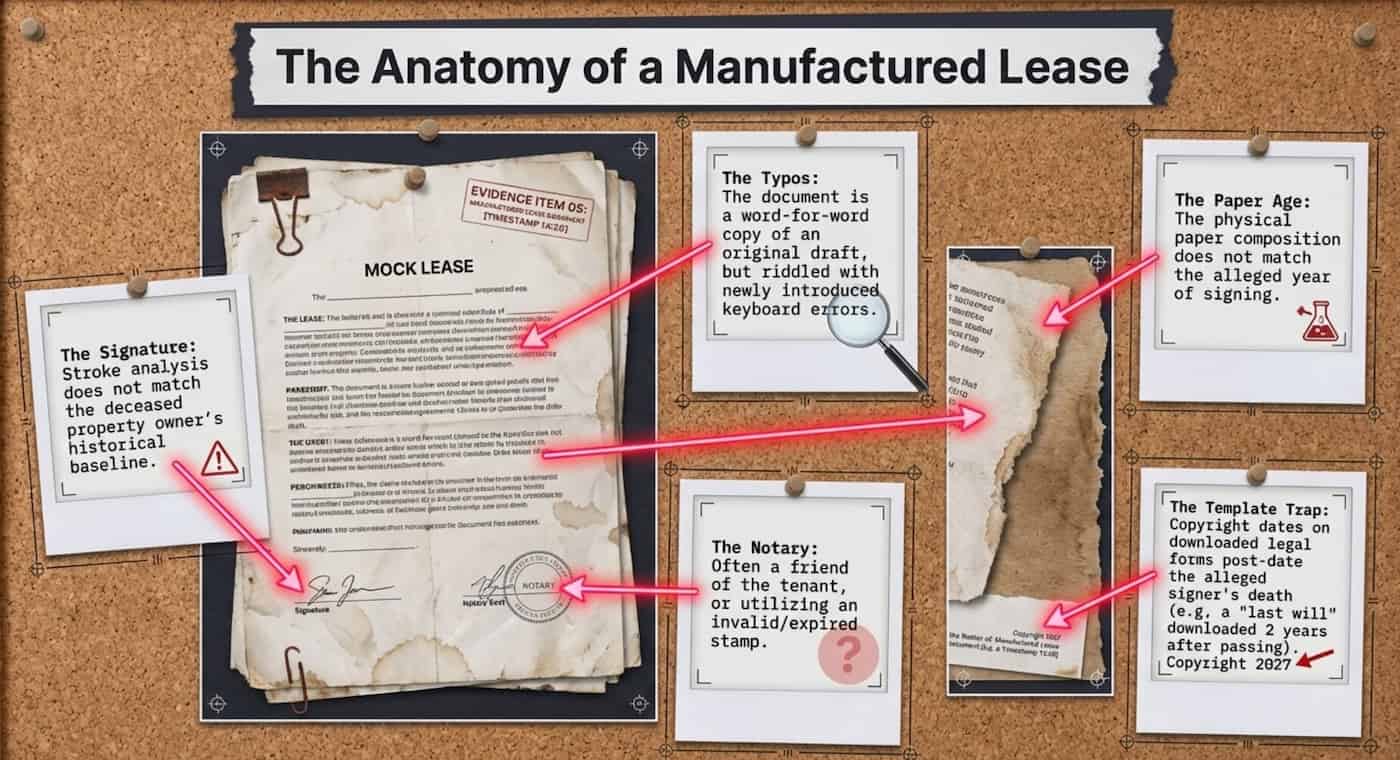
After reviewing the lease, I decided that not only was the signature not real, but also all the pages were basically typed word-for-word from the original lease, but the scammers made typos.
Because they made typos on every page, I was able to actually find the original draft on their computer where they manufactured the lease. So obviously, the tenant in that case lost profoundly and probably had to pay all the bills for all the experts and all the attorneys because they created a fake lease trying to get better terms and stay in the property long past-due. Now that’s a multi-million dollar case. You probably can’t afford that if you’re just a single homeowner or a landlord that owns a triplex—but you can still likely afford and use the help of a forensic document examiner to prove that the lease is a fraud.
What if I have been scammed by a tenant with a fraud lease, but have limited resources to pursue legal action?
This happens quite often with my clients who rent or take over a small property. Their tenant says, “Hey, we have a lease, or we’re in rent control, and here’s this lease that you signed or your dad signed even though he might have passed away.” The client panics because they can’t find any corresponding copies of the previous leases. That’s where the examiner comes in. The examiner will look for a pattern. If somebody in your family, let’s say your dad, had a pattern of running and renting properties for 20 years, they probably have a standard lease.
And if the lease that shows up does not match the formatting, the font, the notary, the time, or all that stuff that matters, the examiner will be able to figure that out. We do an investigation to determine where, if anywhere, the lease deviates from the previous set.
So, if you’re a landlord and you have a tenant that has created a manufactured lease, you can win in court, and then you can finally get them evicted, and you could turn that property. But you will probably need a real estate attorney, and you’ll probably need a forensic document examiner to help prove that case in court. The tenants will likely lie, they could say that you signed it or your friend signed it and that a notary is a friend of theirs.
In that case, another approach that your examiner may take is looking at the paper—specifically the age of the paper. Or if you’re lucky and get access to their computer, you can find the computer file where they manufactured it. I even had one case almost 20 years ago where they had downloaded a template of a last will and testament, and the copyright of where they downloaded it was 2 years after the person died.
Pretty hard to sign a will and testament when you’re dead, right? So if you’re looking for clues on how to do an investigation to determine if a lease is false or not false, let me tell you, wherever you are, these are the steps.
We’ve handled lease problems in San Francisco, Tennessee, in Dallas, in L.A., and with our other experts around the country. It is not uncommon.
How do I know if I should pursue legal action if a tenant is scamming me?
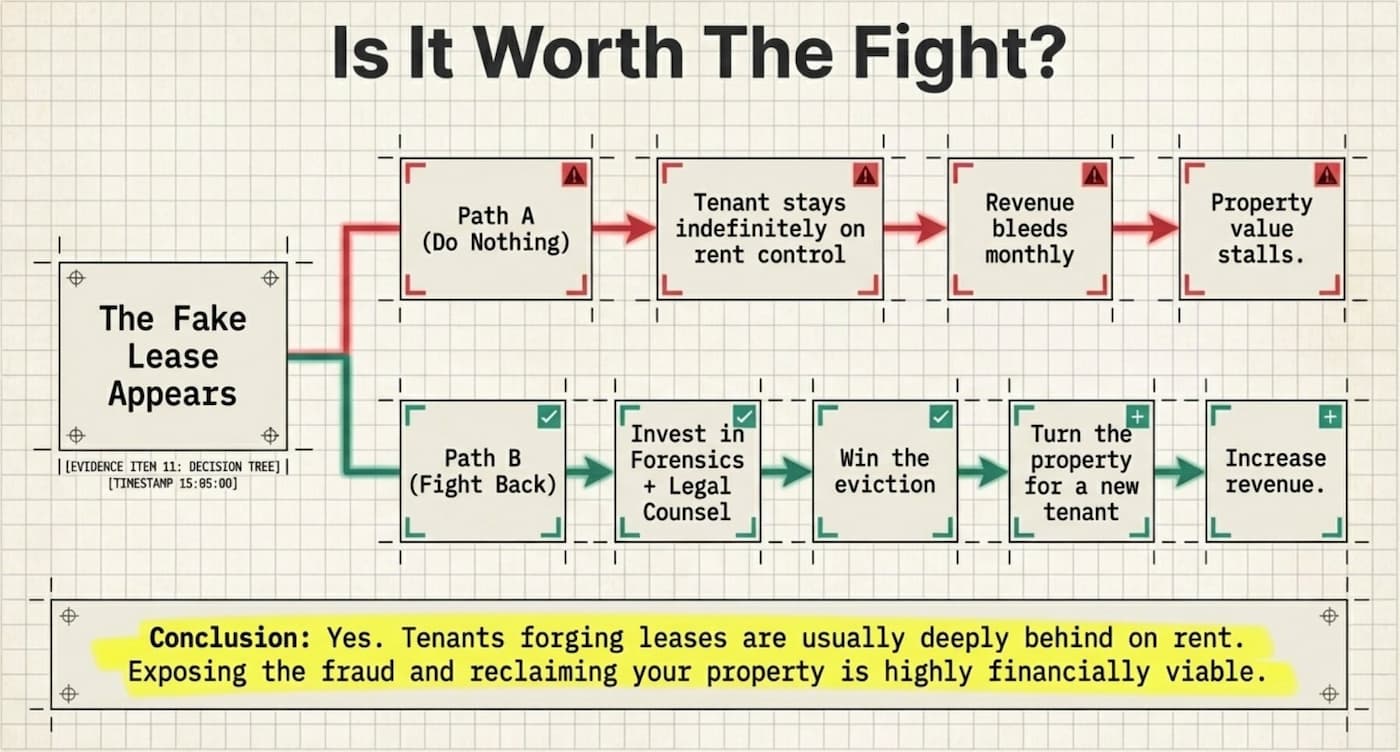
The question you have to ask if you’re a landlord is, is it worth the fight? Is it worth the fight to get this person evicted, to get that property back, to be able to turn it and make a new one, or is it better to let them stay?
And in most cases, if a tenant is forging leases, they’re probably way behind in their lease. They’re on rent control, and they want to stay forever.
Clearly it is very, very possible that the right financial decision for you is to pursue an investigation or legal action.
If you’re unfortunate enough to own property in California, you have a second layer of problems; that is, California is a state that hates landlords. They love tenants. There was a person who moved into somebody’s property in the state for two and a half years without paying rent because the state of California wouldn’t let them get an eviction.
That’s why a lot of people don’t like to own property in California; they like to own property in Texas or Tennessee that is more landlord-friendly, where you actually can evict somebody if they steal $5,000 a month in rent from you.That’s the way I look at it. If someone doesn’t pay rent, it’s like pulling a gun to your head and stealing money out of your business and your family’s pocket.
But the state doesn’t see it that way. Tenants don’t see it that way. They tend to think, “Oh, well, landlords are rich and tenants are poor, and you need to fight.” No. If you sign a contract to pay $3,000 a month rent, you pay it. That’s just the rule. And if you don’t pay it, you’re stealing money from someone else.
But because of the structures and the laws in some states, they see landlords as so rich, but that’s not the truth. Most landlords in the US are mom-and-pop businesses. They own one to three rental units. It’s their nest egg. It’s their family business. So when you don’t pay rent for 4 months, you’re stealing $12,000 with a gun pointed at their head. And that isn’t right.
So if you do have a situation where you know someone forged a lease and they’re trying to get to stay in standard rent control, you need to hire a forensic document examiner.
You need to hire an attorney. And you need to immediately do everything through the proper legal and regulatory channels, such as notifying them, putting an eviction notice on their door, and getting the case in front of a judge as soon as you can. Because once you get to an evidentiary hearing, they’re going to have to move out, or they’re going to give up, because if it gets proven that they’ve manufactured false evidence in a court case, they could actually be prosecuted for a crime.The police might investigate it. Police generally don’t like to investigate civil crimes or “he said, she said” type cases.
But the threat of a civil or criminal action for putting in a false document and lying under oath is serious business. So, that’s something you might want to consider in negotiations.
if you’re a landlord, a real estate investor, or just a big fan of fraud investigation, we might help. We have experts all over the country that help with this kind of thing.
We mainly do the forensic aspect of it, where we handle and analyze the evidence. We can recommend some great attorneys that handle these kinds of cases in all the states that you live and work in.
My name is Bart Baggett. Visit handwritingexperts.com. I happen to own property and have tenants… I’m on your side.
Pick one of your experts. And landlords, just keep it up, man.
Keep your chin up. Luckily the tax laws are in your favor, and you have a right to evict someone if they don’t pay.
Bart Baggett
The Nation’s Leading Forensic Handwriting Expert
CEO of Handwriting Experts Inc.
Forensic Document Examiner • Expert Witness • Legal Consultant
“We solve million dollar forgery cases.”
Telephone: 1-800-980-9030
YouTube: @thehandwritingexpert
LinkedIn: bartbaggett
Facebook: bartbaggett
https://www.instagram.com/forensichandwritingexpert
https://www.tiktok.com/@handwritingexpertsinc
FAQ :
Q1: What can a forensic document examiner do if a tenant presents a forged lease?
A1: A forensic document examiner can analyze the lease for inconsistencies in formatting, font, notary stamps, paper age, and signatures. They can also identify whether the document was manufactured using a computer template — potentially tracing the fraud directly back to its source.
—
Q2: How does a forensic document examiner detect a fake lease?
A2: Examiners compare the suspected lease against the landlord’s known standard lease format, looking for font deviations, unusual notary details, typos, and paper-age anomalies. In some cases, the original fraudulent file can be located on the tenant’s own computer, as occurred in a multi-million dollar case handled by Bart Baggett.
—
Q3: Should a landlord hire an attorney if a tenant forges a lease?
A3: Yes. Landlords facing a forged lease should retain both a real estate attorney and a forensic document examiner. Together, they can build a legally sound case, file proper eviction notices, and present forensic evidence at an evidentiary hearing.
—
Q4: Can a tenant face criminal charges for forging a lease?
A4: Yes. Submitting a forged document as court evidence and lying under oath are serious offenses. A tenant proven to have manufactured a false lease could face criminal prosecution, in addition to losing their civil case and being ordered to cover all opposing legal fees.