In 1971, the publishing world was stunned by the promise of a literary coup: Clifford Irving, a little-known writer, had convinced McGraw-Hill that he was working with the famously reclusive billionaire Howard Hughes on an authorized autobiography. The deal was big—an advance of roughly $750,000. But the real story was just beginning. The autobiography was a complete fabrication, and the supporting documents were forgeries. Even some of the most respected document examiners in the country were fooled—at least, at first.
Clifford Irving forged letters and documents to convince McGraw-Hill that Howard Hughes had authorized his autobiography. The deception fooled experts until investigators compared the forgeries to Irving’s own handwriting, exposing the hoax.
How Did Clifford Irving Pull Off the Hoax?
Irving’s plan was bold. He needed to convince McGraw-Hill—and the world—that he had direct access to Hughes. To do that, he produced letters and documents supposedly written by Hughes himself. But Hughes was a recluse. Publicly available samples of his handwriting were scarce.
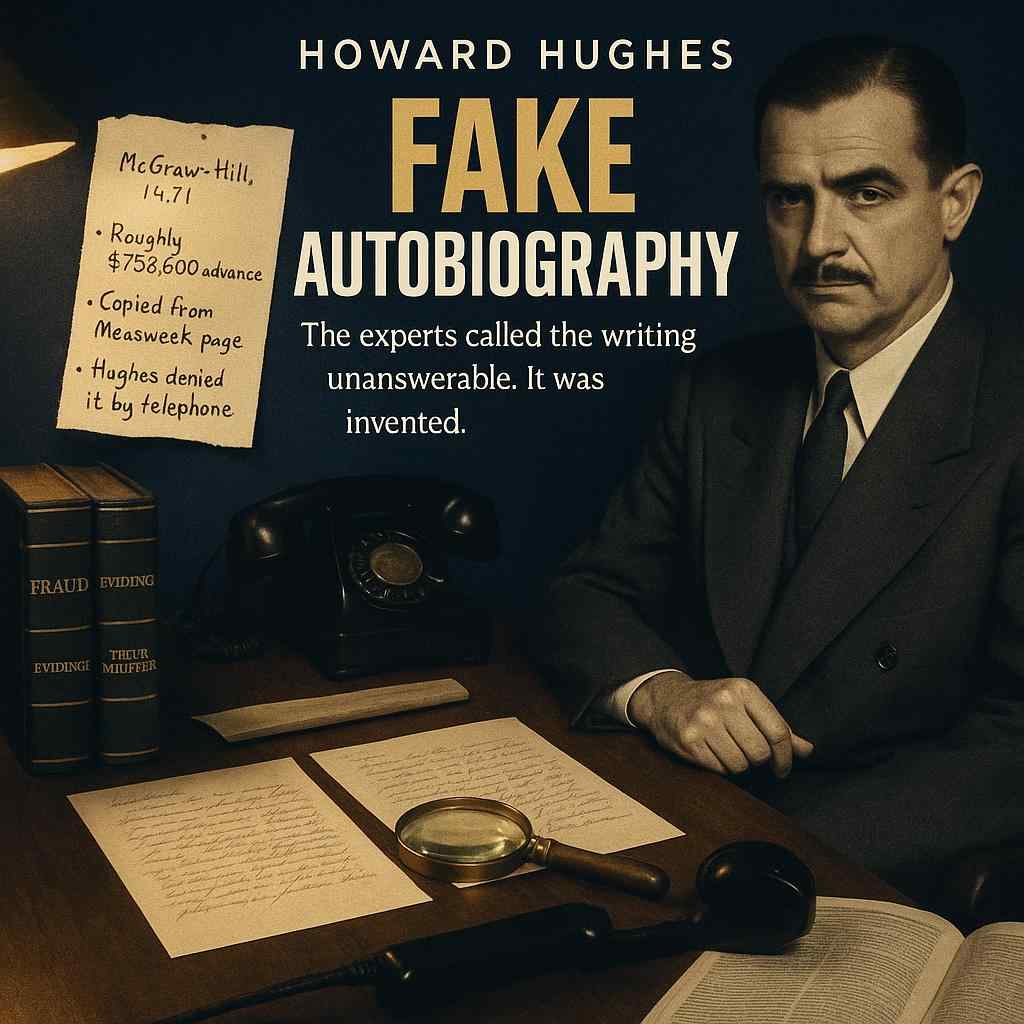
Irving found his source in a single reproduction of Hughes’s handwriting, published in a 1970 Newsweek article. Using this as his template, Irving carefully copied and constructed the supporting documents. The letters matched each other perfectly—because they were all written by the same forger.
Why Did the Experts Get It Wrong?
McGraw-Hill wasn’t careless. They sent the questioned documents to Osborn Associates, one of the most respected forensic document examination firms at the time. The firm’s report was emphatic: the evidence that one hand wrote the documents was “irresistible, unanswerable and overwhelming.”
And they were right—if the question was whether the documents matched each other. But the problem was deeper. The documents matched because Irving had forged them all, based on a single public sample. Without genuine, varied examples of Hughes’s real handwriting to compare, the examiners could only say that the documents were consistent with themselves. They could not reliably say they were genuine Hughes.
How Was the Hoax Exposed?
The unraveling came not through handwriting analysis alone, but through a dramatic intervention. In January 1972, Howard Hughes himself broke his silence. He held a telephone press conference with seven journalists and flatly denied any involvement with Irving or the autobiography.
That was the turning point. Investigators then obtained samples of Clifford Irving’s own handwriting. When these were compared to the disputed documents, revealing details emerged: the same t-crossings, i-dots, and broken letters appeared in both. The forgeries were exposed, and the case against Irving was clear.
What Does This Teach Us About Document Examination?
There’s a crucial lesson here for anyone involved in questioned-document cases. A forensic document examiner relies on comparison—matching the questioned writing to known, genuine samples from the suspected writer. If all you have are forged documents and no authentic exemplars, even the best expert can be misled. The documents may match each other perfectly, but that proves nothing about their authenticity.
In my experience, the quality of your comparison material makes or breaks an expert opinion. Attorneys should always secure genuine writing samples (called “exemplars”) from the suspected writer, not just the document in dispute. The more varied and natural the samples, the stronger the examination.
What Should You Do If You Face a Questioned Document?
If you ever find yourself dealing with a questionable will, signature, or document, take care with the evidence. Preserve the originals—don’t write on them, staple them, or let them be handled unnecessarily. Get a forensic document examiner involved early, and provide as many genuine writing samples as possible. The right preparation can make all the difference in finding the truth.
Frequently Asked Questions
What happened in the Clifford Irving Howard Hughes autobiography case?
In 1971, Clifford Irving forged documents and letters to convince McGraw-Hill that he was working with Howard Hughes on an authorized autobiography. The documents were later revealed to be forgeries.
When did the Howard Hughes fake autobiography hoax occur?
The hoax took place in 1971, with Howard Hughes publicly denying involvement by telephone in January 1972.
What was the outcome of the Clifford Irving case?
Clifford Irving pleaded guilty and was sentenced to 2.5 years in prison, serving 17 months.
Was the handwriting or document ever questioned, and what role did document examination play?
Yes, the documents were examined by Osborn Associates, who initially found them consistent with each other. The hoax was exposed after investigators compared the forgeries to Irving’s own handwriting.
How did Clifford Irving forge Howard Hughes’s handwriting?
Irving copied Hughes’s handwriting from a single reproduction in a 1970 Newsweek article and used it to create the forged documents.
What should someone do if they have a questioned document or signature?
They should preserve the original, avoid altering it, and consult a forensic document examiner with as many genuine writing samples as possible.
If you’re dealing with a questioned will, signature, or document, Handwriting Experts Inc. can help. Visit HandwritingExpertUSA.com or call 1-800-980-9030.