In the world of contested wills, few cases have stirred as much debate as the 1868 dispute over Sylvia Ann Howland’s $2 million estate. At the center stood Hetty Green, later known as “the Witch of Wall Street,” accused of forging a will that would have secured her a fortune. The case became famous not just for the personalities or the money involved, but for a single signature—and the statistical storm that followed.
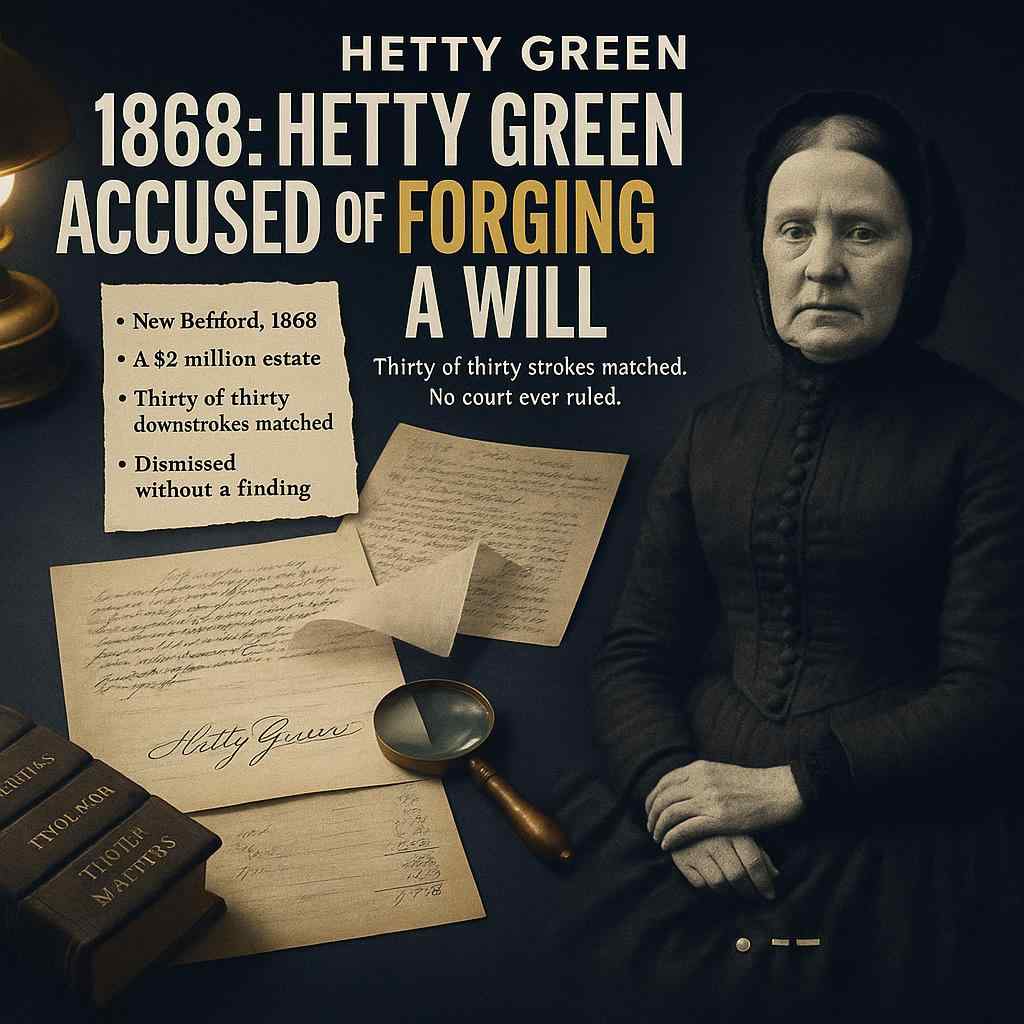
In 1868, Hetty Green was accused of forging a will after a signature matched thirty out of thirty downstrokes with a known genuine signature. Despite the striking match and expert testimony, no court ever ruled the document a forgery.
What Sparked the Controversy?
Sylvia Ann Howland died in 1865, leaving behind an estate worth about $2 million—a staggering sum for the time. Hetty Green, Howland’s niece, stood to gain substantially if a certain will was accepted as genuine. But doubts arose about a key signature on that will. Was it truly Howland’s, or had it been traced or copied?
To answer that, lawyers and experts turned to the signatures themselves. The heart of the dispute was whether one signature had been created by tracing another, a question that would push the boundaries of both forensic science and mathematics in the courtroom.
The Signatures and the Statistical Argument
Enter Charles Sanders Peirce, a noted logician, and his father, Benjamin Peirce, a renowned Harvard mathematician. C.S. Peirce compared 42 genuine signatures of Sylvia Ann Howland, focusing on 30 individual downstrokes in each. When he examined the questioned signature, he found that all 30 downstrokes matched exactly with a known genuine signature.
Benjamin Peirce then testified about the odds of such a match. He calculated the chance of all 30 downstrokes matching between two genuine signatures as roughly one in “two thousand six hundred and sixty-six millions of millions of millions.” In other words, the match was astronomically unlikely if the signatures were both genuine and written independently.
This was one of the earliest uses of statistical evidence in a federal court, and it made headlines. But as any good examiner knows, numbers alone don’t settle every question.
Why the Court Never Ruled on Forgery
Despite the compelling numbers and expert testimony, the court did not declare the signature a forgery. In fact, the judge expressly declined to rule on whether the paper was genuine. The case was dismissed on procedural grounds—specifically, on Hetty Robinson’s (Green’s) competency as a witness. No criminal charges were ever brought, and no court ever found that Hetty Green had forged the will.
This distinction matters. The impressive statistical odds described the chance of such a match between two genuine signatures—not the probability that a forgery had occurred. The difference is subtle but crucial, especially in court, where the burden of proof is high and the meaning of evidence must be clear.
What Would a Document Examiner Look For?
When examining a questioned signature, a forensic document examiner looks for more than just matching strokes. They study natural variation—the small differences that appear when someone signs their name over and over. If two signatures match too closely, especially in fine details like the start and end of each stroke, it can suggest tracing or copying.
Examiners also look for signs of hesitation, unnatural pen lifts, or pressure differences that might indicate a signature was traced rather than written freely. Comparisons are made using known genuine signatures (called exemplars), and the examiner asks: Are the similarities within the range of natural variation, or do they go beyond what’s plausible for genuine writing?
In the Howland case, the statistical match raised a red flag, but without a ruling, the question remained open. It’s a reminder that even the most sophisticated analysis is just one piece of the puzzle.
If You Face a Questioned Will or Signature
If you ever find yourself in a dispute over a will, signature, or any important document, it’s essential to act early. Keep the original document safe and avoid writing on or altering it in any way. Don’t staple, fold, or expose it to unnecessary handling. The sooner a qualified forensic document examiner can review the evidence, the better your chances of a clear and thorough analysis.
Frequently Asked Questions
What happened in the Hetty Green and Howland will case?
In 1868, Hetty Green was accused of forging a will to claim her aunt Sylvia Ann Howland’s $2 million estate after a questioned signature matched a genuine one on all thirty examined downstrokes.
When did the Hetty Green Howland will dispute occur?
The dispute arose after Sylvia Ann Howland’s death in 1865, with the court case taking place in 1868.
What was the outcome of the Hetty Green and Howland will case?
The court dismissed the case without ruling on whether the will or its signature was genuine. Hetty Green was never found to have forged the document.
Was the handwriting or document ever questioned, and what role did document examination play in the Hetty Green Howland will case?
Yes, the signature was questioned. Experts compared the questioned signature to 42 genuine signatures, finding an exact match on thirty downstrokes. Statistical testimony was presented, but the court never ruled on the document’s authenticity.
How did experts examine the signatures in the Howland will case?
Experts compared 30 downstrokes in the questioned signature to those in 42 genuine signatures, looking for matching patterns and using statistical analysis to assess the likelihood of such a match.
What should someone do if they have a questioned will or signature?
They should keep the original document safe, avoid altering it, and consult a qualified forensic document examiner as soon as possible.
If you’re dealing with a questioned will, signature, or document, Handwriting Experts Inc. can help. Visit HandwritingExpertUSA.com or call 1-800-980-9030.