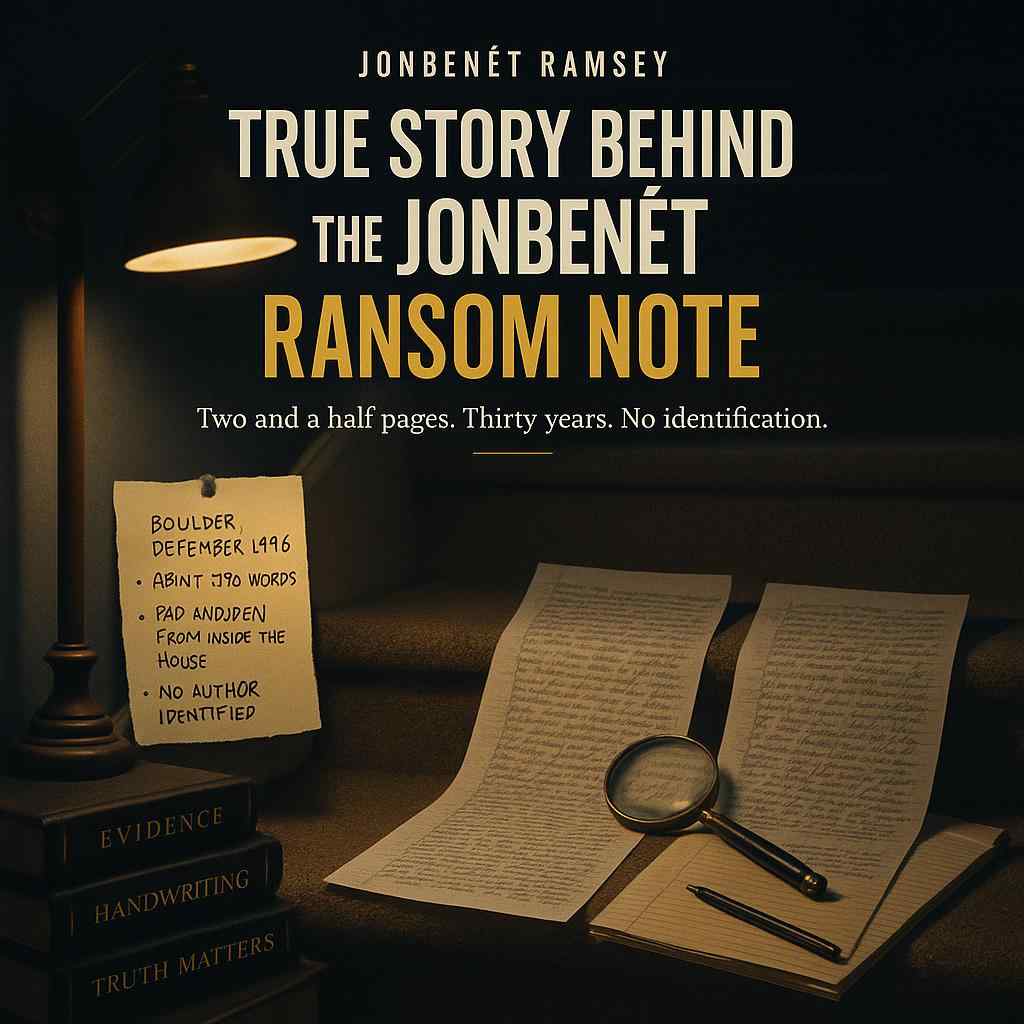
On December 26, 1996, a two-and-a-half-page ransom note was discovered on a staircase in Boulder, Colorado. The note demanded $118,000 for the safe return of JonBenét Ramsey, a six-year-old girl who, heartbreakingly, was already dead inside the house. The pad and pen used to write the note came from inside the Ramsey home, raising immediate questions about who could have written it and when.
Despite extensive forensic analysis by state and private experts, the author of the JonBenét Ramsey ransom note has never been identified. This case is a clear example of how handwriting examination sometimes leads to inconclusive results, even after decades of scrutiny.
What Made the Ransom Note So Puzzling?
The note itself was unusually long—about 370 words spread across two and a half pages. It was found before JonBenét Ramsey’s body was discovered, and its contents immediately became central to the investigation. Unlike most ransom notes, which are brief and direct, this one was detailed and oddly specific, even down to the demand for $118,000, a sum that matched a recent bonus received by JonBenét’s father.
What made the situation even more complex was that the pad and pen used for the note were taken from inside the house. This detail narrowed the field of possible authors to someone who had access to the home that night, but it did not answer the fundamental question: who wrote the note?
How Was the Handwriting Examined?
The JonBenét Ramsey ransom note quickly became one of the most heavily scrutinized documents in American criminal history. The Colorado Bureau of Investigation (CBI) took the lead, performing a detailed forensic analysis of the handwriting. Examiners retained by both law enforcement and the family also conducted independent reviews. Each expert compared the note’s writing to known samples from those close to the case and others who might have had access to the house.
Despite the intense focus, the results were the same across the board. State experts found some indications of authorship but nothing definitive. They could not positively identify or eliminate any individual as the writer. Examiners hired by the family also excluded certain possibilities, but no one was able to reach a conclusion strong enough to name an author. Nearly thirty years later, the case remains open, and no one has ever been charged.
Why Can’t Every Document Be Identified?
There’s a common belief that a handwriting examination will always lead to a clear answer. In reality, there are three possible outcomes: identification, elimination, and inconclusive. Inconclusive does not mean failure—it simply means the available writing does not contain enough unique, habitual features to support a confident opinion either way.
Several factors can make a document difficult or impossible to identify. If the note was written slowly, under stress, or in a disguised hand, the natural writing habits that examiners look for may be absent or suppressed. In the Ramsey case, the length of the note provided more material than most ransom notes, but if the author was intentionally disguising their writing, even a long sample can yield little to work with.
What Does a Document Examiner Look For?
In a case like this, a forensic document examiner compares questioned writing to known samples, looking for individual habits—things like letter forms, slant, spacing, rhythm, and pressure. Examiners work methodically, ruling out natural variation and looking for consistent, distinctive features. When a document is written under duress or with the intent to mislead, many of those features can be masked or altered.
Original documents are always best. Copies can lose subtle details, such as ink flow or pressure marks. When possible, examiners prefer to work from the original note and from genuine, contemporaneous handwriting samples for comparison.
If You Face a Questioned Document
If your family is dealing with a questioned will, signature, or document, the first step is to preserve the original. Avoid writing on, folding, or stapling the document. Seek an examination early, before memories fade and evidence is lost. And always ask your examiner what features would need to be present to support an identification or elimination, before the report is written. If the answer is vague, the opinion is likely to be as well.
Frequently Asked Questions
What happened in the JonBenét Ramsey ransom note case?
On December 26, 1996, a two-and-a-half-page ransom note demanding $118,000 was found in the Ramsey home in Boulder, Colorado. The note was written with a pad and pen from inside the house, and JonBenét Ramsey was later found dead in the same home. The author of the note has never been identified.
When did the JonBenét Ramsey ransom note case happen?
The ransom note was discovered on December 26, 1996, in Boulder, Colorado. The case has remained open for nearly thirty years.
What was the outcome of the JonBenét Ramsey ransom note case?
Despite extensive investigation and forensic analysis, no one has ever been charged in connection with the ransom note, and the author remains unidentified.
Was the handwriting or document ever questioned, and what role did document examination play in the JonBenét Ramsey ransom note case?
Yes, the handwriting was heavily examined by the Colorado Bureau of Investigation and experts retained by both law enforcement and the family. No examiner was able to identify or eliminate any individual as the author.
How does a document examiner approach a ransom note like the one in the JonBenét Ramsey case?
A document examiner compares the questioned writing to known samples, looking for unique writing habits. Factors like disguise or slow writing can make identification difficult.
Why might a handwriting examination result in an inconclusive finding?
An inconclusive result means there are not enough unique features in the writing to identify or eliminate a possible writer. This can happen if the writing is disguised, written slowly, or lacks individual traits.
What should families do if they discover a questionable document?
Families should preserve the original document, avoid marking or altering it, and seek a forensic examination as soon as possible.
If you’re dealing with a questioned will, signature, or document, Handwriting Experts Inc. can help. Visit HandwritingExpertUSA.com or call 1-800-980-9030.