Imagine being accused of a crime you didn’t commit—not once, but twice. Adolf Beck, a respectable Victorian gentleman, found himself at the center of one of England’s most notorious miscarriages of justice. The evidence against him? A series of fraudulent letters, a parade of mistaken eyewitnesses, and the confident testimony of a handwriting expert.
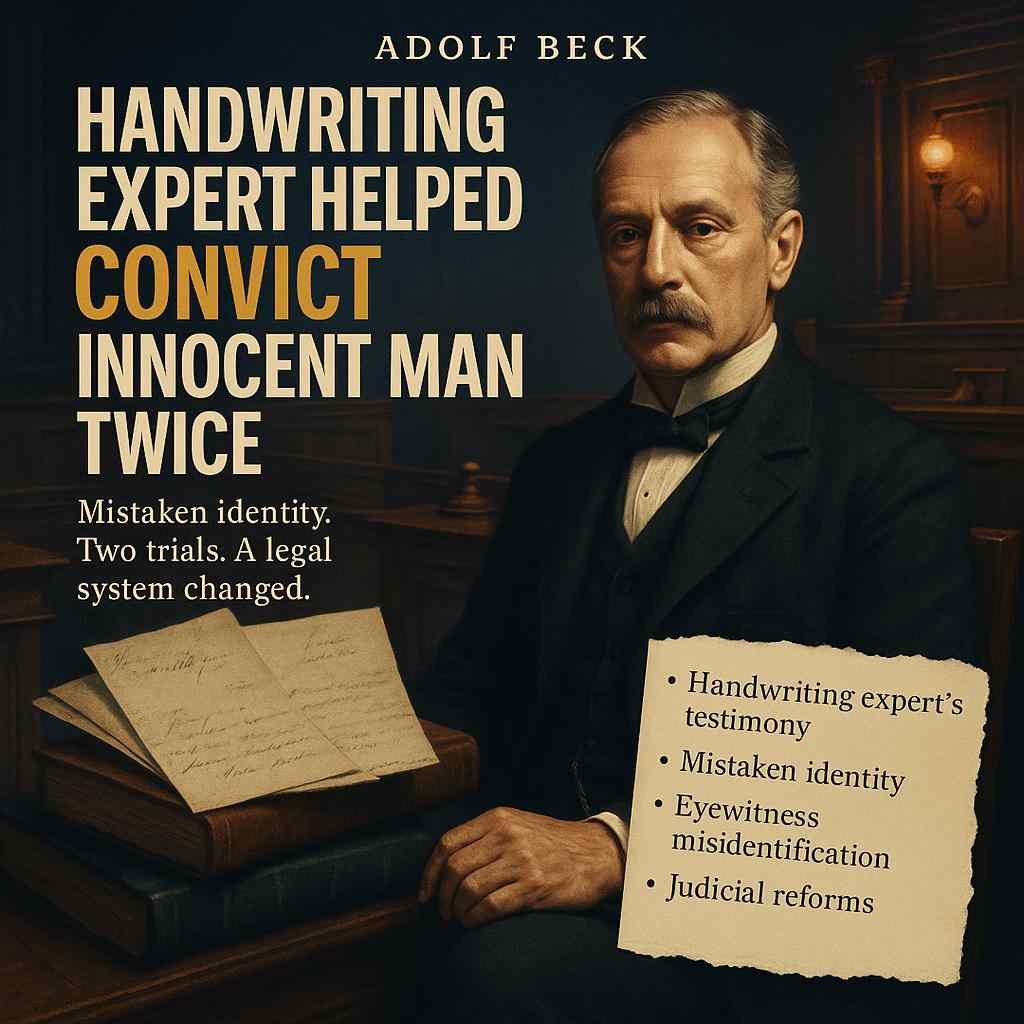
Adolf Beck was wrongfully convicted twice in London, largely on the basis of handwriting analysis and eyewitness misidentification. His ordeal revealed the risks of overreliance on expert testimony and led to major reforms in the British legal system.
How Did Adolf Beck End Up in Court—Twice?
In the late 19th century, a clever fraudster was preying on women in London. Posing as an aristocrat, he would promise marriage or lucrative employment, convincing his victims to hand over their jewelry and valuables. The scheme relied on persuasive letters, written in a hand that seemed to link the crimes together.
When the police finally made an arrest, it was Adolf Beck who stood in the dock. Eyewitnesses confidently identified him as the culprit. Letters allegedly written by the fraudster were compared to Beck’s handwriting. A handwriting expert, Thomas Gurrin, testified that the fraudulent letters were indeed Beck’s, though disguised. The court believed the evidence—and Beck was convicted in 1896.
What Went Wrong With the Evidence?
Beck’s case is a study in how good intentions and expert confidence can go awry. Beck had a strong alibi: during the original crimes in 1877, he was in South America. But this was ignored. Even more troubling, the prosecution blocked any comparison between the 1896 letters and earlier letters from 1877 that could have proved Beck’s innocence. Those earlier letters had been written by Wilhelm Meyer, also known as John Smith—the real perpetrator.
Despite these red flags, the court leaned heavily on the expert’s testimony and the certainty of the eyewitnesses. Beck was sentenced to seven years in prison. After serving his term, he was arrested again in 1904 for similar offenses. Once more, handwriting evidence and mistaken identity led to a conviction.
The Real Culprit Confesses—And the System Responds
In a dramatic turn, the real author of the letters, Wilhelm Meyer, finally confessed in 1904. This confession cleared Beck’s name. He was pardoned and received £5,000 in compensation—a large sum for the time. But the damage had been done: Beck had lost years of his life to a system that failed to see the whole picture.
The fallout from the case was significant. Public outcry and legal debate led to the establishment of the English Court of Criminal Appeal in 1907. For the first time, there was a formal avenue to challenge wrongful convictions in England—a direct result of what happened to Adolf Beck.
What Would a Forensic Document Examiner Look For?
Cases like Beck’s remind us that even expert testimony must be grounded in careful, unbiased analysis. A modern forensic document examiner compares questioned documents to known samples, looking for natural variations in letter forms, spacing, pressure, and rhythm. Genuine signatures and handwriting have subtle inconsistencies—what we call natural variation—that are hard to fake consistently. Disguised or traced writing often reveals tremors, awkward joins, or unnatural uniformity.
But most importantly, a thorough examination means comparing all relevant documents, not just those selected by one side. In Beck’s case, the refusal to compare the 1896 and 1877 letters was a fatal flaw. The right comparison might have spared him years of hardship.
What Should You Do If You Face a Questioned Document?
If you ever find yourself facing a questionable will, signature, or document, the first step is to keep all originals safe and untouched. Avoid writing on, stapling, or otherwise altering the document. Seek a qualified forensic document examiner early in the process—someone who insists on seeing the whole picture, not just a single page.
In my experience, the right question can change a life. Demand that every relevant document is compared. Justice depends on it.
Frequently Asked Questions
What happened in the Adolf Beck case?
Adolf Beck was wrongfully convicted twice in London for fraud, based on letters and handwriting expert testimony, despite strong evidence of his innocence.
When did the Adolf Beck case happen?
Adolf Beck was first convicted in 1896 and again in 1904. The real perpetrator confessed in 1904, leading to Beck’s pardon.
What was the outcome of the Adolf Beck case?
Beck was pardoned after the true culprit confessed, received £5,000 compensation, and his case led to the creation of the English Court of Criminal Appeal in 1907.
Was the handwriting or document ever questioned, and what role did document examination play in the Adolf Beck case?
Handwriting expert Thomas Gurrin testified that Beck wrote the fraudulent letters, but later evidence showed the true author was someone else. The case highlighted the risks of relying solely on expert testimony without full evidence comparison.
How would a forensic document examiner approach a case like Adolf Beck’s today?
A modern examiner would compare all relevant documents, looking for natural variation and signs of disguise, and would insist on unbiased, comprehensive analysis.
What should someone do if they face a questioned will, signature, or document?
Keep all originals safe and unaltered, and consult a qualified forensic document examiner as early as possible.
If you’re dealing with a questioned will, signature, or document, Handwriting Experts Inc. can help. Visit HandwritingExpertUSA.com or call 1-800-980-9030.