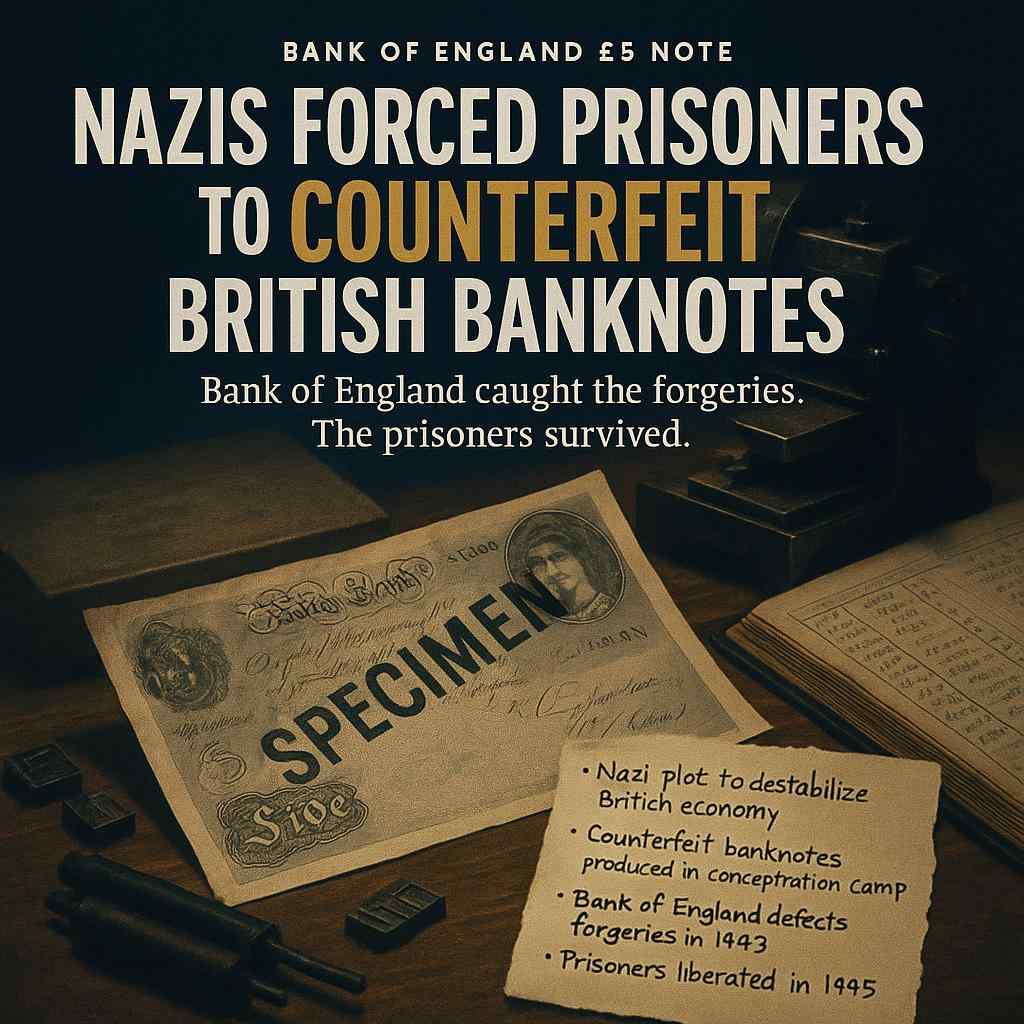
In the midst of World War II, a quiet battle was unfolding far from the front lines. Inside the Sachsenhausen concentration camp, 142 Jewish prisoners were forced by the Nazis to counterfeit British banknotes. Their assignment: produce fake currency so convincing it could destabilize the British economy and fund Nazi operations across Europe.
Operation Bernhard was the Nazi plan to flood Britain with expertly forged banknotes, produced by prisoners under duress. The Bank of England uncovered the scheme in 1943 after spotting a single serial number error, leading to sweeping changes in British currency policy.
The Nazi Plot: Sabotage by Counterfeit
The idea behind Operation Bernhard was as ruthless as it was ambitious. Led by SS Major Bernhard Krüger, the Nazis set out to undermine the British war effort by manufacturing perfect forgeries of £5, £10, £20, and £50 notes. The goal was twofold: destabilize the British economy by flooding it with fake currency, and use the notes to finance espionage and buy war materials.
The operation was housed in Sachsenhausen, a concentration camp north of Berlin. There, skilled prisoners—many of them artists, printers, and bankers—were forced to replicate every detail of British currency. Over the course of the operation, they produced more than £134 million in fake notes, totaling approximately 8.9 million bills.
Outsmarting the Experts: How the Fakes Fooled Europe
What made these forgeries so dangerous was their quality. The prisoners managed to duplicate not only the printed designs, but also the watermarks and paper composition. The notes were so convincing that banks across Europe accepted them as genuine. The Nazis used these forgeries to fund covert operations, pay spies, and purchase goods on the black market.
For a time, the scheme worked. But in 1943, a single detail unraveled the entire plot. The Bank of England discovered a forged note in Morocco with a serial number that had already been marked as paid. This inconsistency—a duplicate serial number—immediately raised red flags. It was the break the bank needed.
The Bank of England’s Response: Containment and Consequence
Once the forgeries were exposed, the Bank of England moved quickly. All notes above £5 were withdrawn from circulation, a drastic step that rendered the existing stock of higher-value notes—both real and fake—worthless. The bank also halted the reissue of £10 notes until 1964, fearing that more counterfeits could surface.
As the Nazis retreated in the final days of the war, many counterfeit bills were dumped in Austria’s Lake Toplitz to avoid discovery. The prisoners who had been forced to produce the notes survived and were liberated in 1945. Yet, the story didn’t end there. Some counterfeit notes resurfaced years later, only to be destroyed by the Austrian National Bank to prevent further fraud.
What Document Examiners Look For in Counterfeiting Cases
Operation Bernhard is a reminder that even the most sophisticated forgeries can leave a trail. When examining suspected counterfeit documents, forensic document examiners focus on details like serial numbers, watermarks, paper quality, and printing techniques. In this case, the duplicate serial number was the telltale sign. Examiners also compare ink composition, fiber content, and microscopic printing features. These elements can reveal whether a document is genuine or a carefully crafted fake.
While signatures are often the focus in will or contract disputes, in currency cases, the integrity of the paper and the accuracy of security features are what matter most. No matter how skilled the forger, a single overlooked detail can expose the truth.
If You Face a Questioned Document
If you ever find yourself dealing with a questionable will, signature, or document, the first step is to preserve the original. Avoid writing on it, stapling, or handling it excessively. Seek a qualified document examiner early in the process—details matter, and an expert can spot inconsistencies that others might miss.
Frequently Asked Questions
What happened in the Operation Bernhard case?
During World War II, Nazis forced 142 Jewish prisoners at Sachsenhausen concentration camp to produce counterfeit British banknotes, aiming to destabilize the British economy and fund Nazi operations.
When did Operation Bernhard happen?
Operation Bernhard took place from 1942 to 1945. The Bank of England detected the forgeries in 1943, and the prisoners were liberated in 1945.
What was the outcome of Operation Bernhard?
The Bank of England withdrew all notes above £5, many counterfeit notes were dumped in Lake Toplitz, and the prisoners survived and were liberated in 1945. The Bank did not reissue £10 notes until 1964.
Was the handwriting or document ever questioned, and what role did document examination play in Operation Bernhard?
The authenticity of the banknotes was questioned. The Bank of England detected the forgeries by spotting a duplicate serial number, and examination of serial numbers, watermarks, and paper exposed the scheme.
How did the Bank of England catch the Operation Bernhard forgeries?
They discovered a forged note in Morocco with a serial number that had already been marked as paid, exposing the counterfeiting operation.
What details do document examiners check in suspected counterfeit currency cases like Operation Bernhard?
Examiners compare serial numbers, watermarks, paper quality, ink, and printing features to determine authenticity and spot forgeries.
What should someone do if they suspect a document or note is counterfeit?
Preserve the original document, avoid handling it unnecessarily, and consult a qualified forensic document examiner as soon as possible.
If you’re dealing with a questioned will, signature, or document, Handwriting Experts Inc. can help. Visit HandwritingExpertUSA.com or call 1-800-980-9030.