Imagine holding a piece of history—a manuscript believed to be written by Galileo himself, describing his first observations of Jupiter’s moons. For decades, the University of Michigan Library treasured such a document, displaying it as a rare artifact from the dawn of modern science. But in 2022, the truth emerged: the manuscript was a modern forgery, its secret betrayed not by ink or handwriting, but by the paper beneath it.
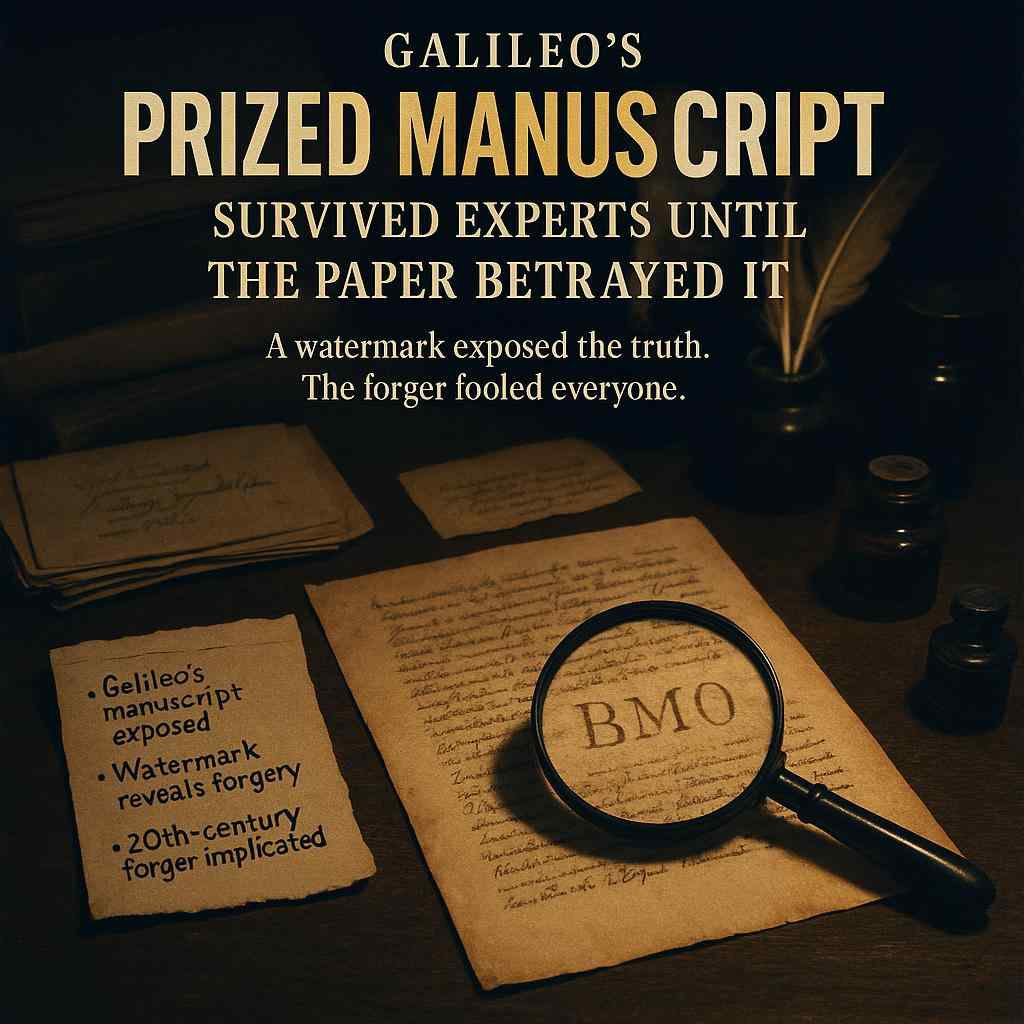
The University of Michigan’s prized Galileo manuscript, thought to date from 1609, was revealed in 2022 as a 20th-century forgery. A historian spotted a watermark on the paper—used decades after Galileo’s time—which proved it could not be authentic.
The Galileo Manuscript: A Treasure with a Hidden Past
The document at the center of this story was a single sheet, with the top half appearing to be a draft letter from Galileo Galilei to the Doge of Venice in August 1609, and the bottom half a set of notes from his January 1610 observations of Jupiter’s moons. This manuscript surfaced publicly at a 1934 auction and was soon acquired by collector Tracy McGregor, who later bequeathed it to the University of Michigan in 1938.
For nearly a century, the manuscript was celebrated as a genuine artifact, surviving the scrutiny of collectors, curators, and even supposed authentication by Cardinal Pietro Maffi—though, as later investigation revealed, Maffi had died years before the auction and the letter attesting to his opinion was missing.
The Forger’s Craft: How Experts Were Fooled
Forgers know that the allure of a famous name can distract even the sharpest eyes. In this case, the forger—believed to be Tobia Nicotra, a prolific 20th-century Italian forger—crafted a document that fit the expectations of scholars and collectors alike. The handwriting, the ink, the style of the text all seemed plausible for Galileo’s era.
In 1934, the manuscript was compared to other documents, including some that were later revealed to be Nicotra’s forgeries as well. Despite these comparisons, the document’s authenticity went largely unquestioned for decades, a testament to the forger’s skill and the challenges of authenticating historical artifacts.
The Watermark That Broke the Case
The turning point came in 2022 when historian Nick Wilding took a closer look at the manuscript’s paper. Using a light table, he identified a watermark: “AS/BMO.” The “BMO” stood for Bergamo, a mark not found on any paper dated before 1770—long after Galileo’s death in 1642. Two paper experts confirmed that the sheet was made no earlier than the late 18th century.
This single detail unraveled the entire story. No matter how convincing the handwriting or ink, the paper itself was an anachronism—an impossibility for a document supposedly written in 1609. The library reexamined the manuscript and, based on the new evidence, concluded it was a 20th-century forgery, likely one of Nicotra’s many clever fakes.
How Document Examiners Approach Cases Like This
Cases like the Galileo manuscript show why forensic document examination goes far beyond handwriting. When authenticating a historical document, examiners consider:
- Paper and Watermarks: The composition, age, and origin of the paper can reveal if it matches the purported date. Watermarks are especially valuable, as they can often be traced to specific regions and time periods.
- Ink and Writing Instruments: Chemical analysis can determine if the ink or pen was available in the claimed era.
- Handwriting Style: Examiners compare the writing to known authentic samples, looking for natural variation and period-appropriate forms.
- Provenance: The document’s ownership history is checked for gaps or suspicious claims.
In this case, it was the watermark—a detail invisible to the naked eye and overlooked for decades—that exposed the truth. It’s a reminder that every part of a document, from the signature to the fibers of the paper, can hold the key to its authenticity.
What This Means for Collectors and Attorneys
The Galileo manuscript forgery is a cautionary tale for anyone dealing with valuable or historic documents. Even artifacts that have survived decades of expert scrutiny can harbor secrets. If you inherit, purchase, or contest a document, always request a thorough forensic examination.
Keep the original document safe and unaltered, avoid writing on or stapling it, and seek expert analysis early. Sometimes, it’s the smallest clue—a watermark, a fiber, a gap in provenance—that will make all the difference.
Frequently Asked Questions
What happened in the Galileo manuscript forgery case?
The University of Michigan’s prized Galileo manuscript, believed to date from 1609, was revealed in 2022 to be a 20th-century forgery after experts discovered a modern watermark in the paper.
When did the Galileo manuscript forgery come to light?
Historian Nick Wilding contacted the University of Michigan in mid-2022, and the forgery was publicly reported in August 2022.
What was the outcome of the Galileo manuscript forgery case?
The University of Michigan Library concluded the manuscript was a 20th-century forgery, likely by Tobia Nicotra, and updated its catalog record and teaching approach.
Was the handwriting or document ever questioned, and what role did document examination play in the Galileo manuscript case?
The handwriting and provenance were previously considered authentic, but the key evidence was the paper’s watermark, which proved the document could not be from Galileo’s time.
How do forensic document examiners detect forgeries like the Galileo manuscript?
Examiners analyze paper, watermarks, ink, handwriting style, and provenance to determine if a document matches its claimed origin.
Who was Tobia Nicotra, and what was his connection to the Galileo manuscript?
Tobia Nicotra was a prolific 20th-century Italian forger believed to have created the Galileo manuscript and many other fake historical documents.
What should collectors or families do if they suspect a document is forged?
They should keep the original document safe, avoid altering it, and seek a forensic document examination as soon as possible.
If you’re dealing with a questioned will, signature, or document, Handwriting Experts Inc. can help. Visit HandwritingExpertUSA.com or call 1-800-980-9030.