When billionaire Howard Hughes died in April 1976, the world was left with a question: what would become of his vast fortune? Hughes died aboard a plane over Texas, and despite his immense wealth—estimated at north of a billion dollars—no one could find a will.
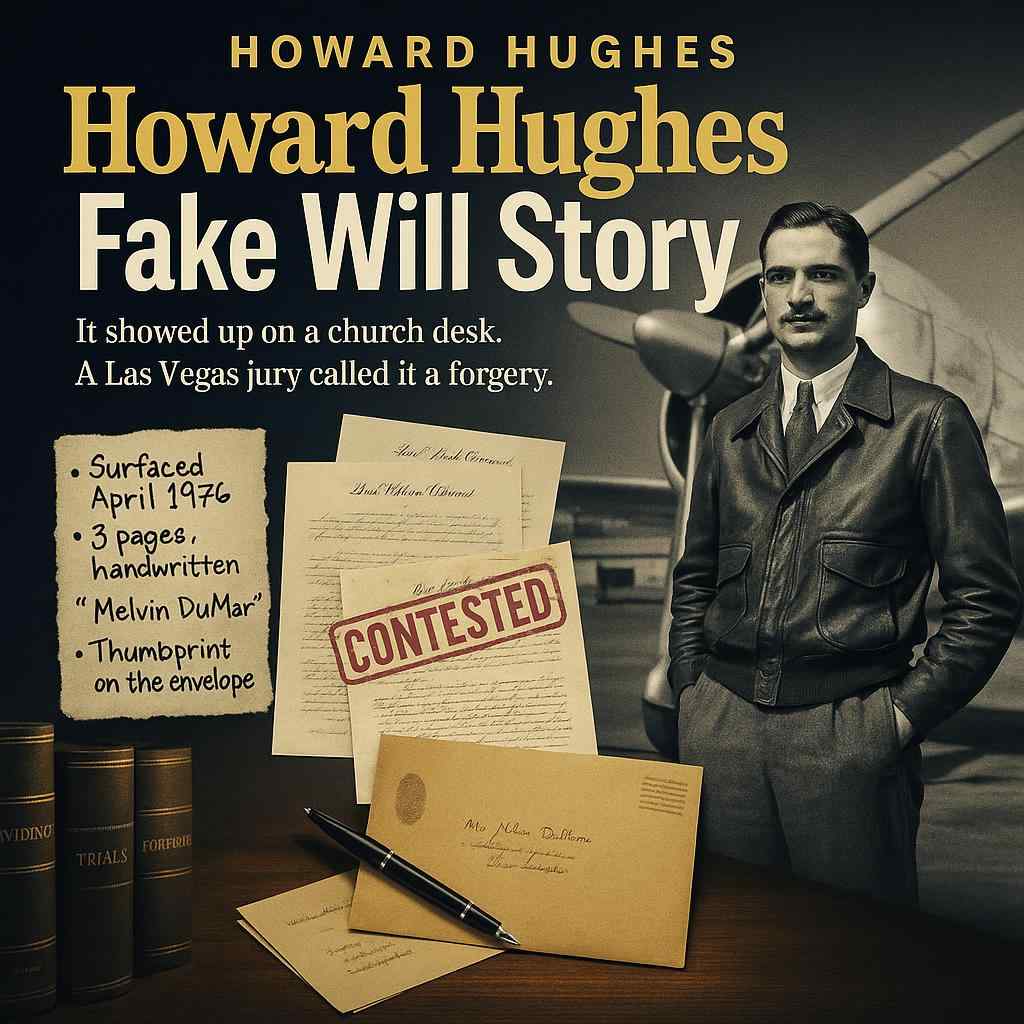
Three weeks later, that changed. At the headquarters of the LDS Church in Salt Lake City, an envelope appeared on a desk. Inside were three handwritten pages, purporting to be Hughes’ last will and testament. No one saw who delivered it. But the document would soon ignite one of the most curious probate battles in American history.
A handwritten will naming Howard Hughes’ heirs surfaced mysteriously at a church office after his death. After a lengthy trial, a Las Vegas jury found it was a forgery, ending one of the most talked-about estate contests of the era.
What Was in the “Mormon Will”?
The document split Hughes’ estate into sixteen shares. One share went to the LDS Church. Another went to a man named “Melvin DuMar” (often spelled Dummar in records). DuMar was a gas station operator in Box Elder County, Utah—hardly the sort of person you’d expect to find in a billionaire’s will.
DuMar’s story was as improbable as the will’s appearance. He claimed that in 1967, he found an old man lying in the Nevada desert, drove him to Las Vegas, and gave him a quarter for a pay phone. The man, he said, was Howard Hughes. Years later, DuMar’s name appeared in the mysterious will.
The Envelope, the Thumbprint, and the Changing Story
At first, DuMar said he had no idea how the will ended up at the church. But when the FBI examined the envelope, they found his thumbprint on it. DuMar then changed his story, claiming a stranger had dropped the envelope at his gas station, that he’d steamed it open, read it, and delivered it himself to Salt Lake City.
Investigators also discovered that DuMar’s wife worked at a magazine that circulated among the wealthy, where she reportedly had access to Hughes’ memos and signature. She denied any involvement, but the coincidence raised eyebrows.
The Trial in Las Vegas
The will was filed for probate in Clark County, Nevada, on April 29, 1976. The case drew national attention. The so-called “Mormon Will” was at the center of a legal battle that would last for years. Handwriting experts testified for both sides, each offering their opinion on whether the will was genuine or a clever forgery.
On June 8, 1978, after about eleven hours of deliberation, the Clark County jury reached its decision: the will was a forgery. No criminal charges were ever filed. The estate was distributed according to existing law, and Melvin DuMar did not receive a share.
The story didn’t end there. Hollywood took notice, and the saga became the basis for the 1980 film Melvin and Howard. DuMar, for his part, spent the rest of his life insisting he had told the truth.
How Document Examiners Approach Cases Like This
Cases like the Hughes “Mormon Will” are a reminder of just how much can ride on a few pages of handwriting. When a document’s authenticity is questioned, forensic document examiners look at much more than just the signature. They examine the letterforms, the pressure and speed of the pen, the rhythm of the writing, and the type of paper and ink used. They compare the questioned writing to known samples from the supposed author, looking for both similarities and differences.
Natural variation—the small, unconscious differences in anyone’s handwriting—is a key part of the analysis. Too much consistency can be a red flag for tracing or forgery. Examiners also pay attention to the story behind the document: how it surfaced, who handled it, and whether the physical evidence (like a thumbprint on an envelope) lines up with the narrative.
One thing I’ve learned after testifying in courtrooms across the country: it’s not the famous name or the dramatic backstory that decides a case. It’s whether the examiner can clearly show the jury, in plain language, why the document fits—or doesn’t fit—the person it’s attributed to.
What Should You Do If You Face a Questioned Will?
If you ever find yourself facing a will, signature, or document that doesn’t seem right, there are a few steps to take. First, keep the original document safe—don’t write on it, staple it, or try to “fix” anything. The condition of the original is critical for examination. Second, reach out to a qualified forensic document examiner early in the process. The sooner an expert can look at the document, the better your chances of understanding what’s really on the page.
Frequently Asked Questions
What happened in the Howard Hughes ‘Mormon Will’ case?
After Howard Hughes died in 1976, a handwritten will surfaced at the LDS Church headquarters, naming sixteen heirs including Melvin DuMar and the church. The will was contested in court.
When did the Howard Hughes ‘Mormon Will’ case happen?
Howard Hughes died in April 1976. The will surfaced three weeks later and was filed for probate on April 29, 1976. The jury delivered its verdict on June 8, 1978.
What was the outcome of the Howard Hughes ‘Mormon Will’ case?
A Las Vegas jury found the will was a forgery after about eleven hours of deliberation. No criminal charges were filed, and the estate was not distributed according to the will.
Was the handwriting or document ever questioned, and what role did document examination play in the Howard Hughes ‘Mormon Will’ case?
Yes, the handwriting on the will was questioned. Handwriting experts testified for both sides during the probate trial, and their analysis was part of the evidence considered by the jury.
How do forensic document examiners analyze a questioned will like the Howard Hughes case?
Examiners compare letterforms, pen pressure, writing rhythm, and materials to known samples, looking for natural variation and signs of forgery.
What should I do if I suspect a will or document is forged?
Keep the original document safe and unaltered, and consult a qualified forensic document examiner as soon as possible.
Who was Melvin DuMar in the Howard Hughes will case?
Melvin DuMar was a Utah gas station operator whose name appeared as a beneficiary in the handwritten will, and who claimed to have once helped Hughes in the Nevada desert.
If you’re dealing with a questioned will, signature, or document, Handwriting Experts Inc. can help. Visit HandwritingExpertUSA.com or call 1-800-980-9030.