In 1929, a man named Martin Coneely walked into the Library of Congress and asked to see some old documents. He left with something remarkable—a pay warrant from 1786 signed by Benjamin Franklin. Coneely tried to sell it to a New York dealer, who promptly declared it a fake. It wasn’t. But that moment changed everything for Coneely, because he realized something crucial: the people buying historical documents often couldn’t tell the difference between real and forged.
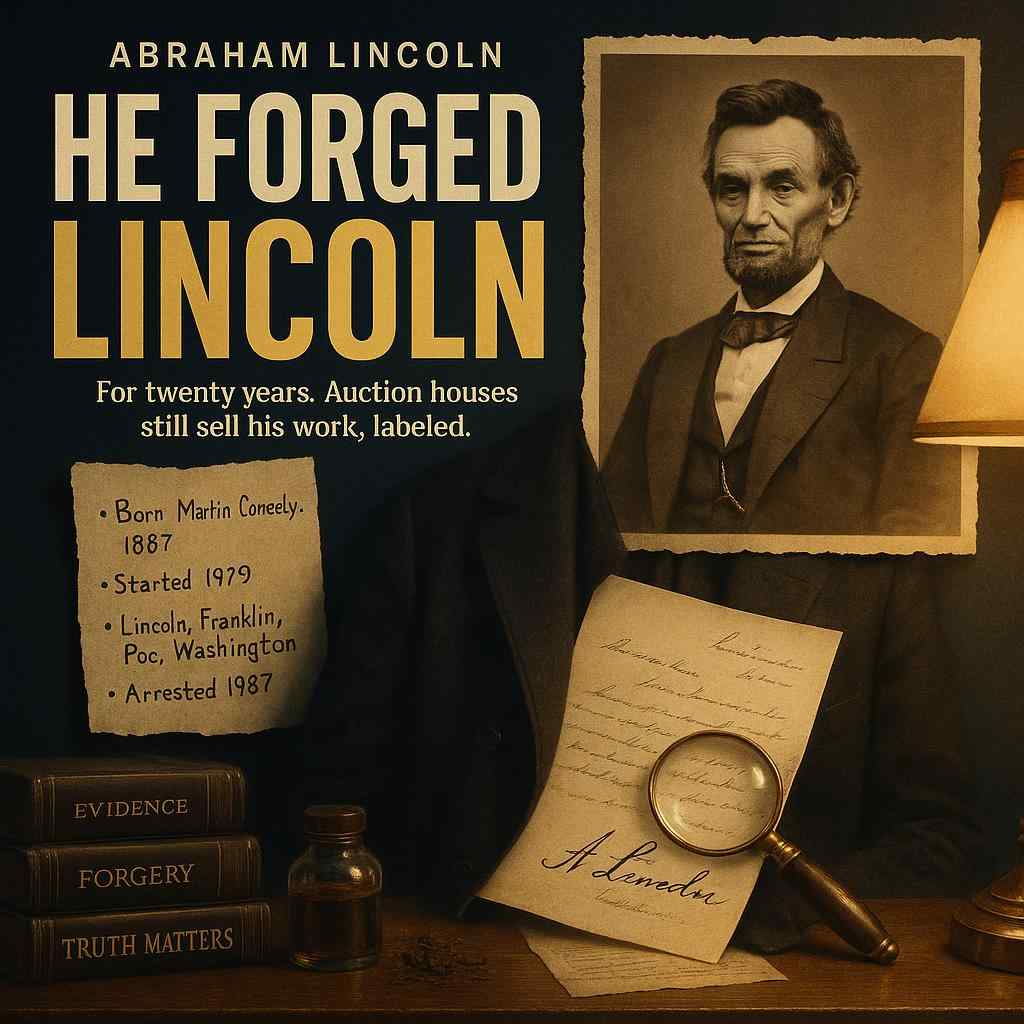
Joseph Cosey, born Martin Coneely, spent two decades forging letters and documents in the names of Abraham Lincoln, Benjamin Franklin, and others. His work fooled collectors and still circulates, now openly labeled as forgeries. Experts spot fakes not by one dramatic test, but by careful comparison of habits and details.
The Making of America’s First Convicted Forger
After that pivotal encounter, Coneely reinvented himself as Joseph Cosey. He became notorious for his skill in imitating the handwriting and style of famous Americans. He didn’t just copy signatures—he produced entire letters, legal briefs, and manuscripts. His subjects ranged from Abraham Lincoln and George Washington to Edgar Allan Poe and Thomas Jefferson. Among his most audacious creations were a supposed “draft” of the Declaration of Independence in Jefferson’s hand and the “manuscript” of Poe’s The Black Cat.
Cosey was methodical. He sourced genuinely old paper, sometimes centuries old. He mixed his own iron-gall ink to match what would have been used in the 18th or 19th centuries. For nearly twenty years, his forgeries made their way into collections, museums, and auction houses.
How Cosey’s Forgeries Fooled—and Failed
Joseph Cosey’s Lincoln letters were especially convincing. According to a 1956 New Yorker profile, he “papered the country” with so many Lincoln forgeries that the autograph market never fully recovered. Some of his fakes are still believed to be in collections today, catalogued as real.
But even the best forger leaves traces. Cosey’s attention to detail often stopped at the main signature. When a document required a second signature—a clerk’s countersignature—he rarely matched the real clerks’ handwriting or names. His Franklin signatures sometimes mimicked Franklin’s style from a decade too early for the supposed date. The more you compare, the more the forger’s own habits start to show through.
Eventually, Cosey was caught. He was arrested in 1937, served about a year in prison, and reportedly returned to forgery after his release. He continued his work into the 1940s and died around 1950. Today, auction houses like RR Auction and Bonhams sell known Cosey forgeries as their own category—labeled, and fetching a few hundred dollars each.
How Document Examiners Spot a Forgery
In my experience as a forensic document examiner, forgery detection is rarely about a single dramatic test. It’s about habits. No one writes exactly the same way twice, and no two people write exactly alike. A skilled forger can copy the shape of a letter, but the underlying rhythm, pressure, and natural variation are much harder to fake.
When examining a questioned document, I look for:
- Consistency with known examples (called exemplars) of the real person’s handwriting
- Signs of tracing, hesitation, or unnatural pen lifts
- Matching ink and paper to the claimed period—but also whether those materials are used in a way that makes sense
- Unusual content or phrasing that doesn’t fit the historical figure’s style
- Secondary signatures or countersigns that match known clerks or witnesses
That’s why, when attorneys or families bring me a document, I always ask for as many genuine examples as possible—checks, cards, contracts, or any writing in the person’s ordinary hand. The more I can compare, the stronger my opinion.
Lessons from the Cosey Case
Joseph Cosey’s story is a reminder that even the best forgeries eventually reveal themselves to careful eyes. The autograph market learned this the hard way. Today, his forgeries are openly sold as curiosities, but some may still be catalogued as genuine in private collections.
If you suspect a will, letter, or historical document might not be genuine, the best first step is preservation. Keep the original safe—don’t write on it, staple it, or expose it to unnecessary handling. Gather as many known samples of the real person’s handwriting as you can. And consult a qualified forensic document examiner early in the process. A careful comparison can save years of uncertainty—or prevent a costly mistake.
Frequently Asked Questions
What happened in the Joseph Cosey and the Lincoln forgeries case?
Joseph Cosey, born Martin Coneely, forged letters and documents in the names of Abraham Lincoln, Benjamin Franklin, George Washington, Edgar Allan Poe, and others. His forgeries circulated widely, some still catalogued as real today.
When did the Joseph Cosey forgeries happen?
Cosey began forging documents in 1929 and continued for nearly twenty years. He was arrested in 1937, served about a year in prison, and continued forging into the 1940s.
What was the outcome of the Joseph Cosey case?
Joseph Cosey was arrested in 1937, served about a year in prison, and reportedly continued forging documents after his release. He died around 1950.
Was the handwriting or document ever questioned, and what role did document examination play in the Joseph Cosey case?
Yes, Cosey’s forgeries were eventually identified through careful comparison with genuine documents. Experts noticed inconsistencies in habits, historical details, and secondary signatures.
How do forensic document examiners spot forgeries like those of Joseph Cosey?
Examiners compare questioned documents with known genuine examples, looking for natural variation, signs of tracing, material consistency, and content that fits the person’s style.
Are Joseph Cosey forgeries still in circulation?
Yes, some Cosey forgeries are believed to still be in collections today. Auction houses now sell known Cosey forgeries as labeled collectibles.
What should someone do if they suspect a will or document is forged?
Preserve the original document, gather genuine handwriting samples, and consult a qualified forensic document examiner as early as possible.
If you’re dealing with a questioned will, signature, or document, Handwriting Experts Inc. can help. Visit HandwritingExpertUSA.com or call 1-800-980-9030.