When you hear the name Martha Stewart, you might think of home décor or television, not a federal courtroom. Yet in 2004, Stewart found herself at the center of a high-profile criminal trial in Manhattan, with a single handwritten notation—“@ 60”—playing a surprisingly visible role.
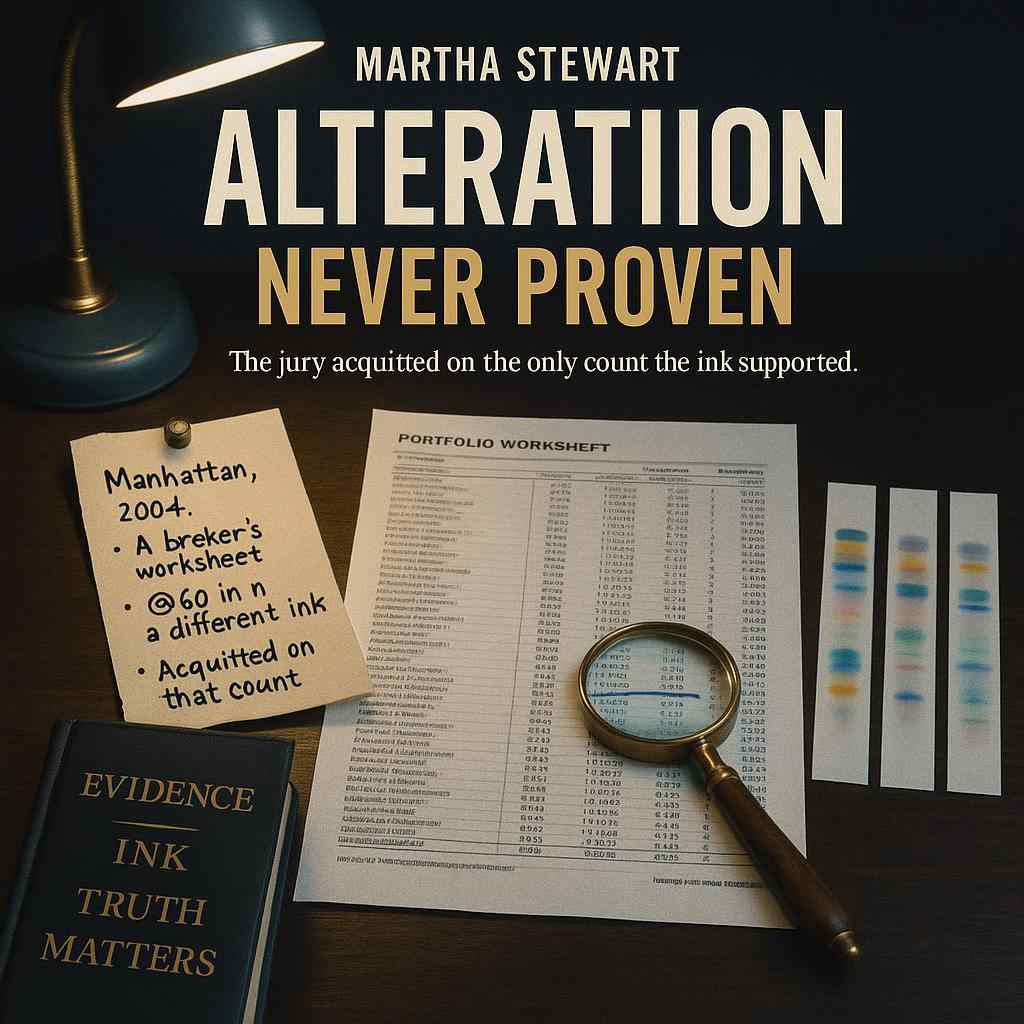
In Martha Stewart’s 2004 trial, a broker’s worksheet carried a contested “@60” notation. Forensic ink analysis showed it was written with a different pen than the rest. The jury acquitted on the only charge that depended on that ink evidence.
The Document at the Heart of the Case
The story began with Stewart’s sale of ImClone stock, a move that brought government scrutiny and eventual prosecution. One document became a focal point: a worksheet from Peter Bacanovic, her Merrill Lynch broker. On this page, beside the ImClone entry, someone had written “@ 60.”
The defense claimed this notation was an ordinary instruction—Stewart wanted to sell if the price hit sixty dollars. Prosecutors, however, suggested the “@ 60” had been added after the fact, as part of a cover story. The ink itself became evidence.
What the Ink Showed—and Didn’t
A Secret Service forensic scientist was called to the stand. His analysis? The “@ 60” was written in ink different from the other notations he tested on the worksheet. This suggested it might have been added at a different time, or with a different pen, than the rest of the notes. Prosecutors argued this was proof of alteration.
But forensic evidence is rarely the whole story. The jury heard the ink testimony, but they also saw everything else—the timeline, the explanations, and the rest of the government’s case. When it came to the count that depended on the worksheet alteration, the jury acquitted Bacanovic. Stewart herself was convicted of conspiracy, making false statements, and obstruction, but not on any count tied directly to the ink or the worksheet.
How Forensic Document Examiners Approach Ink and Notations
Cases like this illustrate what a forensic document examiner actually does. When examining a document, we look at much more than handwriting. Ink analysis can reveal whether a particular entry was made with the same pen as other notes on the page. Tools like thin-layer chromatography can separate ink components, making differences visible even when colors look similar to the naked eye.
But the examiner’s job is to give an objective finding: Are the inks the same or different? Was the notation written at the same time as the rest? We do not—and should not—speculate on motives or intent. That’s for the attorneys and the jury to decide.
Evidence Versus Conclusions: The Jury’s Role
This case is a reminder of the difference between what a forensic examiner can tell you and what a jury must decide. Even when the science is clear—like showing two inks differ—the legal meaning isn’t automatic. The jury weighs the evidence in the broader context of the case.
Attorneys should know: a document examiner provides findings, not arguments. The ink can support a theory, but it doesn’t prove it by itself. In the Stewart trial, the ink evidence was clear, but the jury’s decision reflected the larger picture.
If You Face a Questioned Document
If you’re dealing with a document where timing, ink, or authenticity is in question, keep the original safe and avoid making marks or stapling the page. Get a qualified examiner involved early. The earlier the examination, the more options you have for testing and preserving evidence.
Frequently Asked Questions
What happened in the Martha Stewart @60 worksheet case?
In Martha Stewart’s 2004 trial, a broker’s worksheet included a handwritten “@60” notation. The ink used for this note was different from the rest, raising questions about when and why it was added.
When did the Martha Stewart worksheet case happen?
The events and trial took place in Manhattan in 2004. Martha Stewart was convicted on March 5, 2004, and sentenced on July 16, 2004.
What was the outcome of the Martha Stewart @60 worksheet case?
The jury acquitted Peter Bacanovic on the charge involving alteration of the worksheet. Martha Stewart was convicted of conspiracy, false statements, and obstruction, but not on any charge related to the ink evidence.
Was the handwriting or document ever questioned, and what role did document examination play in the Martha Stewart case?
Yes, the ink of the “@60” notation was analyzed by a Secret Service forensic scientist, who found it differed from other notations. The jury acquitted on the only count the ink evidence supported.
How do forensic document examiners analyze ink differences?
Examiners use methods like thin-layer chromatography to compare ink samples, determining if different pens or times were used for notations.
What should I do if I suspect a document has been altered?
Keep the original document safe, avoid adding marks or staples, and consult a qualified forensic document examiner as soon as possible.
If you’re dealing with a questioned will, signature, or document, Handwriting Experts Inc. can help. Visit HandwritingExpertUSA.com or call 1-800-980-9030.