Imagine opening a letter said to be written by Cleopatra, only to find it penned in flawless nineteenth-century French. That’s exactly what happened in one of history’s most audacious forgery cases—a story that still resonates in courtrooms and archives today.
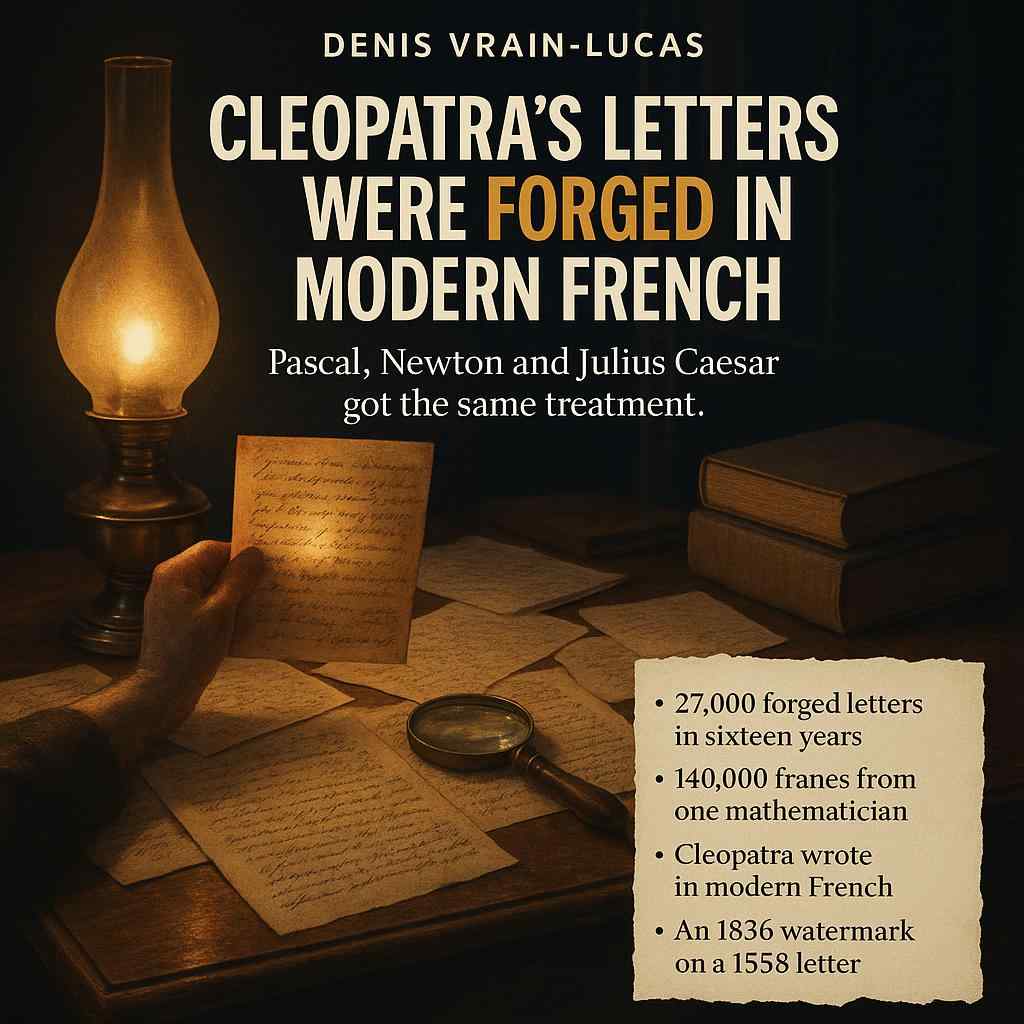
Between 1861 and 1869, Denis Vrain-Lucas sold about 27,000 forged letters to Michel Chasles, a mathematician at the Académie des Sciences. The forgeries included correspondence from figures like Cleopatra, Julius Caesar, and Isaac Newton—all written in modern French. The deception was only exposed when archivists examined the paper and ink, revealing clear anachronisms.
How Did the Vrain-Lucas Forgeries Fool the Experts?
Michel Chasles was a respected mathematician and member of the Académie des Sciences in Paris. In 1861, he began purchasing historical letters from Denis Vrain-Lucas, a dealer who claimed to have unearthed an extraordinary archive. Over the next eight years, Chasles spent between 140,000 and 150,000 francs acquiring what he believed were priceless documents from some of history’s most famous names.
The collection was staggering in scope: letters supposedly written by Cleopatra, Julius Caesar, Mary Magdalene, Judas, and even Isaac Newton. Every one of them, curiously, was written in modern French—the only language Vrain-Lucas actually knew. Yet Chasles was convinced of their authenticity, even presenting correspondence that, he argued, proved Blaise Pascal had discovered the law of gravitation before Newton. When a colleague pointed out that Newton would have been about ten years old at the time, doubts began to surface.
What Finally Exposed the Forgeries?
The turning point came in 1867, when Chasles published some of the forged letters at the Académie. Skepticism grew among his peers, leading to a formal investigation. The court enlisted two archivists—Henri Bordier and Émile Mabille—to examine the documents. Their 1870 report is still considered one of the earliest examples of forensic document examination.
Bordier and Mabille applied a methodical approach. They compared the language, paper, and ink of the supposed ancient letters to known historical standards. The most damning evidence came from the materials themselves: a letter attributed to Charles V, who died in 1558, was written on paper bearing an 1836 watermark. That’s nearly three centuries out of place. The investigators also found that many texts matched printed sources from the 1700s, not the times they were supposedly written.
What Does a Document Examiner Look For in Cases Like This?
In cases involving questioned documents, examiners rely on more than handwriting alone. Here are some of the key elements they analyze:
- Paper and Watermarks: Paper often carries a watermark showing when and where it was manufactured. If the date on the watermark postdates the supposed author, that’s a major red flag.
- Ink and Writing Instruments: The composition of ink can be compared to what was available at the time. Ballpoint pen ink, for example, shouldn’t appear on a letter from the 1700s.
- Language and Style: The vocabulary, spelling, and grammar should match the period. In this case, ancient figures writing in modern French was a giveaway.
- Handwriting Analysis: While a skilled forger can imitate handwriting, natural variation and period-specific letter forms are hard to fake consistently.
Original documents are critical. Copies rarely show details like watermarks or the texture of the ink, which can make or break a case.
What Happened to Denis Vrain-Lucas?
After Bordier and Mabille’s report, the case went to trial. In February 1870, the Correctional Tribunal of Paris sentenced Vrain-Lucas to two years in prison, a 500-franc fine, and court costs. The story became a cautionary tale for collectors, historians, and lawyers alike.
What Can Families and Attorneys Learn from This Case?
The Vrain-Lucas affair shows how easy it is to be misled by a convincing story or a seemingly authentic document. If you’re facing a questioned will, signature, or historical paper, don’t rely on appearances alone. Preserve the original document, avoid writing on or altering it, and consult a qualified document examiner early in the process. Sometimes, the paper itself tells the real story.
Frequently Asked Questions
What happened in the Denis Vrain-Lucas and Chasles forgeries case?
Denis Vrain-Lucas sold about 27,000 forged letters—purportedly from historical figures like Cleopatra and Newton, all written in modern French—to Michel Chasles, a respected mathematician at the Académie des Sciences.
When did the Vrain-Lucas forgeries take place?
The forgeries were sold between 1861 and 1869. The investigation and court report occurred in 1870.
What was the outcome of the Vrain-Lucas case?
In February 1870, Denis Vrain-Lucas was sentenced to two years in prison, fined 500 francs, and ordered to pay court costs.
Was the handwriting or document ever questioned, and what role did document examination play?
Yes, the documents were questioned. Archivists Henri Bordier and Émile Mabille examined the collection, identifying anachronisms like modern paper and language, and their 1870 report is one of the earliest forensic document examinations.
How did experts discover the Vrain-Lucas forgeries?
Experts found that the letters used modern French and that some, like a letter attributed to Charles V, were written on paper with an 1836 watermark—centuries after the supposed author’s death.
What does a forensic document examiner look for in cases like this?
Examiners analyze paper, ink, watermarks, language, and handwriting to determine authenticity. They look for anachronisms and inconsistencies with the claimed time period.
What should someone do if they suspect a will or document is forged?
They should preserve the original, avoid altering it, and consult a qualified forensic document examiner as soon as possible.
If you’re dealing with a questioned will, signature, or document, Handwriting Experts Inc. can help. Visit HandwritingExpertUSA.com or call 1-800-980-9030.