In February 1920, a woman was pulled from Berlin’s Landwehr Canal. She had no identification and spent nearly two years in an asylum, known only as “Miss Unknown.” Over time, she claimed to be Grand Duchess Anastasia, the youngest daughter of Russia’s last Tsar. That claim would ignite one of the longest legal sagas of the twentieth century and captivate the world with the possibility that a Romanov had survived.
Anna Anderson convinced experts and supporters for decades that she was Anastasia, in part through handwriting evidence. But decades later, DNA testing proved she was not related to the Romanov family, ending the mystery.
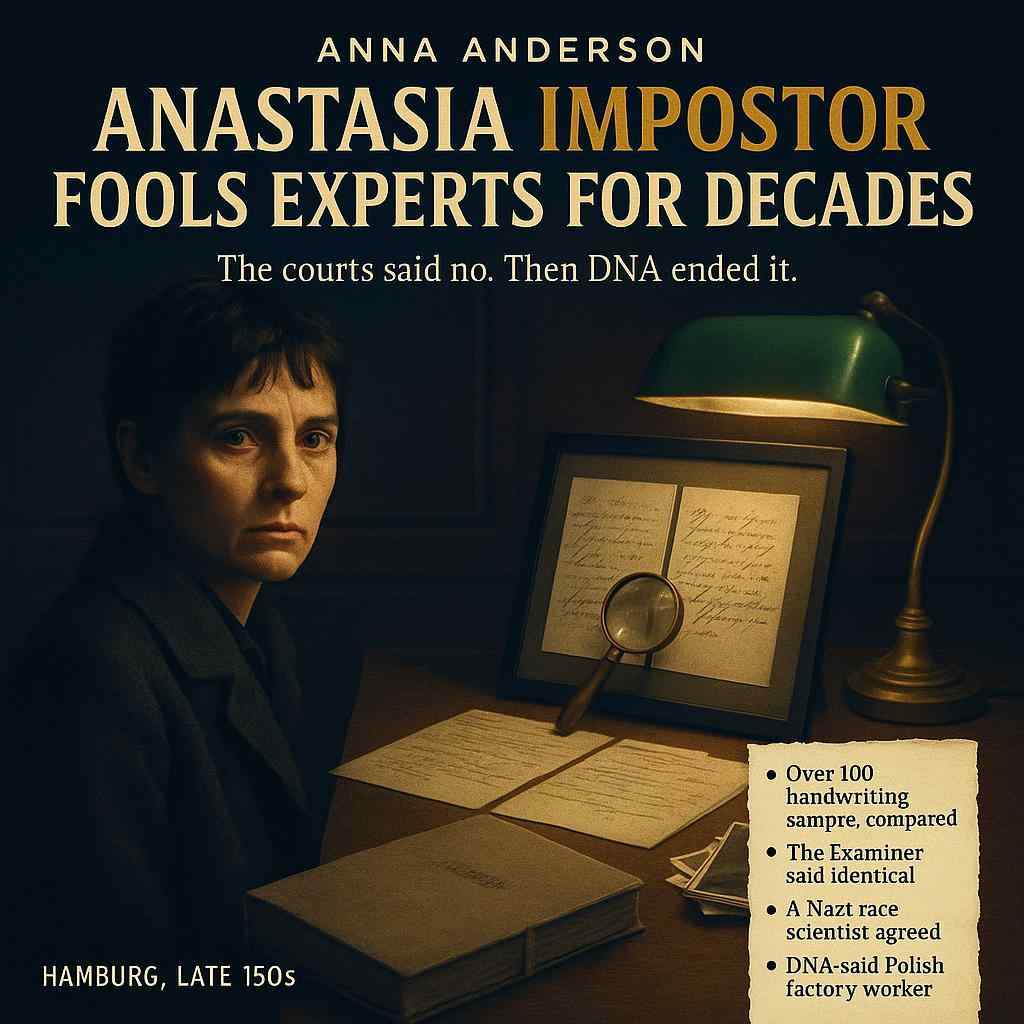
How Did Handwriting Help Anna Anderson’s Claim?
Some of the most persuasive evidence for Anderson’s claim came from handwriting. Dr. Minna Becker, a court-qualified handwriting examiner in Hamburg, compared more than a hundred samples of Anastasia’s handwriting with Anna Anderson’s. Her conclusion was categorical: she believed they were written by the same person. In her words, she had “never before seen two sets of handwriting bearing all these concordant signs which belonged to two different people.” Other experts also weighed in, using physical comparisons such as facial photographs, and some supported Anderson’s claim.
For many, the expert opinion about handwriting seemed decisive. It was offered in court and became a pillar of Anderson’s case as she sought legal recognition as Anastasia across decades of litigation.
What Happened in the Courts?
The legal battle over Anna Anderson’s identity began in earnest in 1938 and lasted for decades, making it the longest-running lawsuit in German history. Courts in Hamburg heard the case multiple times. In 1961, the Hamburg court found that Anderson was not Anastasia. In 1967, she failed to meet her burden of proof on appeal. Finally, in 1970, Germany’s highest court rejected her appeal, not on the facts, but on the legal standard of proof. Despite years of testimony and expert opinions, the courts ultimately did not accept her claim.
How Did DNA Change Everything?
For decades, the mystery lingered. Anderson died in 1984 in Charlottesville, Virginia, with some still believing her claim. It wasn’t until the 1990s that science provided a final answer. Mitochondrial DNA was extracted from Anderson’s preserved tissue and hair samples. This DNA was compared to living relatives of the Romanov family, including Prince Philip, who was related to Anastasia through the maternal line.
The results were clear: Anderson’s DNA did not match the Romanov line. Instead, it matched a relative of Franziska Schanzkowska, a Polish factory worker long suspected of being the real Anna Anderson. The chance she was unrelated to Schanzkowska was reported as less than 1 in 300. But the decisive evidence was the exclusion from the Romanov family, not the inclusion with Schanzkowska. DNA had solved what decades of document and physical comparison could not.
What Would a Document Examiner Look For in a Case Like This?
When a handwriting examiner is asked to compare two sets of writing, the process is methodical. Examiners look for natural variation—those small, unconscious differences that appear in genuine writing samples over time. They compare letter forms, spacing, slant, pressure, and rhythm. A proper examination involves comparing known samples from the same period, using original documents whenever possible, and applying a systematic methodology. The goal is to distinguish between similarities that occur by chance or imitation and those that reflect genuine authorship.
In Anderson’s case, the examiner compared over a hundred samples. But as this story shows, even a confident expert opinion can be upended if the evidence or methodology is incomplete—or if new scientific tools, like DNA, become available later.
What Can Families Learn from the Anna Anderson Case?
If you’re facing a disputed will, signature, or document, it’s important to act carefully from the start. Keep original documents safe and avoid writing on, folding, or stapling them. Seek a qualified document examiner early in the process, and ask them about their methodology—not just their confidence. Remember, certainty in testimony is only as strong as the evidence and methods behind it. And if new evidence emerges, be willing to revisit old conclusions.
Frequently Asked Questions
What happened in the Anna Anderson and Anastasia case?
Anna Anderson claimed to be Grand Duchess Anastasia, the daughter of Russia’s last Tsar. She convinced some experts and supporters, but courts ultimately did not accept her claim.
When did the Anna Anderson case happen?
Anna Anderson was found in Berlin in February 1920. The legal battle began in 1938, with major court rulings in 1961, 1967, and 1970. DNA evidence was published in 1995.
What was the outcome of the Anna Anderson case?
German courts ruled that Anna Anderson was not Anastasia. Later, DNA testing in the 1990s showed she was not related to the Romanov family, but matched a relative of Franziska Schanzkowska.
Was the handwriting or document ever questioned, and what role did document examination play in the Anna Anderson case?
Handwriting was a key piece of evidence. A court-qualified handwriting examiner compared over 100 samples and concluded Anderson and Anastasia had identical handwriting. Decades later, DNA evidence contradicted this opinion.
How do handwriting examiners compare signatures or documents in cases like Anna Anderson’s?
Examiners compare features like letter shapes, spacing, slant, and pressure, looking for natural variation and consistent patterns. They use known samples and systematic methods to reach their conclusions.
What should a family do if they face a disputed will or signature?
Keep the original document safe, avoid altering it, and consult a qualified forensic document examiner early in the process.
If you’re dealing with a questioned will, signature, or document, Handwriting Experts Inc. can help. Visit HandwritingExpertUSA.com or call 1-800-980-9030.