How can you tell if a signature was cut and pasted?
You’re looking at a document and recognize your signature- but you know that you didn’t sign that document.
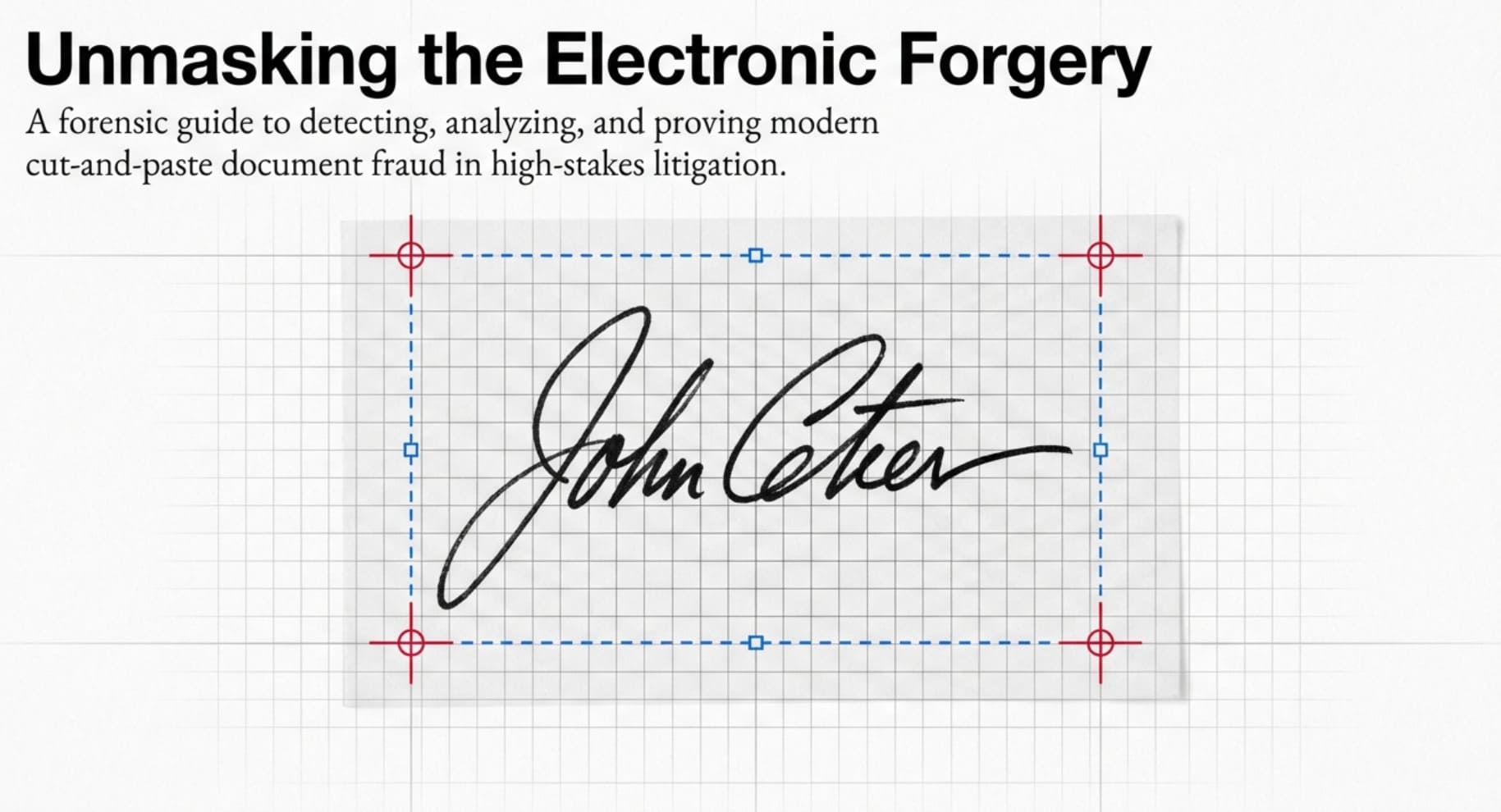
This kind of forgery is called a cut and paste. Forgers used to use scissors and tape to cut someone’s signature out of an old document and copy it into a new document.
Now, a cut and paste is usually done electronically- and is sometimes referred to as an electronic transfer.
These days, with Photoshop, Microsoft Word, and scanners, a fifth grader could do a cut and paste and make it look pretty authentic.
Back in 1972, you had to be pretty fancy. You had to have tape, scissors, copy machines, and shadows.
That’s why a lot of examiners that are in their 70s and 80s don’t fully understand the technology behind Photoshop and electronic transfers; they are so used to dealing with the older style of cut and paste forgeries.
If you’re going to hire a forensic handwriting expert, you might want to get someone that’s a little more familiar with software.
Is a cut and paste document still a forgery?
Essentially, a cut and paste is an altered document. It falls into the classification of forgery because the creator manufactures a document that doesn’t exist.
The document usually gives the illusion that a party agreed to a transaction such as a marital settlement, a prenuptial agreement, a stock transfer, etc., that they did not agree to.
And here’s the kicker on a cut and paste. You will never have an original to inspect. Often on cut and paste cases, the court will say that we can’t use the evidence because there’s not an original wet signature.
Well, guess what, judge? If there was a wet signature, it wouldn’t be a cut and paste. By definition, it was created on a computer, and then the doctored file was printed.
So even though you may have a color output, it might be difficult for you to know just the difference between a color output and a wet ink signature without hiring an expensive forensic document examiner to take their microscope and go actually look at the document.
How can I tell the difference between a cut and paste and a wet signature?
So, a couple definitions for you. A wet signature means that the ink at one time was wet because it came out of a pen and it was written by a human. You can identify a wet signature through indentations on the back of the document and teeny tiny ink blots when you zoom in very close.
In a wet signature case, you want to prove that the forged signature was written by someone else.
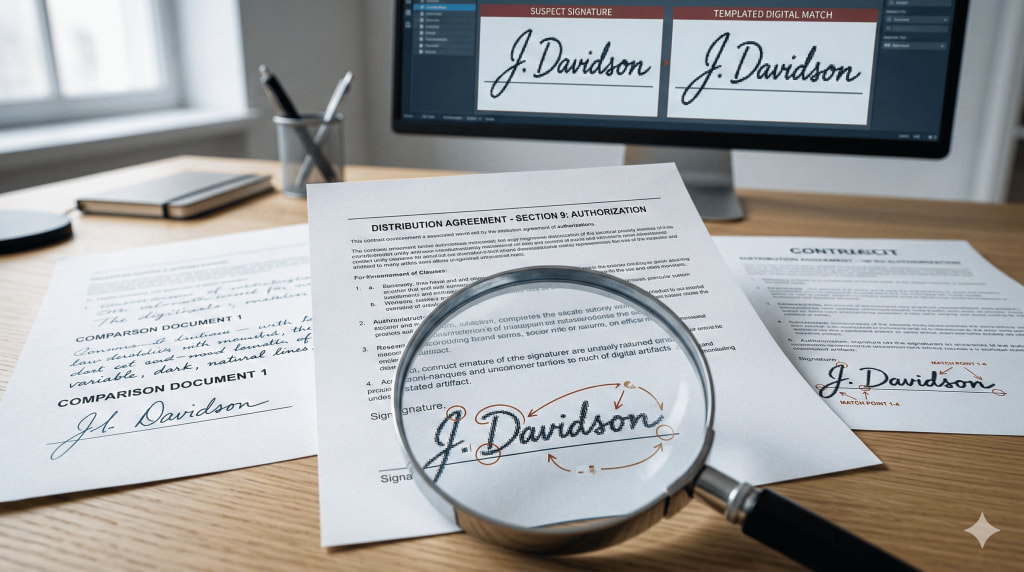
A cut and paste is a lift and copy of a signature from one place to another. In a cut and paste signature, you want to prove that it is your signature, you just didn’t physically sign the altered document.
The secret to proving a cut and paste (and I’ve won 100% of the trials where cut and paste was involved) is you have to find the source document, and if the source document matches that signature exactly, then it’s obviously a cut and paste.
Because there’s a general rule or a general guideline axiom that we use in forensic document examining:
Nobody ever signs their same name twice.
It’s a fact. No one ever signs their name the same way twice. And because of that, there are going to be small micro differences between your own signature, even your initials, even if you sign a hundred times in a row.
It’ll look the same, but there are slight differences and deviances every time you sign anything throughout your whole life.
That rule is really helpful because that axiom tells us if that signature looks like yours, smells like yours, and tastes like yours, but you didn’t sign it, it’s because that *is* your signature, but it wasn’t put there by you. It was transferred from another document.
Proving it is your signature and finding the original document is the key to winning the case.
Are cut and paste cases expensive?
If you’re thinking that maybe there’s a contract or piece of paper that you know in your heart you just didn’t sign, but it looks like your signature- that’s not the most expensive kind of case.
If we have the evidence, that’s probably on the lower end price-wise. In all our cut and paste cases, we found the source document the signature was pulled from and had high quality copies to use as evidence (obviously there was no wet signature because the wet signature would have been the original.)
I remember a case recently in Los Angeles where we did find the source document. It was in the pile of checks overturned in evidence, but the original had been destroyed. It was the bank copy of the check, and it was, of course, two years before the document had the signature.
We were able to prove that the forger used the signature from that check and pasted it onto a forged document using their computer.
Once you track down the original signature that was copied, you have a great chance of proving fraud.
My name is Bart Baggett. If you need help with forensic document examination cases, reach out to our company, Handwriting Experts Incorporated. We will guide you to a handwriting expert near you. Someone that can solve your problem. We solve billion-dollar forgery cases, and that would include altered documents and contracts that need to be cut and pasted.
Bart Baggett
The Nation’s Leading Forensic Handwriting Expert
CEO of Handwriting Experts Inc.
Forensic Document Examiner • Expert Witness • Legal Consultant
“We solve million dollar forgery cases.”
Telephone: 1-800-980-9030
YouTube: @thehandwritingexpert
LinkedIn: bartbaggett
Facebook: bartbaggett
https://www.instagram.com/forensichandwritingexpert
https://www.tiktok.com/@handwritingexpertsinc
—————————————————————-
FAQ
—————————————————————-
Q1: What is a cut and paste signature forgery?
A: A cut and paste signature forgery is an altered document in which a genuine signature is lifted from one document and transferred — electronically or physically — onto a different document the signer never agreed to.
—
Q2: How do forensic document examiners prove a cut and paste forgery?
A: The key is locating the source document the signature was copied from. Because no person signs their name identically twice, an exact match between two signatures confirms one was transferred from the other rather than signed independently.
—
Q3: What is the difference between a wet signature and a cut and paste signature?
A: A wet signature is made directly on paper with ink and shows physical characteristics such as indentations and micro ink blots. A cut and paste signature is a digital copy reproduced on a document; it lacks those physical properties and was never written on that page.
—
Q4: Are cut and paste forgery cases expensive to investigate?
A: Cut and paste cases tend to be on the lower end of cost when strong evidence is available. If the source document containing the original signature can be located and high-quality copies obtained, the investigation can be conducted efficiently.